Akbar Haghdoost Ali, Reza Baneshi Mohammad, Eybpoosh Sana, Khajehkazemi Razieh
Research Center for Modeling in Health, Kerman University of Medical Sciences, Kerman, IR Iran ; Regional Knowledge Hub for HIV/AIDS Surveillance, Kerman University of Medical Sciences, Kerman, IR Iran.
Research Center for Modeling in Health, Kerman University of Medical Sciences, Kerman, IR Iran.
Iran Red Crescent Med J. 2013 Jun;15(6):500-6. doi: 10.5812/ircmj.7673. Epub 2013 Jun 5.
To get more precise responses when gathering information about sensitive topics such as drug use, it is important to use the most optimal method.
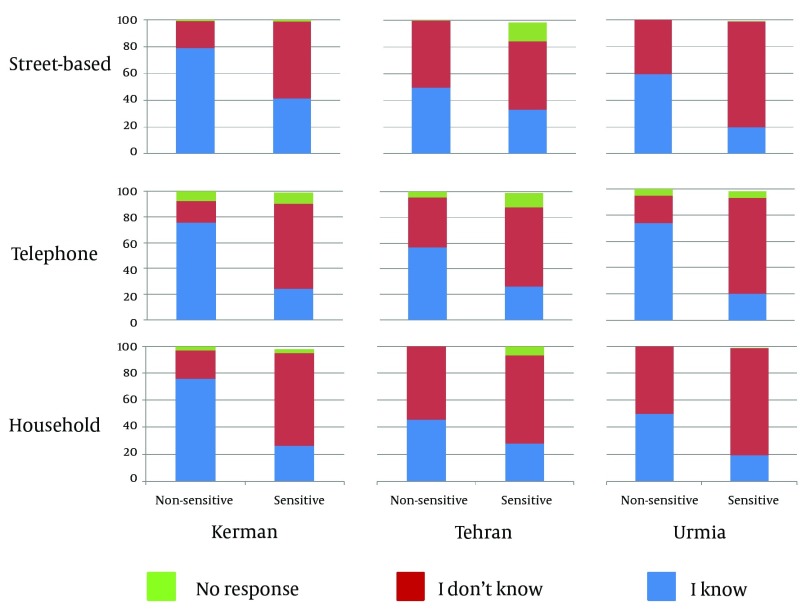
This study was carried out to address the impact of three interview methods (street-based, household, and telephone interviews) on response pattern to sensitive and non-sensitive questions in terms of participation, disclosure and discontinuing rates.
We selected three culturally diverse major cities of Iran. Then, we randomly selected 300 subjects, 100 for each type of interview, from each major city (899 in total). For street-based interviews only pedestrians who were walking alone were recruited, for household interviews only one individual from each house participated (3-4 houses in each alley were selected), and for telephone interviews we selected phone numbers using a random number list. We asked five non-sensitive and five sensitive (related to drug use and sexual contact among their personal network) questions.
For telephone and household interviews, relative to street-based interviews, participants were less likely to disclose alcohol and drug-related behaviors (Adjusted OR = 0.76; 95% CI: 0.60- 0.97) and sexual behaviors among their network (Adjusted OR telephone/street-based = 0.64; 95% CI: 0.39- 1.07 and Adjusted OR household/ street-based = 0.56; 95% CI: 0.33- 0.95). We found that participants who were interviewed via the telephone were more likely (Adjusted OR = 1.24) and those who were interviewed at home were less likely (Adjusted OR = 0.86) to report non-sensitive information compared to participants who were interviewed on the street; however, these findings were not statistically significant. The largest participation rate and the least discontinuation rate were observed for household interviews.
It seems that the methods of interview effect response to both sensitive and non-sensitive questions. We believe that for street-based interviews, respondents may disclose more sensitive information than telephone and household interviews.
在收集有关吸毒等敏感话题的信息时,为了获得更精确的回答,使用最优化的方法很重要。
本研究旨在探讨三种访谈方法(街头访谈、家庭访谈和电话访谈)在参与率、披露率和中断率方面对敏感和非敏感问题回答模式的影响。
我们选择了伊朗三个文化多元的主要城市。然后,从每个主要城市随机选取300名受试者,每种访谈类型各100名(共899名)。对于街头访谈,只招募独自行走的行人;对于家庭访谈,每户只选一人参与(每条小巷选取3 - 4户);对于电话访谈,我们使用随机数列表选择电话号码。我们询问了五个非敏感问题和五个敏感问题(与他们个人社交圈中的吸毒和性接触有关)。
与街头访谈相比,电话访谈和家庭访谈的参与者披露酒精和毒品相关行为的可能性较小(调整后的比值比 = 0.76;95%置信区间:0.60 - 0.97),以及他们社交圈中性行为的可能性较小(电话访谈/街头访谈的调整后比值比 = 0.64;95%置信区间:0.39 - 1.07,家庭访谈/街头访谈的调整后比值比 = 0.56;95%置信区间:0.33 - 0.95)。我们发现,与街头访谈的参与者相比,通过电话访谈的参与者报告非敏感信息的可能性更大(调整后的比值比 = 1.24),而在家中接受访谈的参与者报告非敏感信息的可能性较小(调整后的比值比 = 0.86);然而,这些结果在统计学上并不显著。家庭访谈的参与率最高,中断率最低。
似乎访谈方法会影响对敏感和非敏感问题的回答。我们认为,对于街头访谈,受访者可能比电话访谈和家庭访谈披露更多敏感信息。