Förthmann Benjamin, van Bergeijk Jeroen, Lee Yu-Wei, Lübben Verena, Schill Yvonne, Brinkmann Hella, Ratzka Andreas, Stachowiak Michal K, Hebert Michael, Grothe Claudia, Claus Peter
Institute of Neuroanatomy, Hannover Medical School, Hannover, Germany ; Center for Systems Neuroscience, University of Veterinary Medicine Hannover, Hannover, Germany.
Institute of Neuroanatomy, Hannover Medical School, Hannover, Germany.
PLoS One. 2013 Dec 17;8(12):e82871. doi: 10.1371/journal.pone.0082871. eCollection 2013.
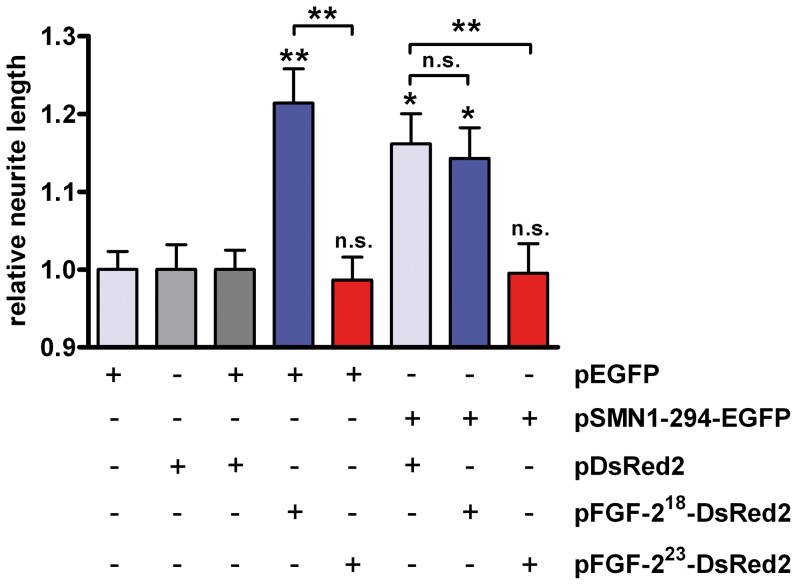
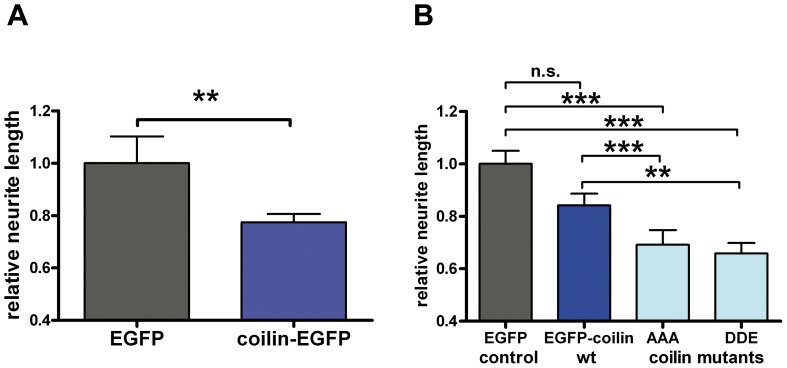
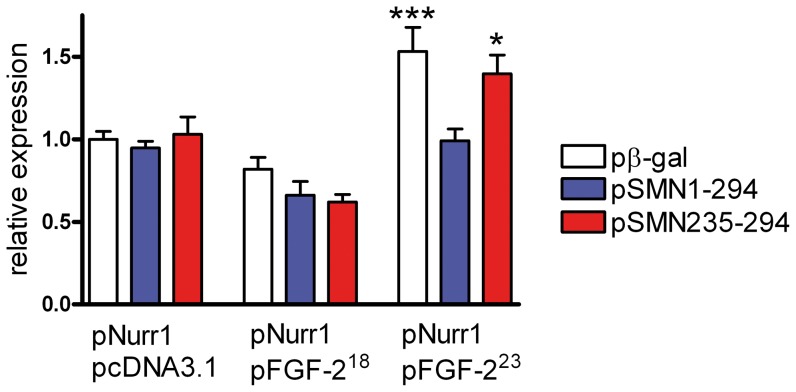
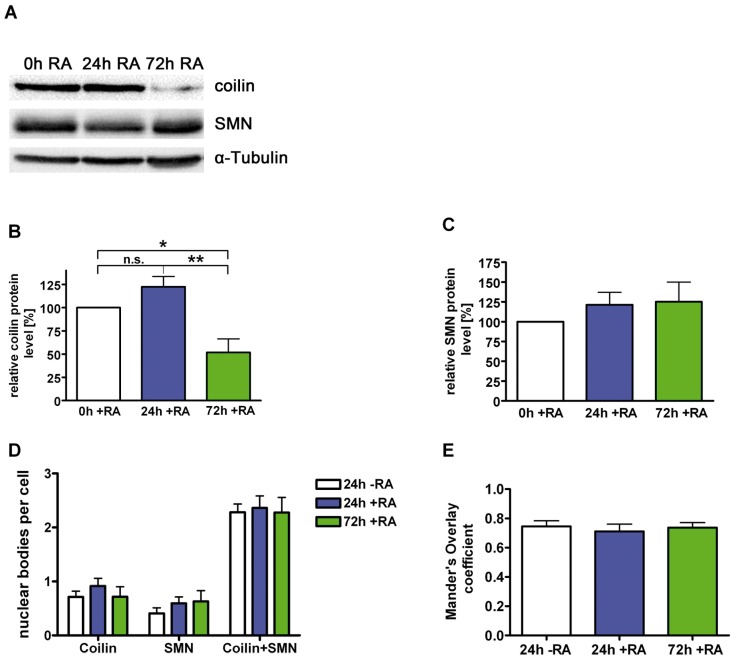
Nuclear bodies are large sub-nuclear structures composed of RNA and protein molecules. The Survival of Motor Neuron (SMN) protein localizes to Cajal bodies (CBs) and nuclear gems. Diminished cellular concentration of SMN is associated with the neurodegenerative disease Spinal Muscular Atrophy (SMA). How nuclear body architecture and its structural components influence neuronal differentiation remains elusive. In this study, we analyzed the effects of SMN and two of its interaction partners in cellular models of neuronal differentiation. The nuclear 23 kDa isoform of Fibroblast Growth Factor - 2 (FGF-2(23)) is one of these interacting proteins - and was previously observed to influence nuclear bodies by destabilizing nuclear gems and mobilizing SMN from Cajal bodies (CBs). Here we demonstrate that FGF-2(23) blocks SMN-promoted neurite outgrowth, and also show that SMN disrupts FGF-2(23)-dependent transcription. Our results indicate that FGF-2(23) and SMN form an inactive complex that interferes with neuronal differentiation by mutually antagonizing nuclear functions. Coilin is another nuclear SMN binding partner and a marker protein for Cajal bodies (CBs). In addition, coilin is essential for CB function in maturation of small nuclear ribonucleoprotein particles (snRNPs). The role of coilin outside of Cajal bodies and its putative impacts in tissue differentiation are poorly defined. The present study shows that protein levels of nucleoplasmic coilin outside of CBs decrease during neuronal differentiation. Overexpression of coilin has an inhibitory effect on neurite outgrowth. Furthermore, we find that nucleoplasmic coilin inhibits neurite outgrowth independent of SMN binding revealing a new function for coilin in neuronal differentiation.
核体是由RNA和蛋白质分子组成的大型亚核结构。运动神经元存活蛋白(SMN)定位于卡哈尔体(CBs)和核宝石。细胞中SMN浓度降低与神经退行性疾病脊髓性肌萎缩症(SMA)相关。核体结构及其结构成分如何影响神经元分化仍不清楚。在本研究中,我们分析了SMN及其两个相互作用伙伴在神经元分化细胞模型中的作用。成纤维细胞生长因子-2的23 kDa核异构体(FGF-2(23))是这些相互作用蛋白之一,此前观察到它通过破坏核宝石的稳定性和从卡哈尔体(CBs)中动员SMN来影响核体。在这里,我们证明FGF-2(23)阻断了SMN促进的神经突生长,并且还表明SMN破坏了FGF-2(23)依赖的转录。我们的结果表明,FGF-2(23)和SMN形成了一个无活性的复合物,通过相互拮抗核功能来干扰神经元分化。卷曲螺旋蛋白是另一种与核SMN结合的伙伴,也是卡哈尔体(CBs)的标记蛋白。此外,卷曲螺旋蛋白对于小核核糖核蛋白颗粒(snRNPs)成熟中的CB功能至关重要。卷曲螺旋蛋白在卡哈尔体之外的作用及其对组织分化的假定影响尚不清楚。本研究表明,在神经元分化过程中,CBs之外的核质卷曲螺旋蛋白水平降低。卷曲螺旋蛋白的过表达对神经突生长有抑制作用。此外,我们发现核质卷曲螺旋蛋白抑制神经突生长,与SMN结合无关,揭示了卷曲螺旋蛋白在神经元分化中的新功能。