1] Translational Cancer Research Unit, Oncology Centre GZA Hospitals Sint-Augustinus, Oosterveldlaan 24, B-2610 Antwerp, Belgium [2] Department of Oncology, University of Antwerp and Antwerp University Hospital, Universiteitsplein 1, B-2610 Antwerp, Belgium.
Translational Cancer Research Unit, Oncology Centre GZA Hospitals Sint-Augustinus, Oosterveldlaan 24, B-2610 Antwerp, Belgium.
Br J Cancer. 2014 Jan 21;110(2):375-83. doi: 10.1038/bjc.2013.743. Epub 2013 Dec 24.
The enumeration of circulating tumour cells (CTCs) with the EpCAM-based CellSearch system has prognostic significance in patients with metastatic breast cancer (MBC). The aim of this study was to explore potential differences in the detection and prognostic significance of CTCs in MBC according to immunohistochemical subtypes of breast cancer.
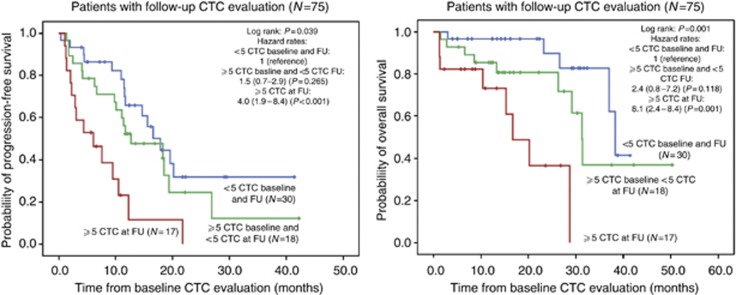
CellSearch CTC counts were obtained from 154 MBC patients before first-line systemic treatment between November 2007 and August 2012. Patients were categorised in five subgroups according to immunohistochemical surrogate definitions of intrinsic subtypes in breast cancer based on hormone receptor status, HER2/neu status and histological grade. Differences in progression-free (PFS) and overall survival (OS) were assessed relative to the cut-off value of ≥5 CTCs per 7.5 ml blood.
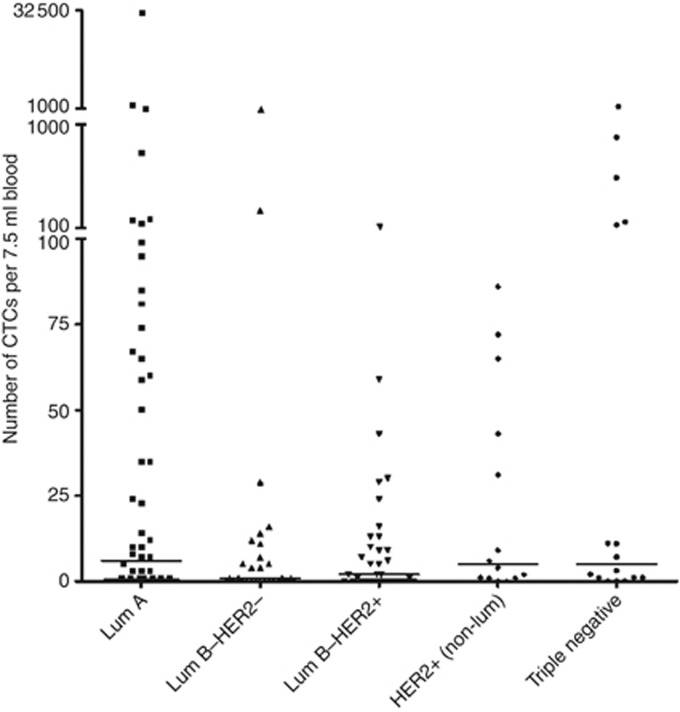
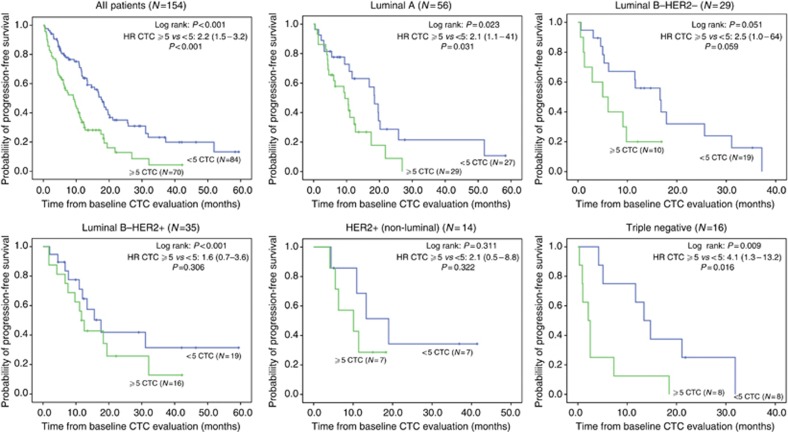
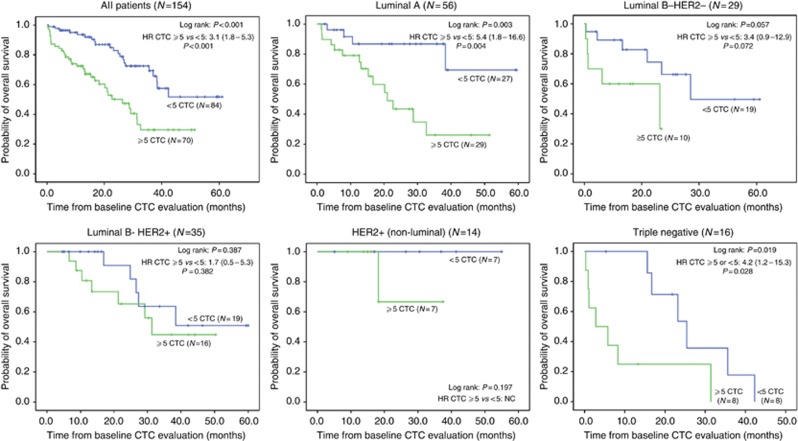
No significant differences were observed in the absolute CTC counts (P=0.120) or in CTC positivity rates according to ≥1 and ≥5 CTCs per 7.5 ml blood detection thresholds (P=0.165 and P=0.651, respectively) between immunohistochemical subtypes. However, very high CTC counts, defined as ≥80 CTCs per 7.5 ml, were observed more frequently in patients with Luminal A and triple negative (TN) breast cancer (P=0.024). In the total study population, the presence of ≥5 CTCs was the single most significant prognostic factor for both PFS and OS in multivariate analysis (P<0.001). A more limited prognostic impact, not reaching statistical significance, was observed in patients with HER2-positive disease as opposed to patients with Luminal A, Luminal B-HER2-negative and TN disease.
The detection of EpCAM+CTCs was not clearly associated with any of the immunohistochemical subtypes of breast cancer in patients with MBC before first-line treatment. Potentially clinically relevant differences were however observed at very high CTC counts. Furthermore, our data suggest a lower prognostic significance of CTC evaluation in HER2-positive patients with MBC.
基于 EpCAM 的 CellSearch 系统对循环肿瘤细胞(CTC)的计数在转移性乳腺癌(MBC)患者中有预后意义。本研究的目的是探讨根据乳腺癌的免疫组织化学亚型,在 MBC 中检测 CTC 及其预后意义的潜在差异。
在 2007 年 11 月至 2012 年 8 月期间,对 154 例接受一线系统治疗前的 MBC 患者进行了 CellSearch CTC 计数。根据激素受体状态、HER2/neu 状态和组织学分级的乳腺癌内在亚型的免疫组织化学替代定义,将患者分为五个亚组。根据≥5 CTCs/7.5ml 血液的截止值,评估无进展生存期(PFS)和总生存期(OS)的差异。
在绝对 CTC 计数(P=0.120)或根据≥1 和≥5 CTCs/7.5ml 血液检测阈值的 CTC 阳性率(P=0.165 和 P=0.651)方面,免疫组织化学亚型之间均无显著差异。然而,在 Luminal A 和三阴性(TN)乳腺癌患者中,观察到非常高的 CTC 计数(定义为≥80 CTCs/7.5ml)更为频繁(P=0.024)。在总研究人群中,在多变量分析中,存在≥5 CTCs 是 PFS 和 OS 的唯一最重要的预后因素(P<0.001)。在 HER2 阳性疾病患者中,与 Luminal A、Luminal B-HER2 阴性和 TN 疾病患者相比,观察到的预后影响更为有限,且无统计学意义。
在接受一线治疗前的 MBC 患者中,EpCAM+CTC 的检测与乳腺癌的任何一种免疫组织化学亚型均无明显关联。然而,在非常高的 CTC 计数时,观察到了潜在的临床相关差异。此外,我们的数据表明,在 HER2 阳性的 MBC 患者中,CTC 评估的预后意义较低。