Garitaonaindia Yago, Aguado-Noya Ramón, Garcia-Grande Aranzazu, Cordoba Mar, Coronado Albi Maria Jose, Campo Cañaveral Jose Luis, Calvo Virginia, Clemente Mariola Blanco, Álvarez Ruth, Peñas Marta, Chara Luis, Royuela Ana, Provencio Mariano
Medical Oncology Department, Puerta de Hierro University Hospital, Majadahonda, Spain.
Instituto de Investigación Sanitaria Puerta de Hierro-Segovia de Arana (IDIPHISA), Puerta De Hierro University Hospital, Majadahonda, Spain.
Transl Lung Cancer Res. 2023 Jul 31;12(7):1414-1424. doi: 10.21037/tlcr-22-827. Epub 2023 Jun 21.
Surgery is regarded as the treatment's cornerstone for early stage and locally advanced non-small cell lung cancer (NSCLC) whenever the tumor is considered resectable. Liquid biopsy is one of the most promising research areas in oncology in the last 10 years, providing a useful non-invasive tool to detect and monitor cancer. The prognostic value of circulating tumor cells (CTCs) has been studied in different cancer types and had been related with a higher risk of relapse and worse prognosis. The aim of this study is to evaluate the prognostic value of CTC detection in patients with stage I-IIIA NSCLC treated with surgery.
We conducted a prospective, single-center study of 180 consecutive patients with resected and pathological confirmed stage I to IIIA (TNM AJCC/UICC 8th edition) NSCLC. Patients' blood samples were processed and CTCs were characterized before and after the surgery. A cohort of patients had CTC determination after chemotherapy and surgery. Cut-off points were established in 1 and 5 CTCs for statistical analysis.
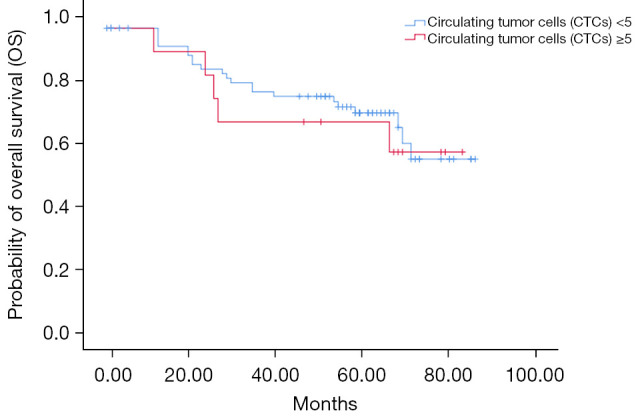
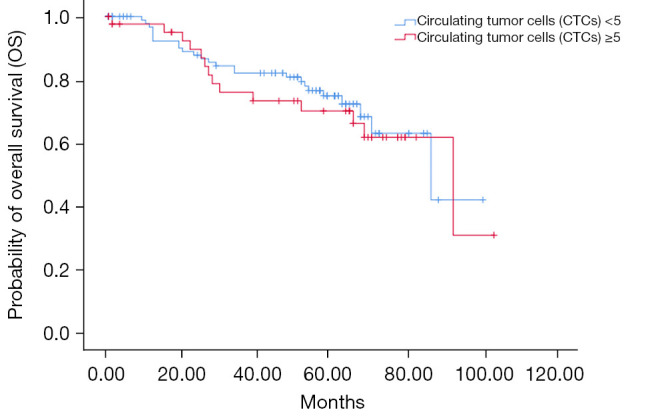
A proportion of 76.7% had at least 1 CTC before the surgery, and 30.6% had 5 or more, while 55.9% had at least 1 CTC after surgery, and 8.3% had 5 or more. We found no correlation between preoperative CTC detection for a cut-off of 5 with neither overall survival (OS) [hazard ratio (HR): 0.99, P=0.887], disease-free survival (DFS) (HR: 0.95, P=0.39) nor relapse (32.7% 28.8%, P=0.596). We also did not find a correlation between postoperative CTCs detection for a cut-off of 5 with either OS (HR: 1.01, P=0.808), DFS (HR: 0.95, P=0.952) or relapse (26.7% 29.5%, P=0.83). The mean change in the number of CTCs over time between preoperative and postoperative samples was 2.13, with a standard deviation of 6.78.
Despite the large cohort of patients included in this study, CTC monitoring in the perioperative setting was not correlated with relapse, DFS or OS in our study, and therefore cannot be recommended as a reliable biomarker for minimal residual disease (MRD) after surgery.
对于早期和局部晚期非小细胞肺癌(NSCLC),只要肿瘤被认为可切除,手术就被视为治疗的基石。液体活检是过去10年肿瘤学中最有前景的研究领域之一,它提供了一种有用的非侵入性工具来检测和监测癌症。循环肿瘤细胞(CTC)的预后价值已在不同癌症类型中进行了研究,并与更高的复发风险和更差的预后相关。本研究的目的是评估CTC检测在接受手术治疗的I-IIIA期NSCLC患者中的预后价值。
我们对180例连续的经手术切除且病理确诊为I至IIIA期(TNM AJCC/UICC第8版)NSCLC的患者进行了一项前瞻性单中心研究。对患者的血样进行处理,并在手术前后对CTC进行特征分析。一组患者在化疗和手术后进行了CTC测定。为进行统计分析,将CTC的截断值设定为1个和5个。
76.7%的患者在手术前至少有1个CTC,30.6%的患者有5个或更多;而手术后55.9%的患者至少有1个CTC,8.3%的患者有5个或更多。我们发现,对于截断值为5的术前CTC检测,与总生存期(OS)[风险比(HR):0.99,P=0.887]、无病生存期(DFS)(HR:0.95,P=0.39)或复发(32.7%对28.8%,P=0.596)均无相关性。我们也未发现对于截断值为5的术后CTC检测与OS(HR:1.01,P=0.808)、DFS(HR:0.95,P=0.952)或复发(26.7%对29.5%,P=0.83)之间存在相关性。术前和术后样本中CTC数量随时间的平均变化为2.13,标准差为6.78。
尽管本研究纳入了大量患者,但围手术期的CTC监测在我们的研究中与复发、DFS或OS均无相关性,因此不能推荐将其作为手术后微小残留病(MRD)的可靠生物标志物。