Frederiksen Brittni N, Steck Andrea K, Kroehl Miranda, Lamb Molly M, Wong Randall, Rewers Marian, Norris Jill M
Colorado School of Public Health, University of Colorado, 13001 E. 17th Place, Box B119, Aurora, CO 80045, USA.
Barbara Davis Center for Childhood Diabetes, University of Colorado, 1775 Aurora Ct., Aurora, CO 80045, USA.
Clin Dev Immunol. 2013;2013:417657. doi: 10.1155/2013/417657. Epub 2013 Dec 4.
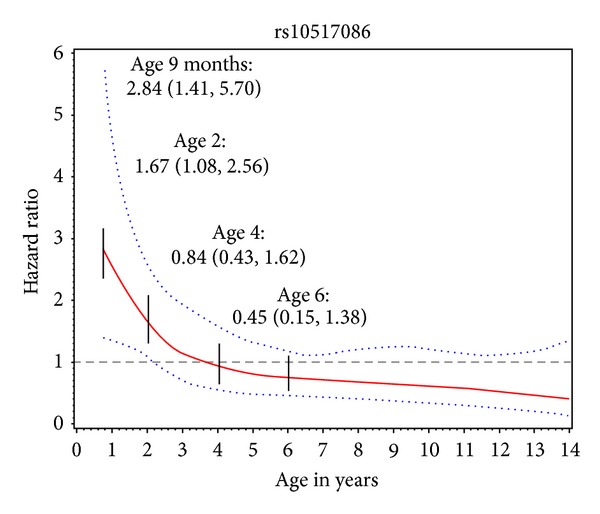
Previously, we examined 20 non-HLA SNPs for association with islet autoimmunity (IA) and/or progression to type 1 diabetes (T1D). Our objective was to investigate fourteen additional non-HLA T1D candidate SNPs for stage- and age-related heterogeneity in the etiology of T1D. Of 1634 non-Hispanic white DAISY children genotyped, 132 developed IA (positive for GAD, insulin, or IA-2 autoantibodies at two or more consecutive visits); 50 IA positive children progressed to T1D. Cox regression was used to analyze risk of IA and progression to T1D in IA positive children. Restricted cubic splines were used to model SNPs when there was evidence that risk was not constant with age. C1QTNF6 (rs229541) predicted increased IA risk (HR: 1.57, CI: 1.20-2.05) but not progression to T1D (HR: 1.13, CI: 0.75-1.71). SNP (rs10517086) appears to exhibit an age-related effect on risk of IA, with increased risk before age 2 years (age 2 HR: 1.67, CI: 1.08-2.56) but not older ages (age 4 HR: 0.84, CI: 0.43-1.62). C1QTNF6 (rs229541), SNP (rs10517086), and UBASH3A (rs3788013) were associated with development of T1D. This prospective investigation of non-HLA T1D candidate loci shows that some SNPs may exhibit stage- and age-related heterogeneity in the etiology of T1D.
此前,我们检测了20个非HLA单核苷酸多态性(SNP)与胰岛自身免疫(IA)和/或进展为1型糖尿病(T1D)的相关性。我们的目的是研究另外14个非HLA T1D候选SNP在T1D病因中与阶段和年龄相关的异质性。在1634名接受基因分型的非西班牙裔白人DAISY儿童中,132人发生了IA(在连续两次或更多次就诊时谷氨酸脱羧酶、胰岛素或IA - 2自身抗体呈阳性);50名IA阳性儿童进展为T1D。采用Cox回归分析IA阳性儿童发生IA和进展为T1D的风险。当有证据表明风险随年龄变化不恒定时,使用受限立方样条对SNP进行建模。C1QTNF6(rs229541)预测IA风险增加(风险比:1.57,可信区间:1.20 - 2.05),但不能预测进展为T1D(风险比:1.13,可信区间:0.75 - 1.71)。SNP(rs10517086)似乎对IA风险表现出与年龄相关的效应,2岁前风险增加(2岁时风险比:1.67,可信区间:1.08 - 2.56),但在较大年龄时无此现象(4岁时风险比:0.84,可信区间:0.43 - 1.62)。C1QTNF6(rs229541)、SNP(rs10517086)和UBASH3A(rs3788013)与T1D的发生有关。这项对非HLA T1D候选基因座的前瞻性研究表明,一些SNP在T1D病因中可能表现出与阶段和年龄相关的异质性。