Faculty of Biomedical Engineering, Osaka Electro-Communication University, 18-8 Hatsucho, Neyagawa, Osaka 572-8530, Japan.
J Neuroeng Rehabil. 2013 Dec 26;10:118. doi: 10.1186/1743-0003-10-118.
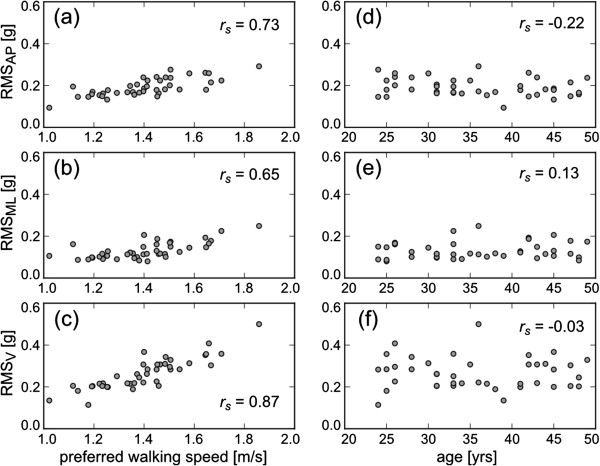
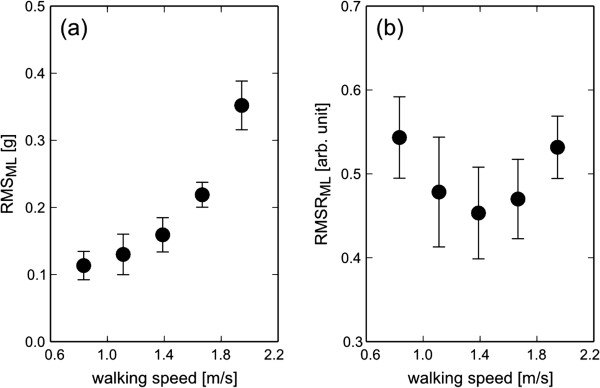
Root mean square (RMS) of trunk acceleration is seen frequently in gait analysis research. However, many studies have reported that the RMS value was related to walking speed. Therefore, the relationship between the RMS value and walking speed should be considered when the RMS value is used to assess gait abnormality. We hypothesized that the RMS values in three sensing axes exhibit common proportions for healthy people if they walk at their own preferred speed and that the RMS proportions in abnormal gait deviate from the common proportions. In this study, we proposed the RMS ratio (RMSR) as a gait abnormality measure and verified its ability to discriminate abnormal gait.
Forty-seven healthy male subjects (24-49 years) were recruited to examine the relationship between walking speed and the RMSR. To verify its ability to discriminate abnormal gait, twenty age-matched male hemiplegic patients (30-48 years) participated as typical subjects with gait abnormality. A tri-axial accelerometer was attached to their lower back, and they walked along a corridor at their own preferred speed. We defined the RMSR as the ratio between RMS in each direction and the RMS vector magnitude.
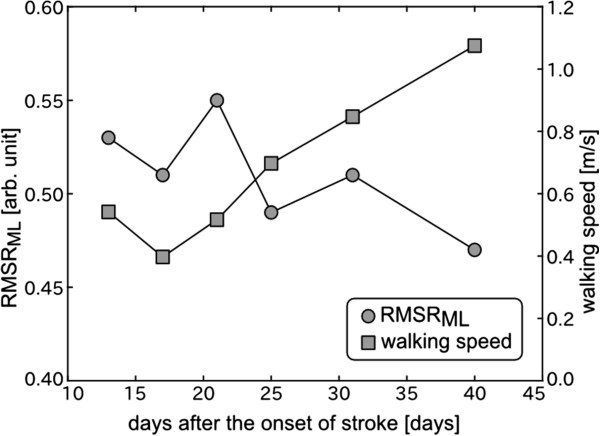
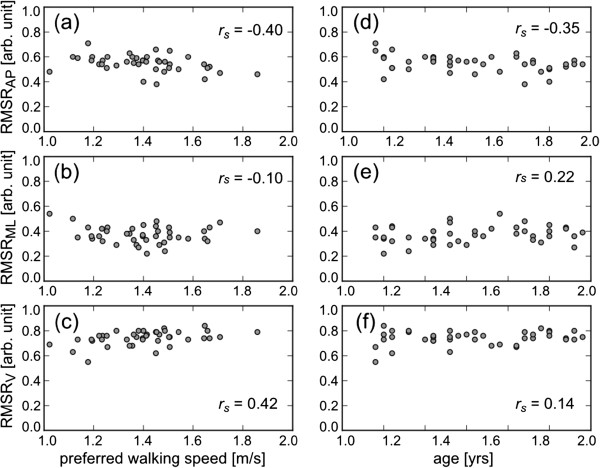
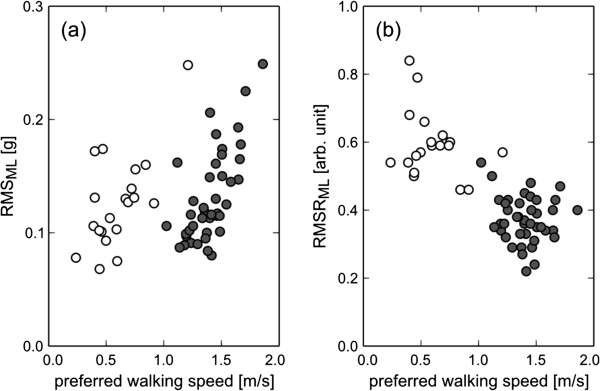
In the healthy subjects, the RMS in all directions related to preferred walking speed. In contrast, RMSR in the mediolateral (ML) direction did not correlate with preferred walking speed (rs = -0.10, p = 0.54) and represented the similar value among the healthy subjects. Moreover, the RMSR in the ML direction for the hemiplegic patients was significantly higher than that for the healthy subjects (p < 0.01).
These results suggest that the RMSR in the ML direction exhibits a common value when healthy subjects walk at their own preferred speed, even if their preferred walking speed were different. For subjects with gait abnormality, the RMSR in the ML direction deviates from the common value of healthy subjects. The RMSR in the ML direction may potentially be a quantitative measure of gait abnormality.
均方根(RMS)的躯干加速度在步态分析研究中经常出现。然而,许多研究报告称 RMS 值与步行速度有关。因此,在使用 RMS 值评估步态异常时,应考虑 RMS 值与步行速度之间的关系。我们假设,如果健康人以自己喜欢的速度行走,三个感应轴的 RMS 值表现出共同的比例,那么异常步态的 RMS 值比例会偏离共同比例。在这项研究中,我们提出 RMS 比(RMSR)作为一种步态异常测量方法,并验证了其区分异常步态的能力。
招募了 47 名健康男性受试者(24-49 岁),以检验行走速度与 RMSR 之间的关系。为了验证其区分异常步态的能力,我们招募了 20 名年龄匹配的男性偏瘫患者(30-48 岁)作为典型的异常步态受试者。在他们的下背部附着一个三轴加速度计,让他们以自己喜欢的速度沿着走廊行走。我们将 RMSR 定义为每个方向的 RMS 与 RMS 矢量幅度的比值。
在健康受试者中,所有方向的 RMS 都与首选步行速度相关。相比之下,横向(ML)方向的 RMSR 与首选步行速度无关(rs=-0.10,p=0.54),并且在健康受试者中具有相似的值。此外,偏瘫患者的 ML 方向 RMSR 明显高于健康受试者(p<0.01)。
这些结果表明,当健康受试者以自己喜欢的速度行走时,即使他们的首选步行速度不同,ML 方向的 RMSR 也会表现出共同的数值。对于步态异常的受试者,ML 方向的 RMSR 偏离了健康受试者的共同数值。ML 方向的 RMSR 可能是步态异常的一种定量测量指标。