Remington Patrick L, Catlin Bridget B, Kindig David A
Population Health Institute, Department of Population Health Sciences, University of Wisconsin School of Medicine and Public Health, 4263 Health Science Learning Center, 750 Highland Ave, Madison, WI 53705. E-mail:
Population Health Institute, Department of Population Health Sciences, University of Wisconsin School of Medicine and Public Health, Madison, Wisconsin.
Prev Chronic Dis. 2013 Dec 26;10:E214. doi: 10.5888/pcd10.130210.
Trends in population health outcomes can be monitored to evaluate the performance of population health systems at the national, state, and local levels. The objective of this study was to compare and contrast 4 measures for assessing progress in population health improvement by using age-adjusted premature death rates as a summary measure of the overall health outcomes in the United States and in all 50 states.
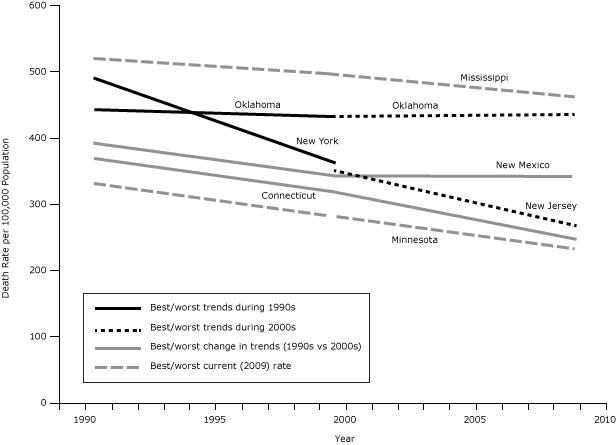
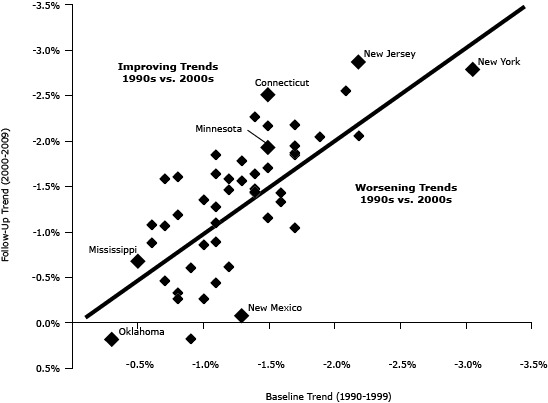
To evaluate the performance of statewide population health systems during the past 20 years, we used 4 measures of age-adjusted premature (<75 years of age) death rates: current rates (2009), baseline trends (1990s), follow-up trends (2000s), and changes in trends from baseline to the follow-up periods (ie, "bending the curve").
Current premature death rates varied by approximately twofold, with the lowest rate in Minnesota (268 deaths per 100,000) and the highest rate in Mississippi (482 deaths per 100,000). Rates improved the most in New York during the baseline period (-3.05% per year) and in New Jersey during the follow-up period (-2.87% per year), whereas Oklahoma ranked last in trends during both periods (-0.30%/y, baseline; +0.18%/y, follow-up). Trends improved the most in Connecticut, bending the curve downward by -1.03%; trends worsened the most in New Mexico, bending the curve upward by 1.21%.
Current premature death rates, recent trends, and changes in trends vary by state in the United States. Policy makers can use these measures to evaluate the long-term population health impact of broad health care, behavioral, social, and economic investments in population health.
可监测人群健康结果的趋势,以评估国家、州和地方各级人群健康系统的绩效。本研究的目的是通过使用年龄调整后的过早死亡率作为美国及所有50个州总体健康结果的汇总指标,比较和对比4种评估人群健康改善进展的指标。
为评估过去20年全州人群健康系统的绩效,我们使用了4种年龄调整后的过早(<75岁)死亡率指标:当前率(2009年)、基线趋势(20世纪90年代)、随访趋势(21世纪00年代)以及从基线到随访期的趋势变化(即“曲线变弯”)。
当前过早死亡率相差约两倍,明尼苏达州最低(每10万人中有268例死亡),密西西比州最高(每10万人中有482例死亡)。在基线期,纽约州的死亡率改善最为明显(每年-3.05%),在随访期,新泽西州改善最为明显(每年-2.87%),而俄克拉荷马州在两个时期的趋势均排名最后(基线期-0.30%/年;随访期+0.18%/年)。康涅狄格州的趋势改善最为明显,曲线向下弯曲了-1.03%;新墨西哥州的趋势恶化最为明显,曲线向上弯曲了1.21%。
美国各州的当前过早死亡率、近期趋势以及趋势变化各不相同。政策制定者可利用这些指标来评估广泛的医疗保健、行为、社会和经济对人群健康投资的长期人群健康影响。