Zhang Ao, Dong Beihua, Doucet Aurélien J, Moldovan John B, Moran John V, Silverman Robert H
Department of Molecular Medicine, Cleveland Clinic Lerner College of Medicine of Case Western Reserve University, Cleveland Clinic, Cleveland, OH, 44195, USA, Department of Cancer Biology, Lerner Research Institute, Cleveland Clinic, Cleveland, OH 44195, USA, Department of Human Genetics, Ann Arbor, MI 48109, USA, Cellular and Molecular Biology Program, Ann Arbor, MI 48109, USA, Department of Internal Medicine, Ann Arbor, MI 48109, USA and Howard Hughes Medical Institute, University of Michigan Medical School, Ann Arbor, Michigan, 48109, USA.
Nucleic Acids Res. 2014 Apr;42(6):3803-20. doi: 10.1093/nar/gkt1308. Epub 2013 Dec 25.
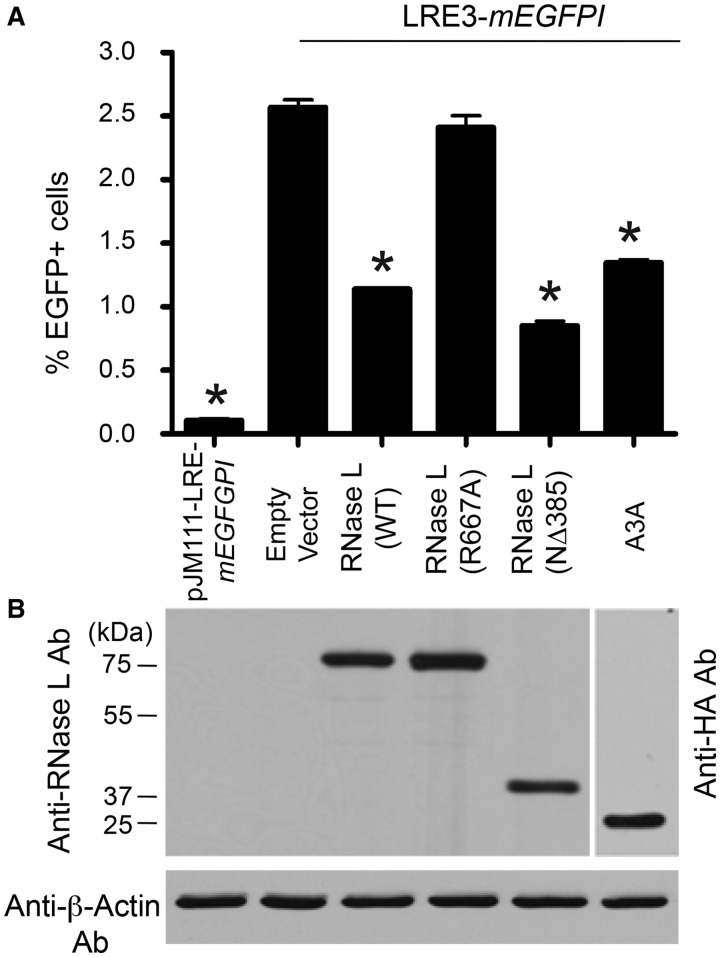
Retrotransposons are mobile genetic elements, and their mobility can lead to genomic instability. Retrotransposon insertions are associated with a diverse range of sporadic diseases, including cancer. Thus, it is not a surprise that multiple host defense mechanisms suppress retrotransposition. The 2',5'-oligoadenylate (2-5A) synthetase (OAS)-RNase L system is a mechanism for restricting viral infections during the interferon antiviral response. Here, we investigated a potential role for the OAS-RNase L system in the restriction of retrotransposons. Expression of wild type (WT) and a constitutively active form of RNase L (NΔ385), but not a catalytically inactive RNase L mutant (R667A), impaired the mobility of engineered human LINE-1 (L1) and mouse intracisternal A-type particle retrotransposons in cultured human cells. Furthermore, WT RNase L, but not an inactive RNase L mutant (R667A), reduced L1 RNA levels and subsequent expression of the L1-encoded proteins (ORF1p and ORF2p). Consistently, confocal immunofluorescent microscopy demonstrated that WT RNase L, but not RNase L R667A, prevented formation of L1 cytoplasmic foci. Finally, siRNA-mediated depletion of endogenous RNase L in a human ovarian cancer cell line (Hey1b) increased the levels of L1 retrotransposition by ∼2-fold. Together, these data suggest that RNase L might function as a suppressor of structurally distinct retrotransposons.
逆转录转座子是可移动的遗传元件,其移动性可导致基因组不稳定。逆转录转座子插入与多种散发性疾病相关,包括癌症。因此,多种宿主防御机制抑制逆转录转座并不奇怪。2',5'-寡腺苷酸(2-5A)合成酶(OAS)-核糖核酸酶L系统是干扰素抗病毒反应期间限制病毒感染的一种机制。在此,我们研究了OAS-核糖核酸酶L系统在限制逆转录转座子方面的潜在作用。野生型(WT)和组成型活性形式的核糖核酸酶L(NΔ385)的表达,而非催化无活性的核糖核酸酶L突变体(R667A),损害了工程化人LINE-1(L1)和小鼠脑内A型颗粒逆转录转座子在培养的人细胞中的移动性。此外,WT核糖核酸酶L,而非无活性的核糖核酸酶L突变体(R667A),降低了L1 RNA水平以及随后L1编码蛋白(ORF1p和ORF2p)的表达。一致地,共聚焦免疫荧光显微镜显示WT核糖核酸酶L,而非核糖核酸酶L R667A,阻止了L1细胞质灶的形成。最后,在人卵巢癌细胞系(Hey1b)中,siRNA介导的内源性核糖核酸酶L的消耗使L1逆转录转座水平增加了约2倍。总之,这些数据表明核糖核酸酶L可能作为结构不同的逆转录转座子的抑制剂发挥作用。