Aliano Stefania, Cirmena Gabriella, Fugazza Giuseppina, Bruzzone Roberto, Palermo Claudia, Sessarego Mario
Department of Internal Medicine, I.R.C.C.S. A.O.U. San Martino-IST, Genoa, Italy.
Leuk Res Rep. 2013 Aug 31;2(2):75-8. doi: 10.1016/j.lrr.2013.07.004. eCollection 2013.
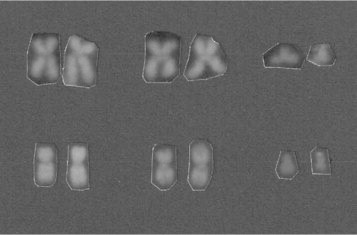
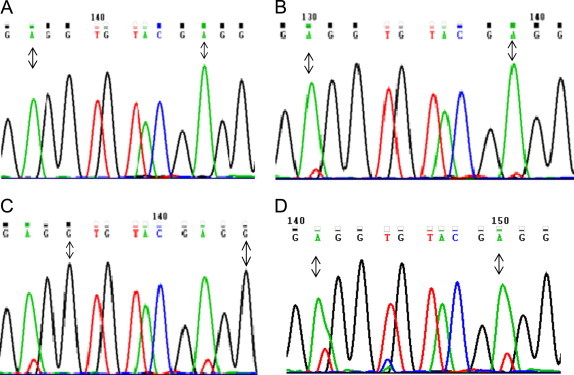
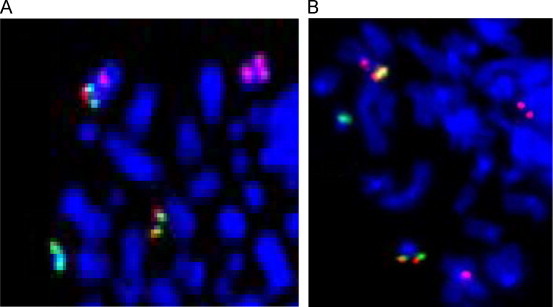
Most chronic myeloid leukemia (CML) patients show the Philadelphia chromosome (Ph) arising from the reciprocal t(9;22), but 5-10% present variants of this translocation involving different breakpoints besides 9q34 and 22q11. WE REPORT THE NON SIMULTANEOUS OCCURRENCE OF TWO DIFFERENT TYPES OF PH TRANSLOCATION IN A CML PATIENT: a t(9;22)(q34;q11) standard and a three-way variant t(9;11;22)(q34;p15;q11). Bone marrow cells with standard translocation did not have BCR/ABL kinase domain (KD) mutations and were sensitive to imatinib therapy. In contrast, bone marrow cells with the variant translocation showed two BCR/ABL KD mutations and were resistant to imatinib, thus inducing transformation to the blast phase and karyotype evolution.
大多数慢性髓性白血病(CML)患者表现出由相互易位t(9;22)产生的费城染色体(Ph),但5%-10%的患者除了9q34和22q11外,还存在涉及不同断点的这种易位变体。我们报告了一名CML患者中两种不同类型的Ph易位并非同时出现:一种是标准的t(9;22)(q34;q11),另一种是三向变体t(9;11;22)(q34;p15;q11)。具有标准易位的骨髓细胞没有BCR/ABL激酶结构域(KD)突变,并且对伊马替尼治疗敏感。相比之下,具有变体易位的骨髓细胞显示出两个BCR/ABL KD突变,并且对伊马替尼耐药,从而诱导向原始细胞期转化和核型演变。