Faculty of Veterinary Science, University of Sydney, Sydney, NSW, 2006, Australia.
Anim Genet. 2014 Apr;45(2):157-70. doi: 10.1111/age.12103. Epub 2013 Dec 26.
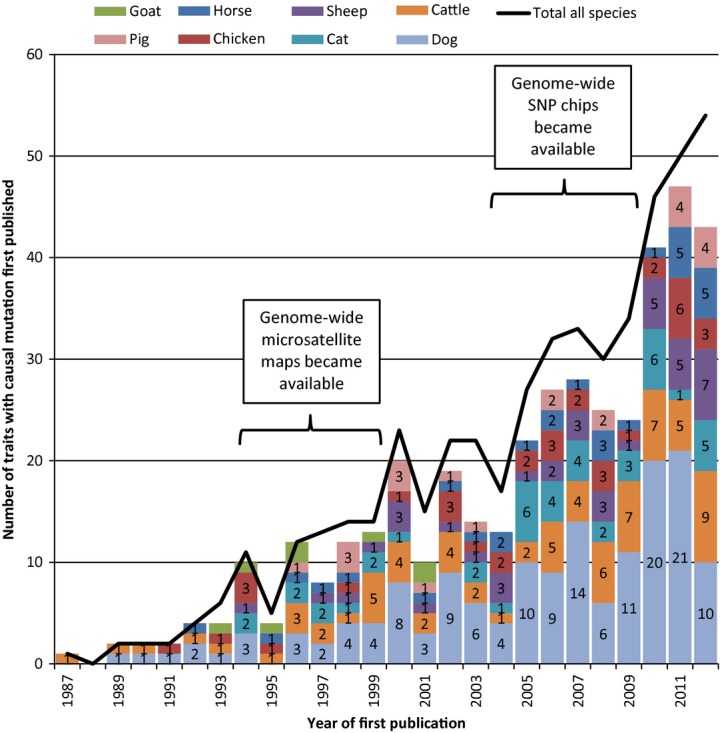
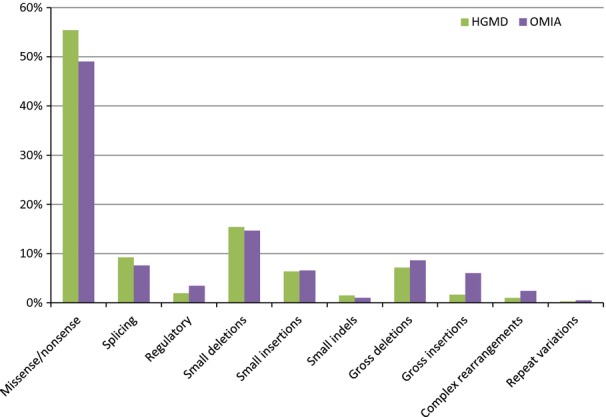
Within two years of the re-discovery of Mendelism, Bateson and Saunders had described six traits in non-laboratory animals (five in chickens and one in cattle) that show single-locus (Mendelian) inheritance. In the ensuing decades, much progress was made in documenting an ever-increasing number of such traits. In 1987 came the first discovery of a causal mutation for a Mendelian trait in non-laboratory animals: a non-sense mutation in the thyroglobulin gene (TG), causing familial goitre in cattle. In the years that followed, the rate of discovery of causal mutations increased, aided mightily by the creation of genome-wide microsatellite maps in the 1990s and even more mightily by genome assemblies and single-nucleotide polymorphism (SNP) chips in the 2000s. With sequencing costs decreasing rapidly, by 2012 causal mutations were being discovered in non-laboratory animals at a rate of more than one per week. By the end of 2012, the total number of Mendelian traits in non-laboratory animals with known causal mutations had reached 499, which was half the number of published single-locus (Mendelian) traits in those species. The distribution of types of mutations documented in non-laboratory animals is fairly similar to that in humans, with almost half being missense or non-sense mutations. The ratio of missense to non-sense mutations in non-laboratory animals to the end of 2012 was 193:78. The fraction of non-sense mutations (78/271 = 0.29) was not very different from the fraction of non-stop codons that are just one base substitution away from a stop codon (21/61 = 0.34).
在孟德尔主义重新发现后的两年内,贝特森和桑德斯(Bateson and Saunders)已经描述了非实验室动物中的六个表现单基因座(孟德尔式)遗传的特征(五个在鸡中,一个在牛中)。在随后的几十年中,在记录越来越多的此类特征方面取得了很大进展。1987 年,首次在非实验室动物中发现了孟德尔特征的因果突变:甲状腺球蛋白基因(TG)中的无义突变,导致牛的家族性甲状腺肿。在接下来的几年中,由于在 20 世纪 90 年代创建了全基因组微卫星图谱,甚至在 21 世纪 00 年代创建了基因组组装和单核苷酸多态性(SNP)芯片,因果突变的发现率大大提高。随着测序成本的迅速降低,到 2012 年,非实验室动物中的因果突变每周发现率超过一个。到 2012 年底,已知因果突变的非实验室动物中的孟德尔特征总数达到 499 个,是这些物种中公布的单基因座(孟德尔式)特征总数的一半。在非实验室动物中记录的突变类型的分布与人类非常相似,其中近一半是错义或无义突变。到 2012 年底,非实验室动物中的错义突变与无义突变的比例为 193:78。无义突变的分数(78/271=0.29)与距终止密码子仅一个碱基替换的终止密码子的分数(21/61=0.34)相差不大。