Department of Internal Medicine, Hôpital Edouard Herriot, Université de Lyon, Hospices Civils de Lyon, Lyon 69003, France.
BMC Neurol. 2013 Dec 28;13:212. doi: 10.1186/1471-2377-13-212.
TNFα blockers have drastically improved rheumatoid arthritis prognosis by preventing joint destruction in DMARD resistant patients. Altering cytokine balance in immune diseases may expose to paradoxical adverse events.
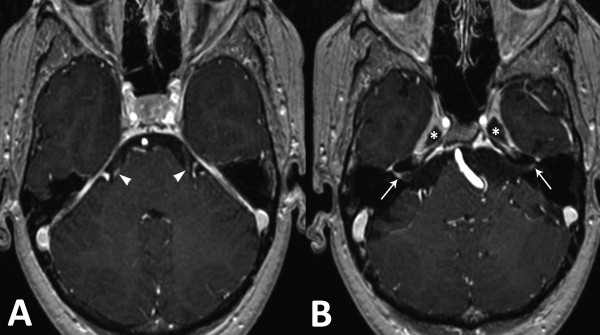
We present the case of a 40-year-old woman, with a confirmed erosive and seropositive RA, successfully treated by TNFα blocker (etanercept) for seven years, and who developed a severe neurosarcoidosis. She had lymphocytic meningitis, bilateral peripheral facial paralysis and anosmia, associated with bilateral hilar lymph nodes, papilloedema, anterior uveitis and elevated serum angiotensin-converting enzyme level. Magnetic resonance imaging showed a bilateral thickening of the Gasser's ganglia walls and enhanced signal of the vestibulocochlear, the facial and the proximal portion of trijeminal nerves.
This case raised the issue of the imputability of etanercept in the development of neurosarcoidosis. Neurological symptoms onset in patients on TNFα blockers should lead to exclude infections, induced lupus but also paradoxical neurosarcoidosis.
TNFα 阻滞剂通过预防 DMARD 耐药患者的关节破坏,极大地改善了类风湿关节炎的预后。改变免疫疾病中的细胞因子平衡可能会导致矛盾的不良反应。
我们介绍了一位 40 岁女性的病例,她患有明确的侵蚀性和血清阳性类风湿关节炎,经过 TNFα 阻滞剂(依那西普)治疗七年,成功缓解,随后发展为严重的神经结节病。她患有淋巴细胞性脑膜炎、双侧周围性面瘫和嗅觉丧失,伴有双侧肺门淋巴结肿大、视乳头水肿、前葡萄膜炎和血清血管紧张素转换酶水平升高。磁共振成像显示双侧鼓索神经壁增厚,前庭耳蜗、面神经和三叉神经近端信号增强。
该病例提出了依那西普在神经结节病发展中的可归因性问题。TNFα 阻滞剂治疗的患者出现神经症状时,应排除感染、诱导性狼疮,还应排除矛盾的神经结节病。