Faculty of Pharmacy, Federal University of Rio de Janeiro.
Nuclear Engineering Institute, National Nuclear Energy Commission.
Int J Nanomedicine. 2013;8:4689-701. doi: 10.2147/IJN.S51383. Epub 2013 Dec 10.
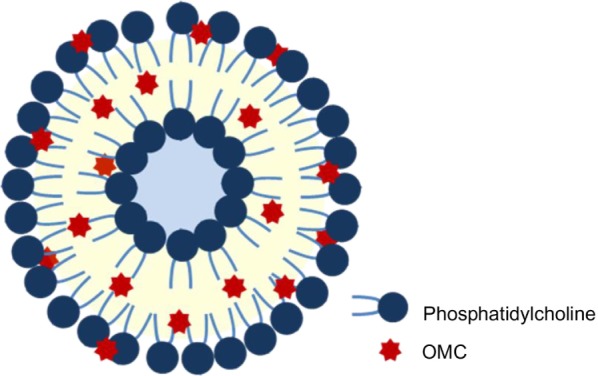
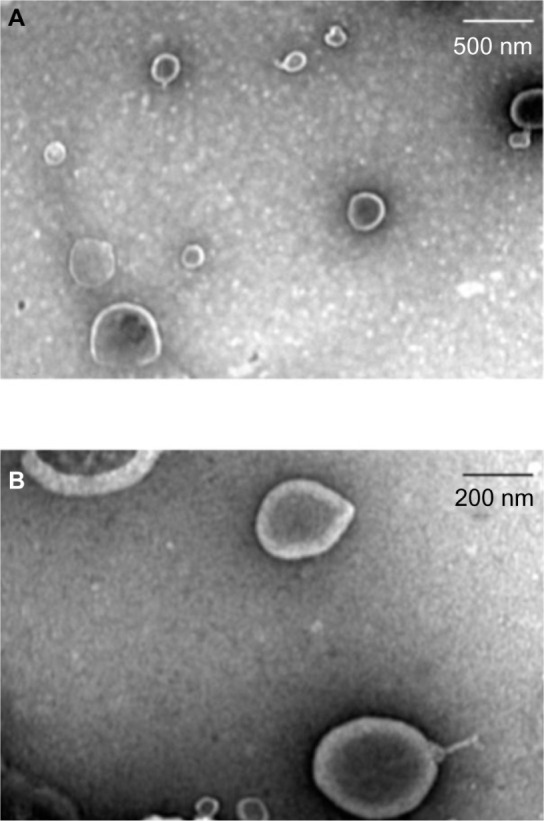
Solar radiation causes damage to human skin, and photoprotection is the main way to prevent these harmful effects. The development of sunscreen formulations containing nanosystems is of great interest in the pharmaceutical and cosmetic industries because of the many potential benefits. This study aimed to develop and evaluate an octyl methoxycinnamate (OMC) liposomal nanosystem (liposome/OMC) to obtain a sunscreen formulation with improved safety and efficacy by retaining OMC for longer on the stratum corneum.
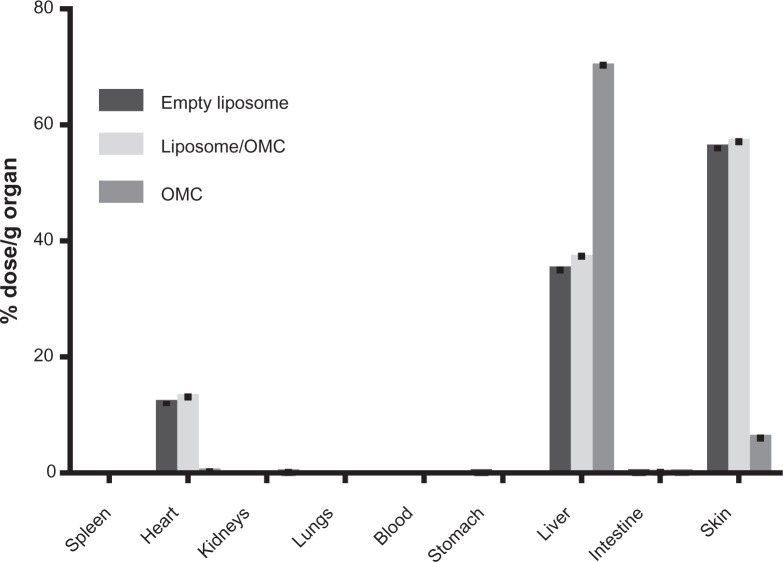
The liposome/OMC nanostructure obtained was tested for enzymatic hydrolysis with lipase from Rhizomucor miehei and biodistribution with liposomes labeled with technetium-99m. The liposome/OMC formulation was then incorporated in a gel formulation and tested for ocular irritation using the hen's egg test-chorio-allantoic membrane (HET-CAM) assay, in vitro and in vivo sun protection factor, in vitro release profile, skin biometrics, and in vivo tape stripping.
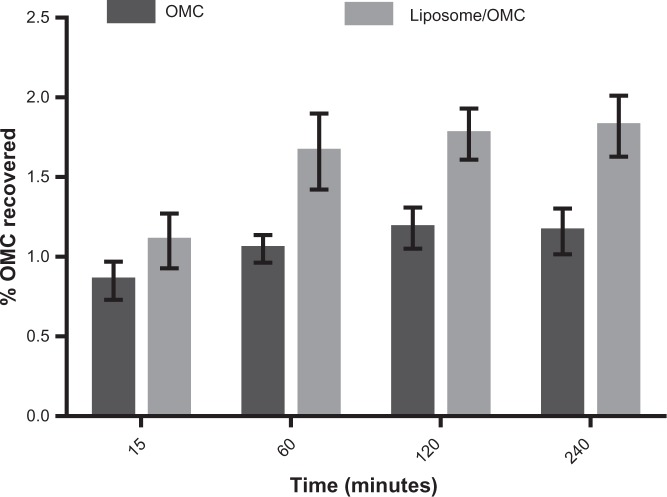
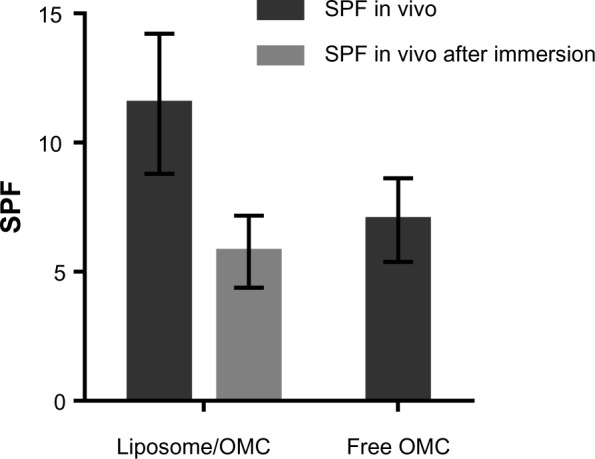
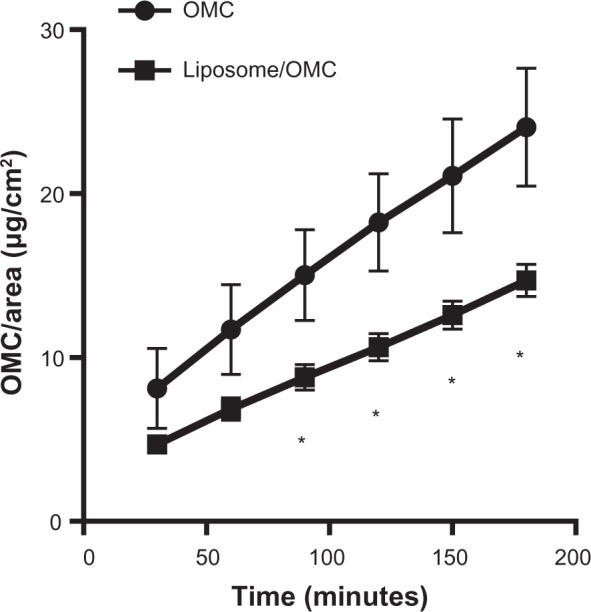
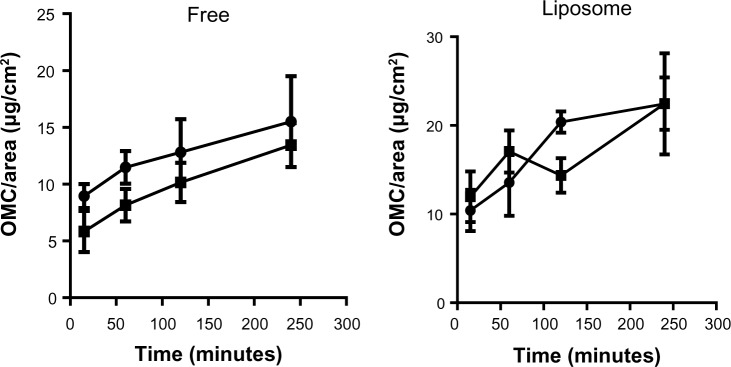
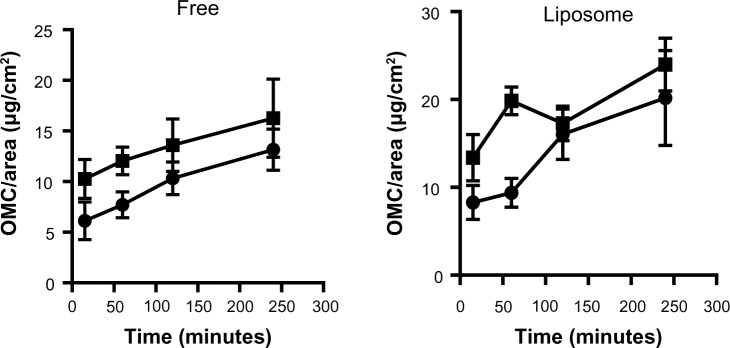
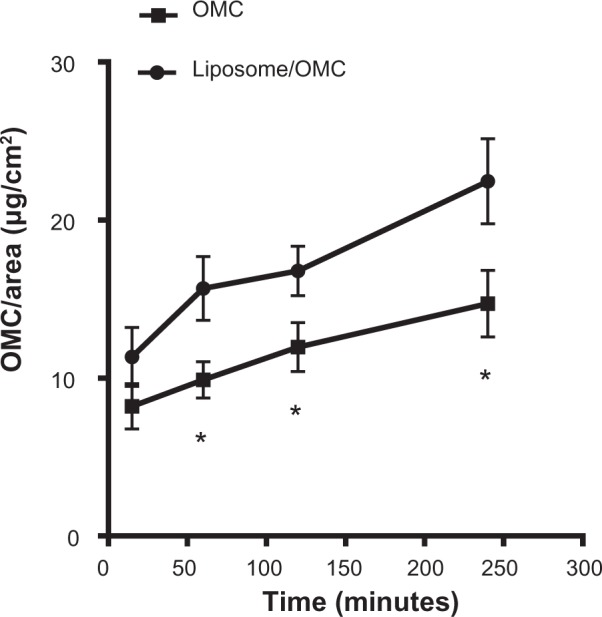
The liposome/OMC nanosystem was not hydrolyzed from R. miehei by lipase. In the biodistribution assay, the liposome/OMC formulation labeled with technetium-99m had mainly deposited in the skin, while for OMC the main organ was the liver, showing that the liposome had higher affinity for the skin than OMC. The liposome/OMC formulation was classified as nonirritating in the HET-CAM test, indicating good histocompatibility. The formulation containing liposome/OMC had a higher in vivo solar photoprotection factor, but did not show increased water resistance. Inclusion in liposomes was able to slow down the release of OMC from the formulation, with a lower steady-state flux (3.9 ± 0.33 μg/cm(2)/hour) compared with the conventional formulation (6.3 ± 1.21 μg/cm(2)/hour). The stripping method showed increased uptake of OMC in the stratum corneum, giving an amount of 22.64 ± 7.55 μg/cm(2) of OMC, which was higher than the amount found for the conventional formulation (14.57 ± 2.30 μg/cm(2)).
These results indicate that liposomes are superior carriers for OMC, and confer greater safety and efficacy to sunscreen formulations.
开发并评价一种辛基甲氧基肉桂酸(OMC)脂质体纳米系统(liposome/OMC),以获得一种防晒配方,通过在角质层上更长时间保留 OMC 来提高安全性和功效。
测试了获得的脂质体/OMC 纳米结构对米黑根毛霉脂肪酶的酶水解作用,并用放射性核素 99m 锝标记的脂质体进行了体内分布。然后将脂质体/OMC 配方纳入凝胶配方,并使用鸡胚绒毛尿囊膜(HET-CAM)试验、体外和体内防晒因子、体外释放曲线、皮肤生物计量学和体内胶带剥离试验来测试其眼部刺激性。
脂质体/OMC 纳米系统不会被脂肪酶从米黑根毛霉中水解。在体内分布试验中,用 99m 锝标记的脂质体/OMC 制剂主要沉积在皮肤中,而 OMC 的主要器官是肝脏,表明脂质体对皮肤的亲和力高于 OMC。脂质体/OMC 制剂在 HET-CAM 试验中被分类为非刺激性,表明其具有良好的组织相容性。含有脂质体/OMC 的配方在体内具有更高的太阳防晒因子,但没有增加的耐水性。包封在脂质体中能够减缓制剂中 OMC 的释放,与常规制剂(6.3±1.21μg/cm2/小时)相比,稳态通量较低(3.9±0.33μg/cm2/小时)。剥离方法显示出角质层中 OMC 的摄取增加,给予 22.64±7.55μg/cm2 的 OMC 量,高于常规制剂(14.57±2.30μg/cm2)的量。
这些结果表明,脂质体是 OMC 的优良载体,为防晒配方提供了更高的安全性和功效。