Department of Neurology and Neurosurgery, Montreal Neurological Institute, McGill University Montreal, QC, Canada ; International Laboratory for Brain, Music and Sound Research (BRAMS) Montreal, QC, Canada.
Front Psychol. 2013 Dec 12;4:932. doi: 10.3389/fpsyg.2013.00932. eCollection 2013.
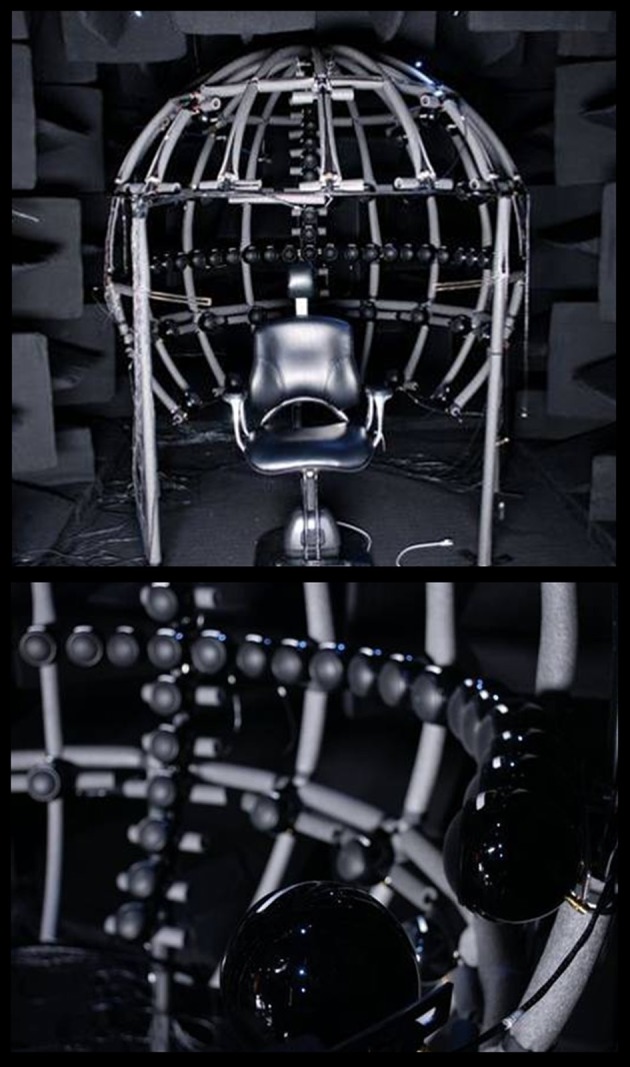
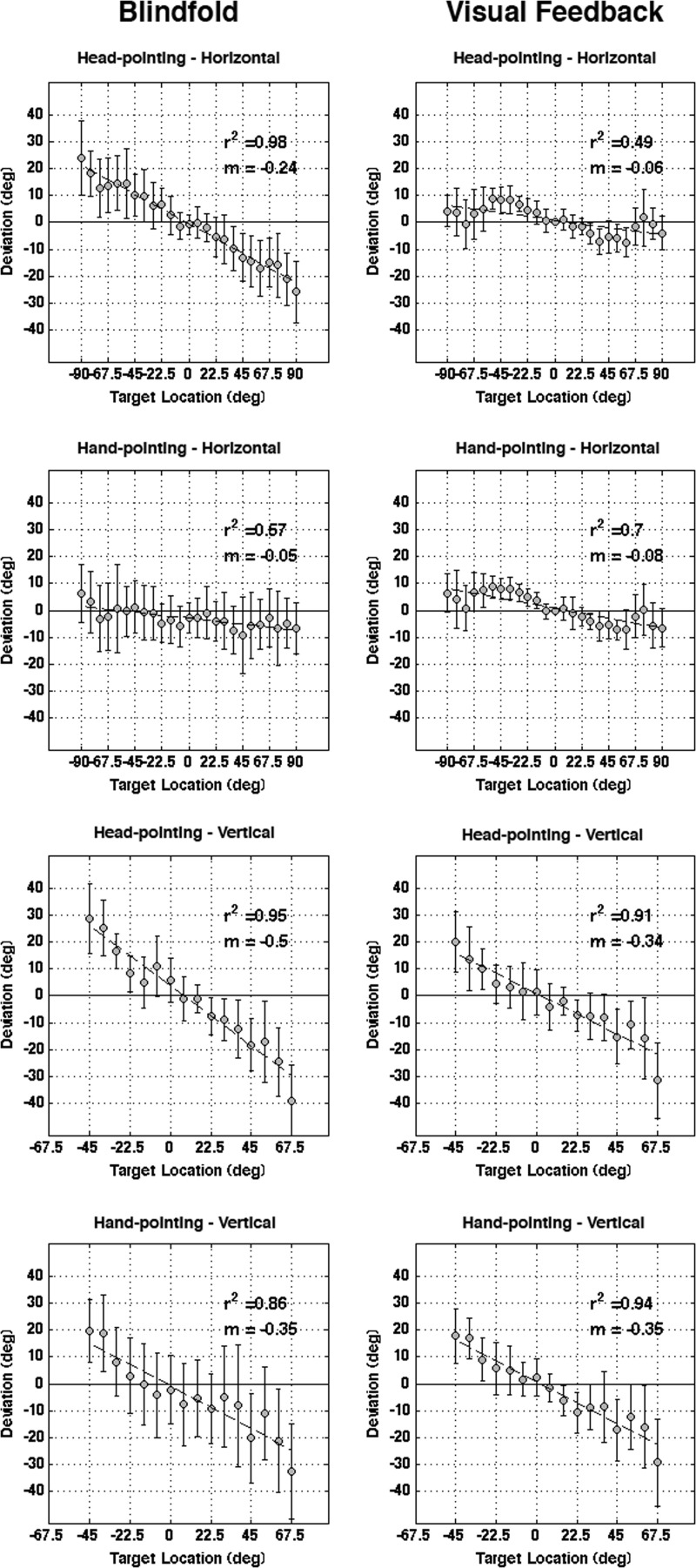
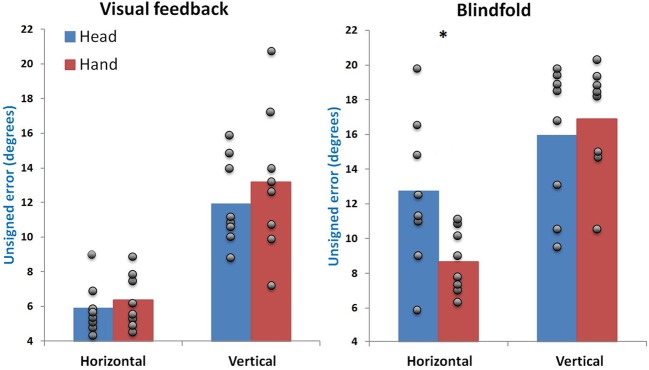
Numerous recent reports have suggested that individuals deprived of vision are able to develop heightened auditory spatial abilities. However, most such studies have compared the blind to blindfolded sighted individuals, a procedure that might introduce a strong performance bias. Indeed, while blind individuals have had their whole lives to adapt to this condition, sighted individuals might be put at a severe disadvantage when having to localize sounds without visual input. To address this unknown, we compared the sound localization ability of eight sighted individuals with and without a blindfold in a hemi-anechoic chamber. Sound stimuli were broadband noise delivered via two speaker arrays: a horizontal array with 25 loudspeakers (ranging from -90° to +90°; 7.5°) and a vertical array with 16 loudspeakers (ranging from -45° to +67.5°). A factorial design was used, where we compared two vision conditions (blindfold vs. non-blindfold), two sound planes (horizontal vs. vertical) and two pointing methods (hand vs. head). Results show that all three factors significantly interact with one another with regards to the average absolute deviation error. Although blindfolding significantly affected all conditions, it did more so for head-pointing in the horizontal plane. Moreover, blindfolding was found to increase the tendency to undershoot more eccentric spatial positions for head-pointing, but not hand-pointing. Overall, these findings suggest that while proprioceptive cues appear to be sufficient for accurate hand pointing in the absence of visual feedback, head pointing relies more heavily on visual cues in order to provide a precise response. It also strongly argues against the use of head pointing methodologies with blindfolded sighted individuals, particularly in the horizontal plane, as it likely introduces a bias when comparing them to blind individuals.
大量近期的报告表明,失明个体能够发展出高度发达的听觉空间能力。然而,大多数此类研究将盲人与蒙住眼睛的视力正常个体进行了比较,这种程序可能会引入强烈的表现偏差。事实上,虽然盲人有一生的时间来适应这种情况,但视力正常的个体在没有视觉输入的情况下定位声音时可能会处于严重的劣势。为了解决这个未知问题,我们在半消声室中比较了八名视力正常个体在蒙住眼睛和不蒙住眼睛两种情况下的声音定位能力。声音刺激是通过两个扬声器阵列提供的宽带噪声:一个水平阵列有 25 个扬声器(范围从-90°到+90°;7.5°),一个垂直阵列有 16 个扬声器(范围从-45°到+67.5°)。使用了一个因子设计,我们比较了两种视觉条件(蒙住眼睛与不蒙住眼睛)、两种声音平面(水平与垂直)和两种指向方法(手与头)。结果表明,所有三个因素在平均绝对偏差误差方面都与彼此显著相互作用。尽管蒙住眼睛显著影响了所有条件,但在水平平面上对头指向的影响更大。此外,蒙住眼睛被发现增加了对头指向更偏心空间位置的欠射趋势,但对手指向没有影响。总体而言,这些发现表明,虽然本体感觉线索在手在没有视觉反馈的情况下进行准确指向时似乎已经足够,但头指向更依赖于视觉线索,以提供精确的反应。这也强烈反对在蒙住眼睛的视力正常个体中使用头指向方法,特别是在水平平面上,因为这可能会在将他们与盲人进行比较时引入偏差。