Huang Peirong, Niu Wenquan, Ni Zhentian, Wang Renzuo, Sun Xiaodong
Department of Ophthalmology, Shanghai First People's Hospital, School of Medicine, Shanghai Jiao Tong University, Shanghai, China.
State Key Laboratory of Medical Genomics, Ruijin Hospital, School of Medicine, Shanghai Jiao Tong University, Shanghai, China ; Department of Hypertension, Ruijin Hospital, School of Medicine, Shanghai Jiao Tong University, Shanghai, China.
PLoS One. 2013 Dec 23;8(12):e82454. doi: 10.1371/journal.pone.0082454. eCollection 2013.
Central retinal vein occlusion (CRVO) associates with severe vision outcome and no proven beneficial treatment. Our meta-analysis intended to appraise the efficacy and safety of anti-vascular endothelial growth factor (anti-VEGF) agents in macular edema (ME) following CRVO.
Data were collected and analyzed by Review Manager 5.2.1. We employed a random-effects model to eliminate between-study heterogeneity. Nfs (called fail-safe number) was calculated to evaluate the publication bias.
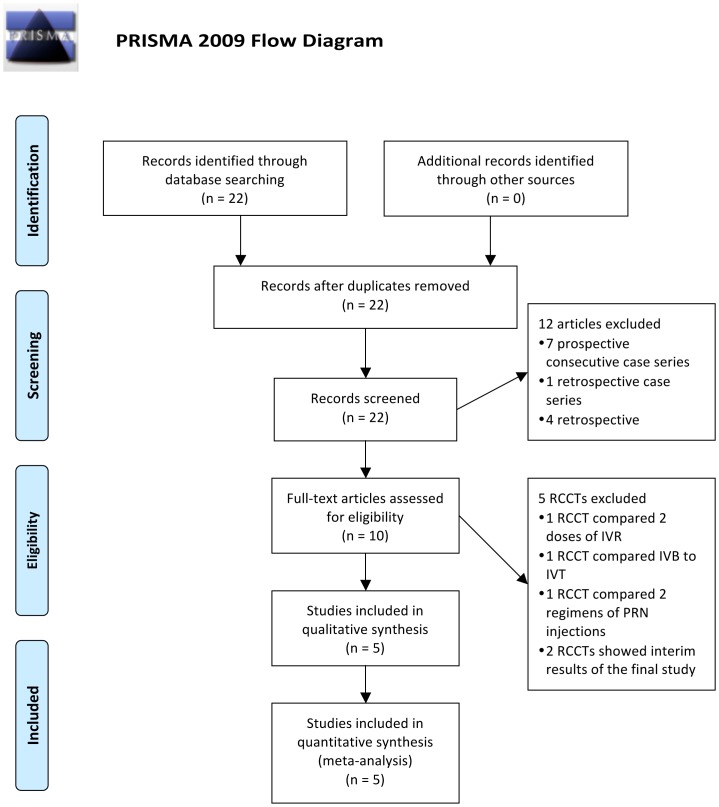
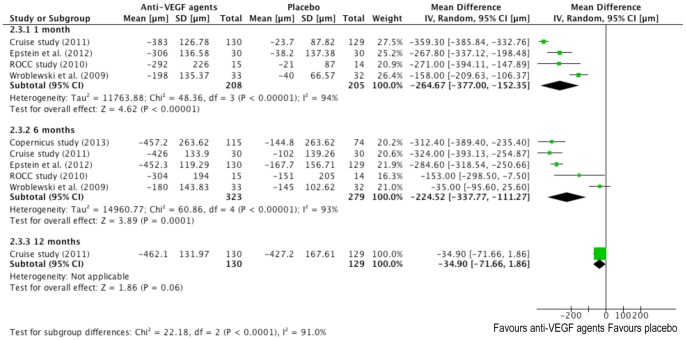
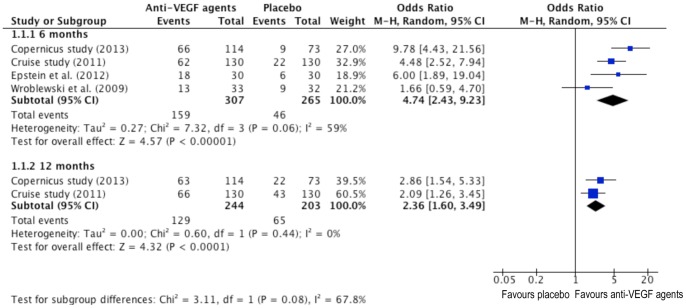
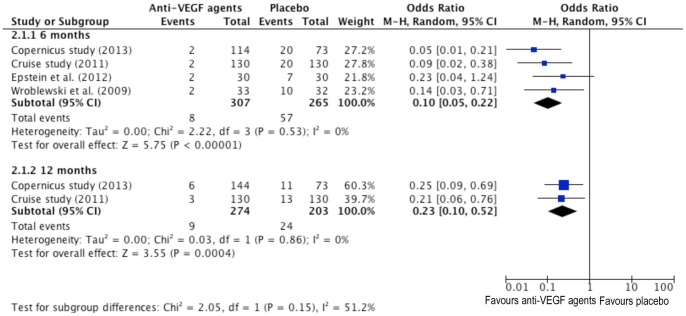
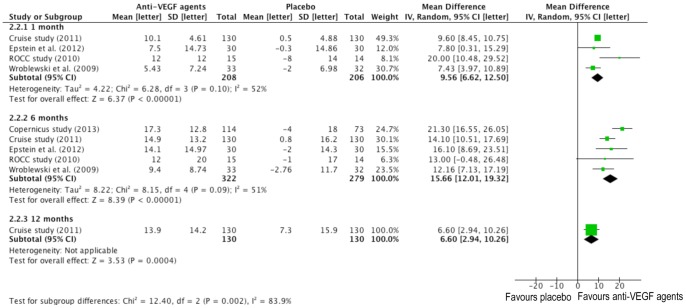
We included 5 trials consisting 323 cases and 281 controls. Primary outcomes showed that overall comparison of anti-VEGF agents with placebo control yielded a 374% and 136% increased tendency for a gain of 15 letters or more on Early Treatment Diabetic Retinopathy Study (ETDRS) chart (95% confidence interval [95% CI]: 2.43-9.23; P<0.00001; I(2) = 59%, 95% CI: 1.60-3.49; P<0.0001; I(2) = 0%, respectively) at 6 and 12 months. Secondary outcomes showed that a 90% and 77% decreased risk at 6 and 12 months for a loss of 15 letters or more. The overall mean difference showed a statistically significance in best-corrected visual acuity (BCVA) on each time point. However, changes of central retinal thickness (CRT) lost significance at 12 months after 6-month as-needed treatment. The incidence of adverse events (AEs) had no statistical difference between anti-VEGF and placebo groups. Subgroup analyses indicated that patients receiving Aflibercept got the highest tendency to gain 15 letters or more (OR = 9.78; 95% CI: 4.43-21.56; P<0.00001). Age controlled analysis suggested a weaken tendency of BCVA improvement in age over 50 (MD = 12.26; 95% CI: 7.55-16.98; P<0.00001). Subgroup analysis by clinical classification showed a strengthen difference of BCVA changes at 6 months in ischemic type (MD = 19.65 letters, 95% CI: 13.15 to 26.14 letters, P<0.00001).
Our results showed that anti-VEGF agents were superior to placebo in CRVO-ME treatment with no statistically significant AEs, especially in younger people and for ischemic type.
视网膜中央静脉阻塞(CRVO)常导致严重的视力损害,且尚无经证实有效的治疗方法。我们的荟萃分析旨在评估抗血管内皮生长因子(anti-VEGF)药物治疗CRVO后黄斑水肿(ME)的疗效和安全性。
通过Review Manager 5.2.1收集和分析数据。我们采用随机效应模型来消除研究间的异质性。计算失效安全数(Nfs)以评估发表偏倚。
我们纳入了5项试验,共323例病例和281例对照。主要结果显示,与安慰剂对照相比,anti-VEGF药物在6个月和12个月时,在早期糖尿病视网膜病变研究(ETDRS)视力表上视力提高15个字母或更多的总体比较中,增加趋势分别为374%和136%(95%置信区间[95%CI]:2.43 - 9.23;P < 0.00001;I² = 59%,95%CI:1.60 - 3.49;P < 0.0001;I² = 0%)。次要结果显示,在6个月和12个月时,视力下降15个字母或更多的风险分别降低了90%和77%。各时间点最佳矫正视力(BCVA)的总体平均差异具有统计学意义。然而,在6个月按需治疗后,12个月时视网膜中央厚度(CRT)的变化失去了统计学意义。抗VEGF组和安慰剂组不良事件(AE)的发生率无统计学差异。亚组分析表明,接受阿柏西普治疗的患者视力提高15个字母或更多的趋势最高(OR = 9.78;95%CI:4.43 - 21.56;P < 0.00001)。年龄控制分析表明,50岁以上患者BCVA改善趋势减弱(MD = 12.26;95%CI:7.55 - 16.98;P < 0.00001)。按临床分类进行的亚组分析显示,缺血型在6个月时BCVA变化的差异更大(MD = 19.65字母,95%CI:13.15至26.14字母,P < 0.00001)。
我们的结果表明,在CRVO-ME治疗中,anti-VEGF药物优于安慰剂,且不良事件无统计学显著差异,尤其是在年轻人和缺血型患者中。