Center for the Investigation of Congenital Aberrancies of Vascular Development, Little Rock, AR, USA.
Orphanet J Rare Dis. 2013 Dec 30;8:199. doi: 10.1186/1750-1172-8-199.
Arteriovenous malformations (AVMs) are a type of high-flow vascular malformations that most commonly occurs in the head and neck. They are present at birth but are usually clinically asymptomatic until later in life. The pathogenesis of AVMs remains unclear and therapeutic approaches to AVMs are unsatisfied. In order to provide a tool for studying the pathogenesis and therapies of this disease, we established and studied a xenograft animal model of human AVMs.
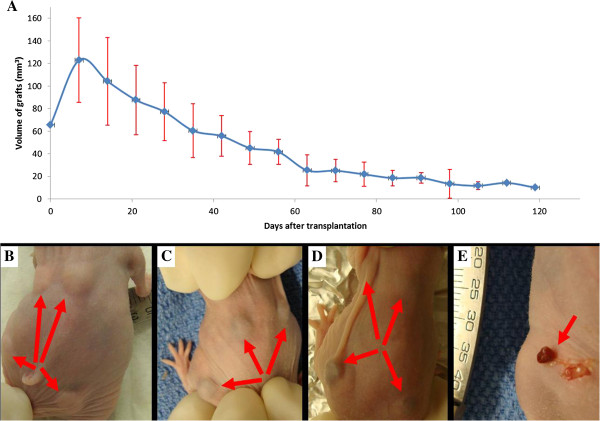
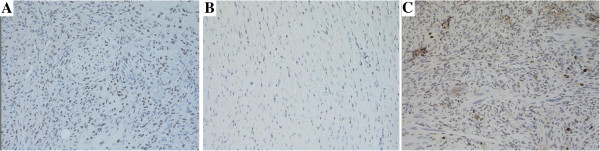
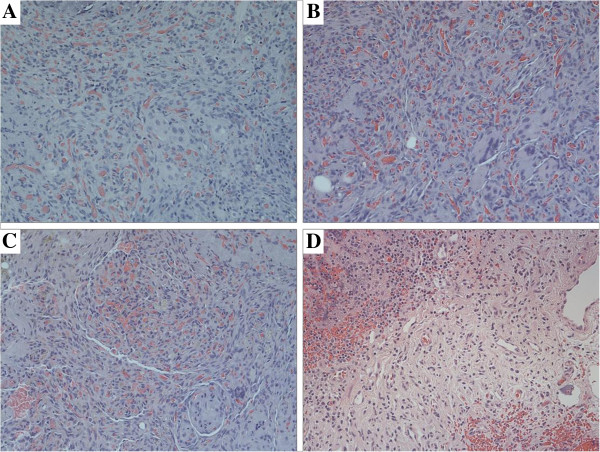
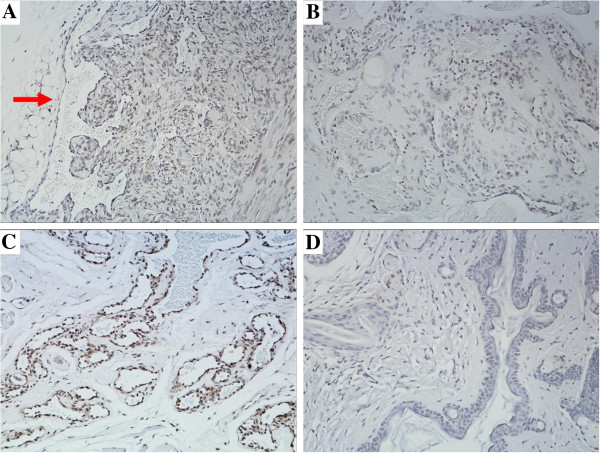
Fresh human AVMs specimens harvested from 4 patients were sectioned (5 x 5 x 5 mm) and xenografted subcutaneously in 5 immunologically naïve nude mice (Athymic Nude-Foxn1(nu)). Each mouse had four pieces specimens in four quadrants along the back. The grafts were observed weekly for volume, color and texture. The grafts were harvested at every 30 days intervals for histologic examination. All grafts (n = 20) were sectioned and stained for hematoxylin and eosin (H&E). Comparative pathologic evaluation of the grafts and native AVMs were performed by two blinded pathologists. Immunohistochemical examination of human-specific nuclear antigen, vascular endothelial growth factor receptor-2 (VEGFR-2) and Ki-67 was performed.
Clinical characteristics and pathologic diagnosis of native human derived AVMs were confirmed. 85% (n = 17) of AVM xenografts survived although the sizes decreased after implantation. Histological examination demonstrated numerous small and medium-size vessels and revealed structural characteristics matching the native AVMs tissue.76.5% (n = 13) of the surviving xenografts were positive for Ki-67 and human-specific nuclear antigen suggesting survival of the human derived tissue, 52.9% (n = 9) were positive for VEGFR-2.
This preliminary xenograft animal model suggests that AVMs can survive in the nude mouse. The presence of human-specific nuclear antigen, VEGFR-2, and Ki-67 demonstrates the stability of native tissue qualities within the xenografts.
动静脉畸形(AVM)是一种高流量血管畸形,最常见于头颈部。它们在出生时就存在,但通常在生命后期才出现临床无症状。AVM 的发病机制尚不清楚,治疗方法也不尽人意。为了为研究这种疾病的发病机制和治疗方法提供一种工具,我们建立并研究了人 AVM 的异种移植动物模型。
从 4 名患者中采集的新鲜人 AVM 标本被切成(5x5x5mm)小块,并在 5 只免疫原性未成熟的裸鼠(Athymic Nude-Foxn1(nu))的皮下进行异种移植。每只老鼠背部的四个象限各有四块标本。每周观察移植物的体积、颜色和质地。每隔 30 天采集一次移植物用于组织学检查。所有移植物(n=20)均进行切片并进行苏木精和伊红(H&E)染色。两名盲法病理学家对移植物和天然 AVM 进行了比较病理评估。对人特异性核抗原、血管内皮生长因子受体-2(VEGFR-2)和 Ki-67 进行了免疫组织化学检测。
证实了源自人类的天然 AVM 的临床特征和病理诊断。85%(n=17)的 AVM 异种移植物存活,尽管植入后体积减小。组织学检查显示有大量的小和中等大小的血管,并且显示出与天然 AVM 组织相匹配的结构特征。76.5%(n=13)的存活异种移植物 Ki-67 和人特异性核抗原阳性,表明人类来源组织的存活,52.9%(n=9)VEGFR-2 阳性。
这个初步的异种移植动物模型表明 AVM 可以在裸鼠中存活。人特异性核抗原、VEGFR-2 和 Ki-67 的存在表明异种移植物中天然组织的稳定性。