Lu Zhong, Qi Li, Bo Xue Jun, Liu Guo Dong, Wang Jun Ming, Li Guixin
Department of Oncology, Clinical College of Weifang Medical University, Weifang, Shandong province, China.
Department of Urology, the People's Hospital of Dongying City, Dongying, Shandong province, China.
J Res Med Sci. 2013 Aug;18(8):647-52.
Prostate cancer is one of the most common cancer types both in western and eastern countries, involving mostly elder men. The mechanisms underlying the prostate cancer development remain unclear. Prostate-specific antigen (PSA) is the only well accepted marker for prostate cancer diagnosis and prognosis. The diagnosis and treatment of prostate cancer are facing big challenges. Here, we evaluated the expression of Dipeptidyl peptidase IV (CD26/DPPIV) and C-X-C chemokine receptor type 4 (CXCR4), two known cancer-related molecules but without clear data on prostate cancer population, and their correlation with clinical parameters in prostate cancer tissue array. To explore the correlation of CD26 and CXCR4 expression in prostate carcinoma and their relationship with clinical parameters.
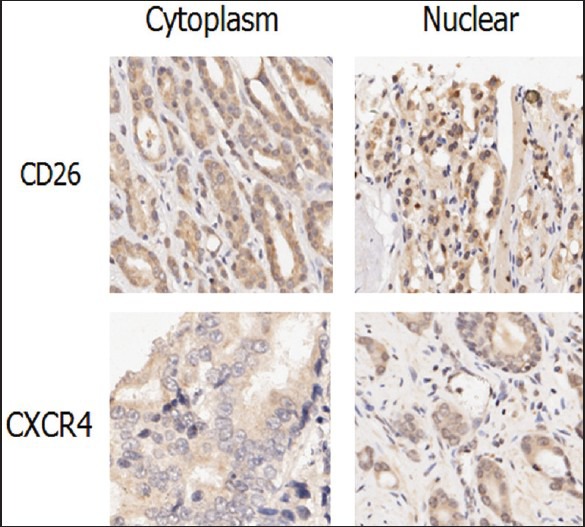
We immunohistochemically stained the tissue array containing samples from 36 cases with prostate cancer with CD26 and CXCR4 antibodies. Then we analyzed the expression of CD26 and CXCR4 and its relationship with clinical parameters. We used immunohistochemical staining to evaluate the expression of CD26 and CXCR4 in a set of tissue array containing 36 cases of prostate cancers and eight peritumoral normal prostatic tissues. The data were statistically analyzed with Statistical Package for Social Sciences (SPSS) 16.0 software. The difference between parameters was compared with nonparametric test and correlation analysis was performed with Spearman test. P < 0.05 was considered as significant.
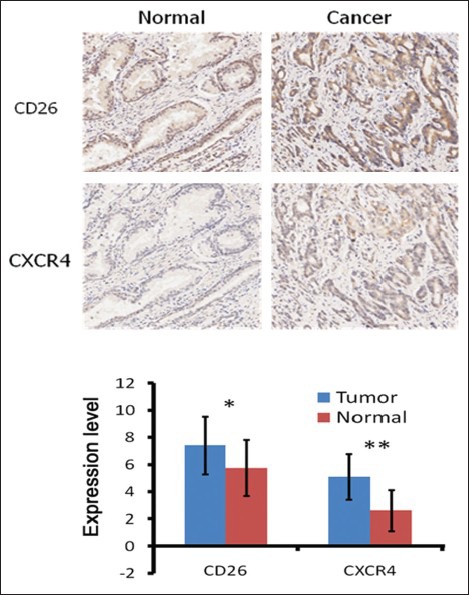
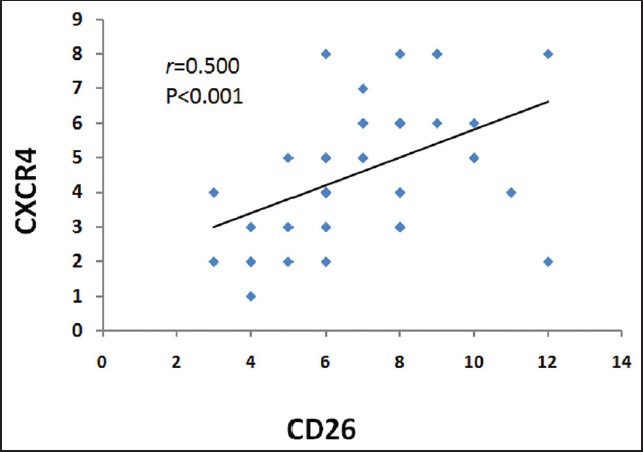
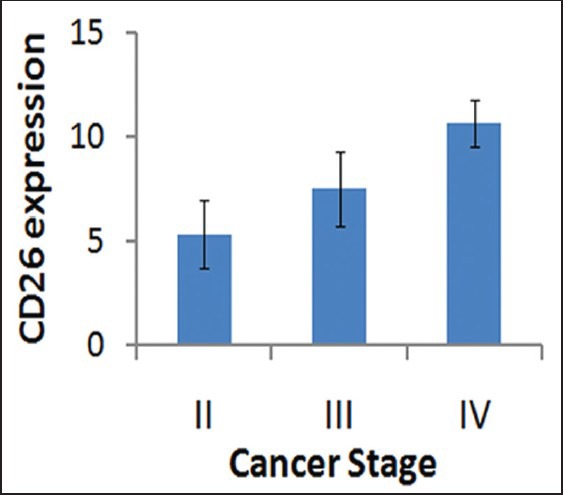
We found both CD26 and CXCR4 expression were higher in cancer tissue than in normal tissues. CD26 and CXCR4 levels were correlated with each other. Moreover, CD26 was correlated with PSA level, tumor residue, cancer stage, and tumor size in the studied samples.
Our data indicate that CD26 may be a good indicator for cancer behaviors of prostate cancer in clinic.
前列腺癌是西方国家和东方国家最常见的癌症类型之一,主要发生于老年男性。前列腺癌发生的潜在机制仍不清楚。前列腺特异性抗原(PSA)是前列腺癌诊断和预后唯一被广泛认可的标志物。前列腺癌的诊断和治疗面临巨大挑战。在此,我们评估了二肽基肽酶IV(CD26/DPPIV)和C-X-C趋化因子受体4(CXCR4)这两种已知的癌症相关分子在前列腺癌组织阵列中的表达情况,此前尚无关于前列腺癌人群的明确数据,同时评估了它们与临床参数的相关性。以探讨CD26和CXCR4在前列腺癌中的表达相关性及其与临床参数的关系。
我们用CD26和CXCR4抗体对包含36例前列腺癌样本的组织阵列进行免疫组化染色。然后分析CD26和CXCR4的表达及其与临床参数的关系。我们采用免疫组化染色评估一组包含36例前列腺癌和8例瘤旁正常前列腺组织的组织阵列中CD26和CXCR4的表达。数据用社会科学统计软件包(SPSS)16.0软件进行统计学分析。参数间差异采用非参数检验进行比较,相关性分析采用Spearman检验。P<0.05被认为具有统计学意义。
我们发现癌组织中CD26和CXCR4的表达均高于正常组织。CD26和CXCR4水平相互相关。此外,在所研究的样本中,CD26与PSA水平、肿瘤残留、癌症分期和肿瘤大小相关。
我们的数据表明,CD26可能是临床上前列腺癌癌症行为的一个良好指标。