Oberstadt Moritz C, Bien-Möller Sandra, Weitmann Kerstin, Herzog Susann, Hentschel Katharina, Rimmbach Christian, Vogelgesang Silke, Balz Ellen, Fink Matthias, Michael Heike, Zeden Jan-Philip, Bruckmüller Henrike, Werk Anneke N, Cascorbi Ingolf, Hoffmann Wolfgang, Rosskopf Dieter, Schroeder Henry W S, Kroemer Heyo K
Department of Pharmacology, Ernst-Moritz-Arndt-University, Greifswald, Germany.
BMC Cancer. 2013 Dec 31;13:617. doi: 10.1186/1471-2407-13-617.
Resistance of the highly aggressive glioblastoma multiforme (GBM) to drug therapy is a major clinical problem resulting in a poor patient's prognosis. Beside promoter methylation of the O6-methylguanine-DNA-methyltransferase (MGMT) gene the efflux transporters ABCB1 and ABCG2 have been suggested as pivotal factors contributing to drug resistance, but the methylation of ABCB1 and ABCG2 has not been assessed before in GBM.
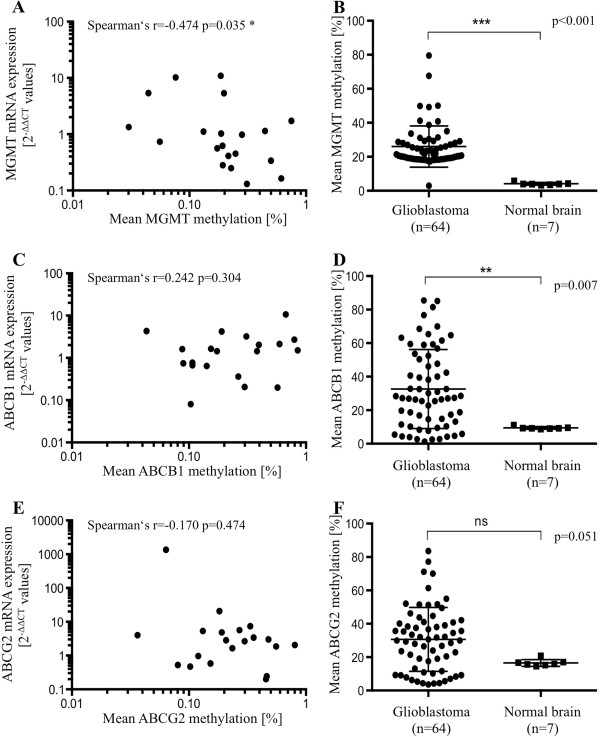
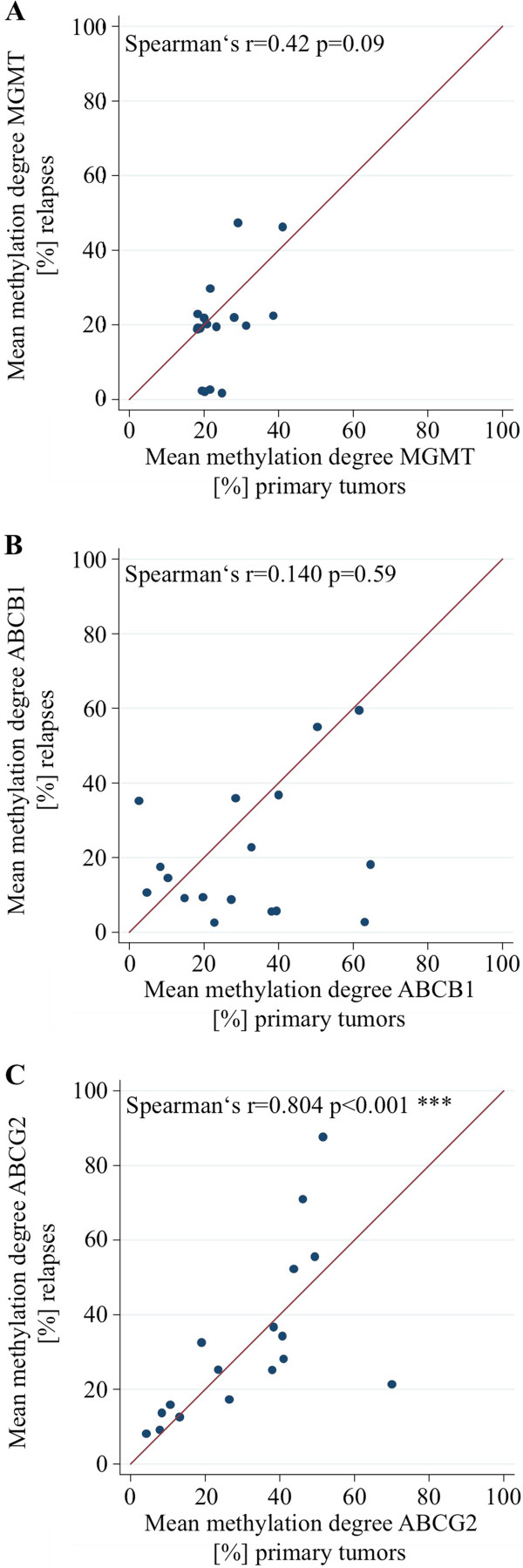
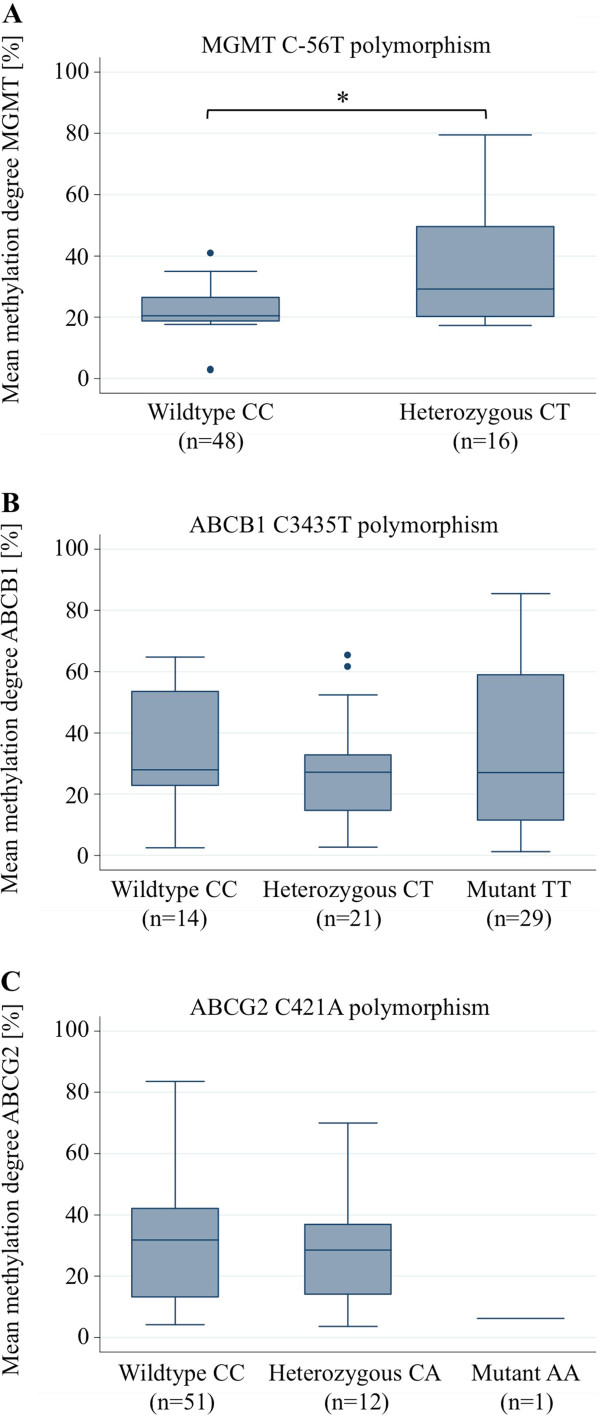
Therefore, we evaluated the proportion and prognostic significance of promoter methylation of MGMT, ABCB1 and ABCG2 in 64 GBM patient samples using pyrosequencing technology. Further, the single nucleotide polymorphisms MGMT C-56 T (rs16906252), ABCB1 C3435T (rs1045642) and ABCG2 C421A (rs2231142) were determined using the restriction fragment length polymorphism method (RFLP). To study a correlation between promoter methylation and gene expression, we analyzed MGMT, ABCB1 and ABCG2 expression in 20 glioblastoma and 7 non-neoplastic brain samples.
Despite a significantly increased MGMT and ABCB1 promoter methylation in GBM tissue, multivariate regression analysis revealed no significant association between overall survival of glioblastoma patients and MGMT or ABCB1 promoter methylation. However, a significant negative correlation between promoter methylation and expression could be identified for MGMT but not for ABCB1 and ABCG2. Furthermore, MGMT promoter methylation was significantly associated with the genotypes of the MGMT C-56 T polymorphism showing a higher methylation level in the T allele bearing GBM.
In summary, the data of this study confirm the previous published relation of MGMT promoter methylation and gene expression, but argue for no pivotal role of MGMT, ABCB1 and ABCG2 promoter methylation in GBM patients' survival.
高度侵袭性的多形性胶质母细胞瘤(GBM)对药物治疗的耐药性是一个主要的临床问题,导致患者预后不良。除了O6-甲基鸟嘌呤-DNA甲基转移酶(MGMT)基因的启动子甲基化外,外排转运蛋白ABCB1和ABCG2也被认为是导致耐药性的关键因素,但此前尚未评估GBM中ABCB1和ABCG2的甲基化情况。
因此,我们使用焦磷酸测序技术评估了64例GBM患者样本中MGMT、ABCB1和ABCG2启动子甲基化的比例及其预后意义。此外,使用限制性片段长度多态性方法(RFLP)测定了单核苷酸多态性MGMT C-56 T(rs16906252)、ABCB1 C3435T(rs1045642)和ABCG2 C421A(rs2231142)。为了研究启动子甲基化与基因表达之间的相关性,我们分析了20例胶质母细胞瘤和7例非肿瘤性脑样本中MGMT、ABCB1和ABCG2的表达情况。
尽管GBM组织中MGMT和ABCB1启动子甲基化显著增加,但多变量回归分析显示胶质母细胞瘤患者的总生存期与MGMT或ABCB1启动子甲基化之间无显著关联。然而,可确定MGMT启动子甲基化与表达之间存在显著负相关,而ABCB1和ABCG2则无此相关性。此外,MGMT启动子甲基化与MGMT C-56 T多态性的基因型显著相关,在携带T等位基因的GBM中甲基化水平更高。
总之,本研究数据证实了先前发表的MGMT启动子甲基化与基因表达之间的关系,但认为MGMT、ABCB1和ABCG2启动子甲基化在GBM患者生存中无关键作用。