Abdallah Soad A, Al-Shatti Laila A, Alhajraf Ali F, Al-Hammad Noura, Al-Awadi Bashayer
General Science Unit, College of Nursing, Public Authority for Applied Education & Training (PAAET), leave from Women's College for Arts, Science & Education, Botany Department, Ain Shams University, Al-Shuwaikh B, PO Box 64923, Kuwait City, 70466 Kuwait. On tenured Cairo, Egypt.
Biomedical Sciences Department, College of Nursing, PAAET, Kragujevac, Kuwait City, Kuwait.
Springerplus. 2013 Dec 23;2:687. doi: 10.1186/2193-1801-2-687. eCollection 2013.
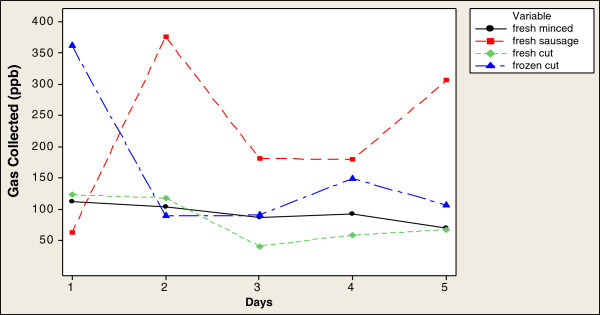
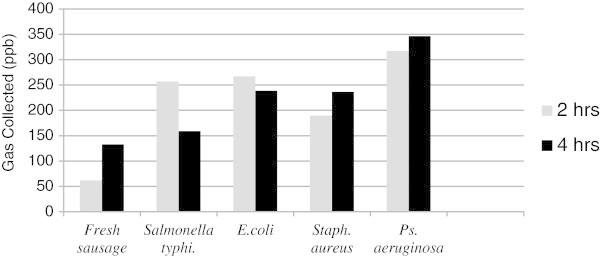
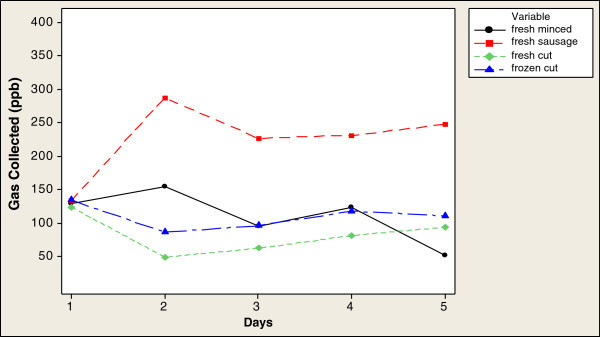
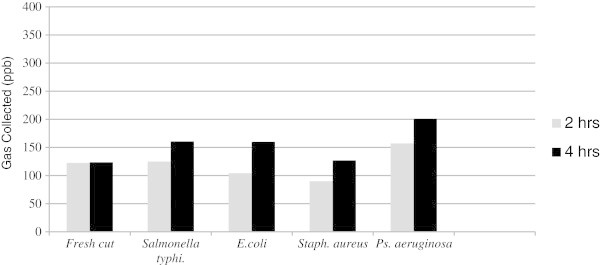
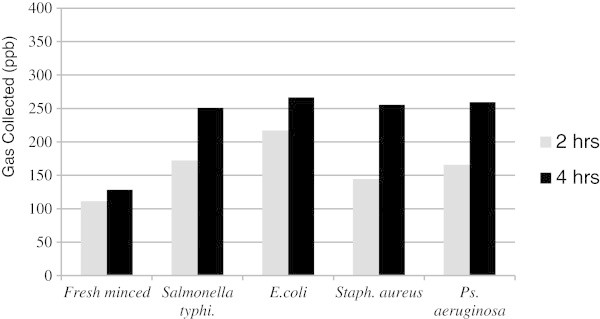
This study aims to investigate the application of a fast electronic nose system (Cyranose 320) for detecting foodborne bacteria. The system proved to be very efficient in detecting microbes in beef and sausage samples. In the first part of the study, the total viable counts (TVC) from fresh and frozen beef samples were determined using the standard microbiological method and by the application of the electronic nose. The second part applied the electronic nose to beef before and after contamination with different bacterial pathogens separately: E. coli O157: H7, Salmonellatyphimurium 857, Staphylococcus aureus 29213 and Pseudomonas aeruginosa 27853. The results revealed that the Cyranose 320 can detect the TVC in different beef and sausage samples and quantify the volatile organic compounds produced at concentrations from 50 ppb to > 350 ppb. The concentrations of gases collected from the samples before and after separate contamination with these pathogenic bacteria were highly significantly correlated (P < 0.005). From this study one can conclude that the electronic nose system is a rapid way for detecting volatile organic compounds produced by foodborne bacteria that contaminate beef.
本研究旨在探讨一种快速电子鼻系统(Cyranose 320)在检测食源细菌方面的应用。该系统在检测牛肉和香肠样本中的微生物时被证明非常有效。在研究的第一部分,使用标准微生物学方法并通过电子鼻的应用来测定新鲜和冷冻牛肉样本中的总活菌数(TVC)。第二部分分别将电子鼻应用于被不同细菌病原体污染前后的牛肉:大肠杆菌O157:H7、鼠伤寒沙门氏菌857、金黄色葡萄球菌29213和铜绿假单胞菌27853。结果显示,Cyranose 320能够检测不同牛肉和香肠样本中的TVC,并对浓度为50 ppb至> 350 ppb时产生的挥发性有机化合物进行定量。在分别被这些致病细菌污染前后,从样本中收集的气体浓度具有高度显著的相关性(P < 0.005)。从这项研究可以得出结论,电子鼻系统是检测污染牛肉的食源细菌产生的挥发性有机化合物的一种快速方法。