Woodward R M, Miledi R
Proc Natl Acad Sci U S A. 1987 Jun;84(12):4135-9. doi: 10.1073/pnas.84.12.4135.
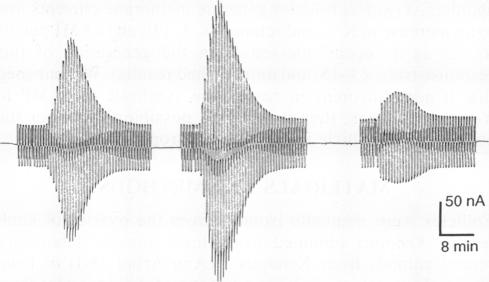
Membrane currents were recorded, using the voltage clamp technique, from Xenopus laevis oocytes still surrounded by their enveloping follicular and epithelial cells. Exposure of the follicles to mammalian gonadotropins elicited a current generated largely by an increase in membrane K+ conductance. The gonadotropin response resembled responses elicited by adenosine and catecholamines in the same follicle, but was not blocked by purinergic or catecholaminergic antagonists. The gonadotropin-induced currents were potentiated by the adenylate cyclase activator forskolin and by phosphodiesterase inhibitors; similar currents were elicited in the same follicle by intraoocyte injection of cAMP, which indicates a role for this second messenger in the response mechanism. Gonadotropin responses were either abolished or substantially reduced after treatments that remove the ovarian epithelial and follicular cells. Our experiments suggest that the gonadotropin receptors, and the K+ channels they regulate, reside in the follicular cells.
利用电压钳技术,在非洲爪蟾卵母细胞仍被其包被的卵泡细胞和上皮细胞包围时记录膜电流。将卵泡暴露于哺乳动物促性腺激素会引发一种电流,这种电流主要是由膜钾离子电导增加产生的。促性腺激素反应类似于同一卵泡中腺苷和儿茶酚胺引发的反应,但不受嘌呤能或儿茶酚胺能拮抗剂的阻断。促性腺激素诱导的电流被腺苷酸环化酶激活剂福斯高林和磷酸二酯酶抑制剂增强;通过向卵母细胞内注射cAMP在同一卵泡中引发了类似的电流,这表明这种第二信使在反应机制中起作用。在去除卵巢上皮细胞和卵泡细胞的处理后,促性腺激素反应要么被消除,要么大幅降低。我们的实验表明,促性腺激素受体及其调节的钾离子通道存在于卵泡细胞中。