Department of Dermatology, Venereology and Allergology, University Hospital Würzburg, Josef-Schneider-Strasse 2, Würzburg, 97080, Germany; Comprehensive Cancer Center Mainfranken, University Hospital Würzburg, Josef-Schneider-Strasse 6, Würzburg, 97080, Germany.
Cancer Med. 2013 Oct;2(5):674-86. doi: 10.1002/cam4.133. Epub 2013 Sep 18.
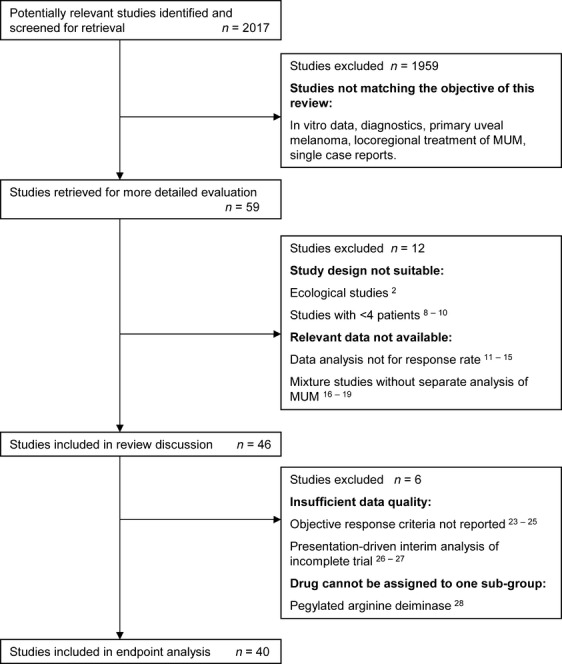
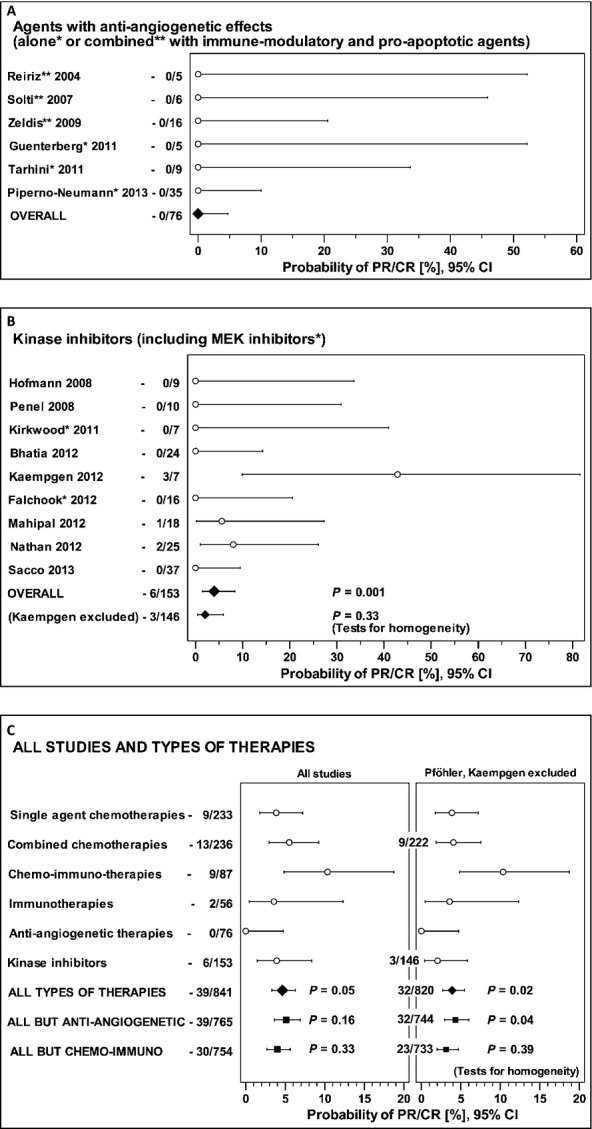
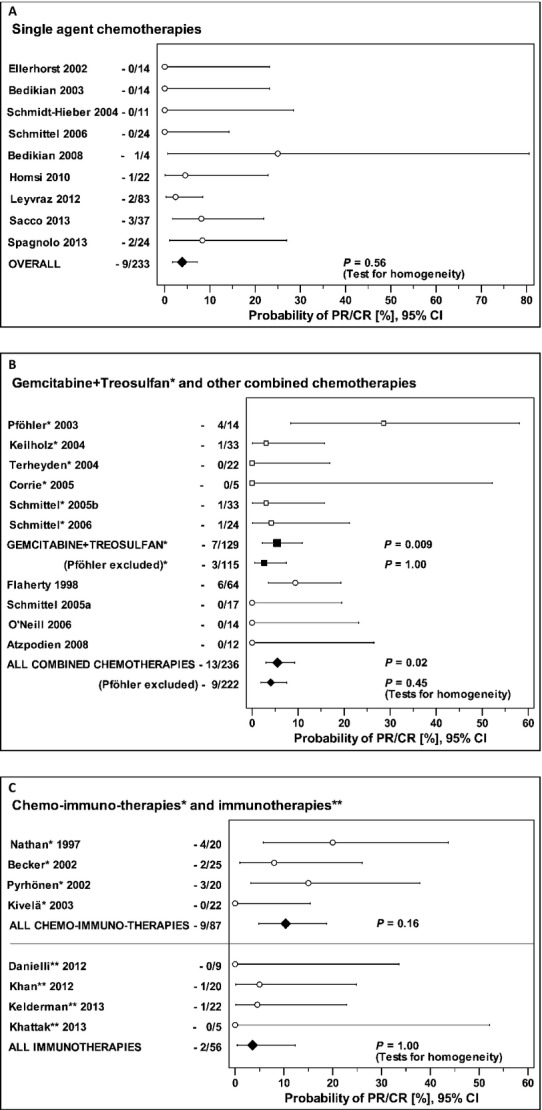
Up to 50% of patients with uveal melanoma develop metastatic disease with poor prognosis. Regional, mainly liver-directed, therapies may induce limited tumor responses but do not improve overall survival. Response rates of metastatic uveal melanoma (MUM) to systemic chemotherapy are poor. Insights into the molecular biology of MUM recently led to investigation of new drugs. In this study, to compare response rates of systemic treatment for MUM we searched Pubmed/Web of Knowledge databases and ASCO website (1980-2013) for "metastatic/uveal/melanoma" and "melanoma/eye." Forty studies (one case series, three phase I, five pilot, 22 nonrandomized, and two randomized phase II, one randomized phase III study, data of three expanded access programs, three retrospective studies) with 841 evaluable patients were included in the numeric outcome analysis. Complete or partial remissions were observed in 39/841 patients (overall response rate [ORR] 4.6%; 95% confidence intervals [CI] 3.3-6.3%), no responses were observed in 22/40 studies. Progression-free survival ranged from 1.8 to 7.2, median overall survival from 5.2 to 19.0 months as reported in 21/40 and 26/40 studies, respectively. Best responses were seen for chemoimmunotherapy (ORR 10.3%; 95% CI 4.8-18.7%) though mainly in first-line patients. Immunotherapy with ipilimumab, antiangiogenetic approaches, and kinase inhibitors have not yet proven to be superior to chemotherapy. MEK inhibitors are currently investigated in a phase II trial with promising preliminary data. Despite new insights into genetic and molecular background of MUM, satisfying systemic treatment approaches are currently lacking. Study results of innovative treatment strategies are urgently awaited.
多达 50%的葡萄膜黑色素瘤患者会发展为预后不良的转移性疾病。局部治疗,主要是针对肝脏的治疗方法可能会引起有限的肿瘤反应,但不能改善总体生存率。转移性葡萄膜黑色素瘤(MUM)对全身化疗的反应率较低。最近对 MUM 的分子生物学的深入了解导致了对新药的研究。在这项研究中,为了比较 MUM 的全身治疗反应率,我们在 Pubmed/Web of Knowledge 数据库和 ASCO 网站(1980-2013 年)上搜索了“转移性/葡萄膜/黑色素瘤”和“黑色素瘤/眼睛”。共纳入 40 项研究(1 项病例系列研究、3 项 I 期研究、5 项试验性研究、22 项非随机研究和 2 项随机 II 期研究、1 项随机 III 期研究、3 项扩大准入计划的数据、3 项回顾性研究),共 841 例可评估患者纳入数值结局分析。在 841 例患者中,有 39 例(总缓解率[ORR]为 4.6%;95%置信区间[CI]为 3.3-6.3%)观察到完全或部分缓解,在 40 项研究中有 22 项未观察到缓解。无进展生存期从 1.8 到 7.2 不等,中位总生存期从 5.2 到 19.0 个月,分别在 21/40 和 26/40 项研究中报告。在一线治疗中,化疗免疫治疗(ORR 10.3%;95%CI 4.8-18.7%)的疗效最佳。然而,免疫治疗(如 ipilimumab)、抗血管生成方法和激酶抑制剂尚未被证明优于化疗。MEK 抑制剂目前正在一项 II 期临床试验中进行研究,初步数据有希望。尽管对 MUM 的遗传和分子背景有了新的认识,但目前仍缺乏令人满意的全身治疗方法。迫切需要等待创新治疗策略的研究结果。