Grup d'Oncogènesi i Antitumorals (GOA), Institut d'Investigacions Biomèdiques Sant Pau (IIB-Sant Pau), Barcelona, Spain; Centro de Investigación Biomédica en Red en Bioingeniería, Biomateriales y Nanomedicina (CIBER-BBN), Barcelona, Spain.
Cancer Med. 2013 Dec;2(6):950-63. doi: 10.1002/cam4.153. Epub 2013 Oct 31.
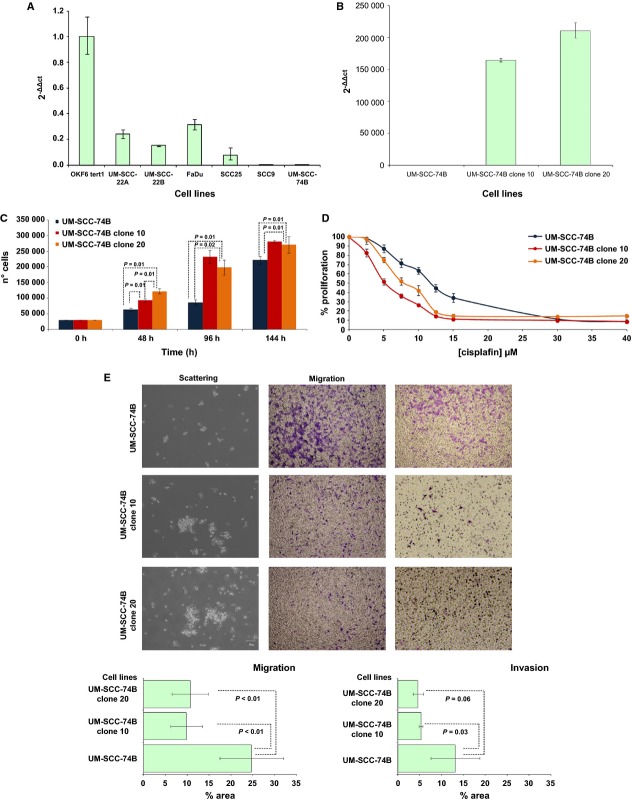
Currently there are no molecular markers able to predict clinical outcome in locally advanced head and neck squamous cell carcinoma (HNSCC). In a previous microarray study, RAB25 was identified as a potential prognostic marker. The aim of this study was to analyze the association between RAB25 expression and clinical outcome in patients with locally advanced HNSCC treated with standard therapy. In a retrospective immunohistochemical study (n = 97), we observed that RAB25-negative tumors had lower survival (log-rank, P = 0.01) than patients bearing positive tumors. In an independent prospective mRNA study (n = 117), low RAB25 mRNA expression was associated with poor prognosis. Using classification and regression tree analysis (CART) we established two groups of patients according to their RAB25 mRNA level and their risk of death. Low mRNA level was associated with poor local recurrence-free (log-rank, P = 0.005), progression-free (log-rank, P = 0.002) and cancer-specific (log-rank, P < 0.001) survival. Multivariate Cox model analysis showed that low expression of RAB25 was an independent poor prognostic factor for survival (hazard ratio: 3.84, 95% confidence interval: 1.93-7.62, P < 0.001). Patients whose tumors showed high RAB25 expression had a low probability of death after treatment. We also found lower RAB25 expression in tumors than in normal tissue (Mann-Whitney U, P < 0.001). Moreover, overexpression of RAB25 in the UM-SCC-74B HNSCC cell line increased cisplatin sensitivity, and reduced cell migration and invasion. Our findings support a tumor suppressor role for RAB25 in HNSCC and its potential use to identify locally advanced patients with a high probability of survival after genotoxic treatment.
目前尚无能够预测局部晚期头颈部鳞状细胞癌(HNSCC)临床结局的分子标志物。在之前的微阵列研究中,RAB25 被鉴定为一种潜在的预后标志物。本研究旨在分析 RAB25 表达与接受标准治疗的局部晚期 HNSCC 患者临床结局之间的关联。在一项回顾性免疫组织化学研究(n=97)中,我们观察到 RAB25 阴性肿瘤的生存率较低(对数秩检验,P=0.01),低于携带阳性肿瘤的患者。在一项独立的前瞻性 mRNA 研究(n=117)中,低 RAB25 mRNA 表达与不良预后相关。使用分类和回归树分析(CART),我们根据患者的 RAB25 mRNA 水平及其死亡风险建立了两组患者。低 mRNA 水平与局部无复发生存(对数秩检验,P=0.005)、无进展生存(对数秩检验,P=0.002)和癌症特异性生存(对数秩检验,P<0.001)不良相关。多变量 Cox 模型分析显示,RAB25 低表达是生存的独立不良预后因素(风险比:3.84,95%置信区间:1.93-7.62,P<0.001)。肿瘤 RAB25 表达较高的患者治疗后死亡的可能性较低。我们还发现肿瘤中的 RAB25 表达低于正常组织(Mann-Whitney U,P<0.001)。此外,在 UM-SCC-74B HNSCC 细胞系中过表达 RAB25 可增加顺铂敏感性,并降低细胞迁移和侵袭。我们的研究结果支持 RAB25 在 HNSCC 中作为肿瘤抑制因子的作用及其在识别接受遗传毒性治疗后具有高生存可能性的局部晚期患者中的潜在用途。