Kulthe V V, Chaudhari P D
Department of Pharmaceutics, Institute of Pharmacy, National Institute of Medical Sciences University, Jaipur-303 121, India.
Department of Pharmaceutics, Modern College of Pharmacy, Nigdi, Pune-411 044, India.
Indian J Pharm Sci. 2013 Sep;75(5):523-32.
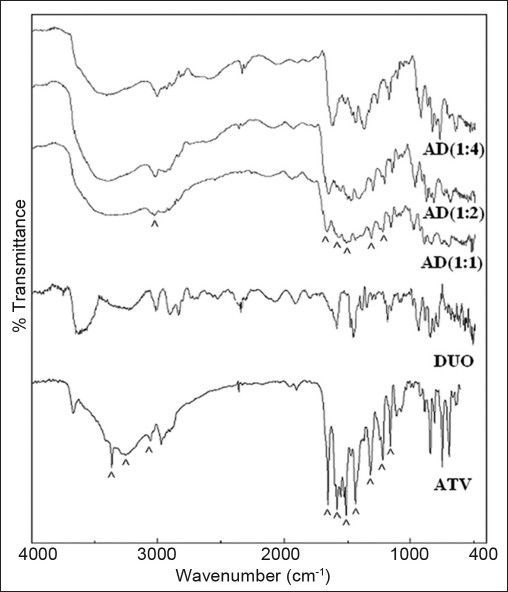
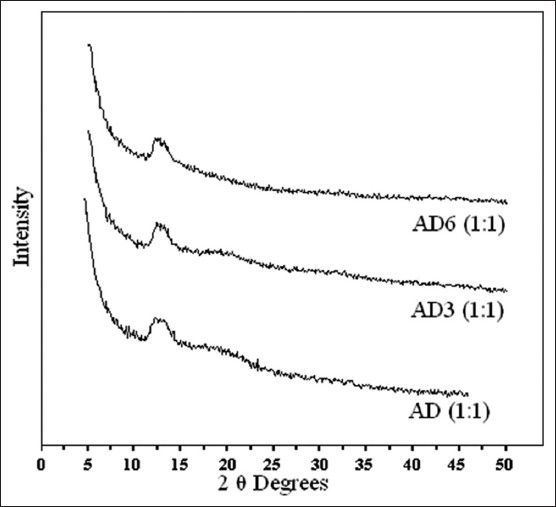
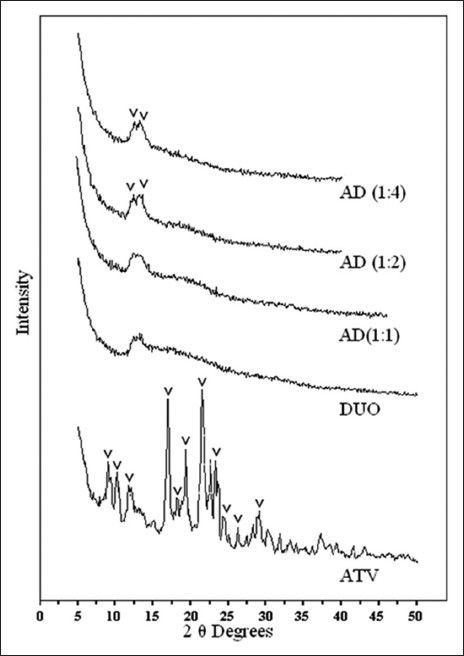
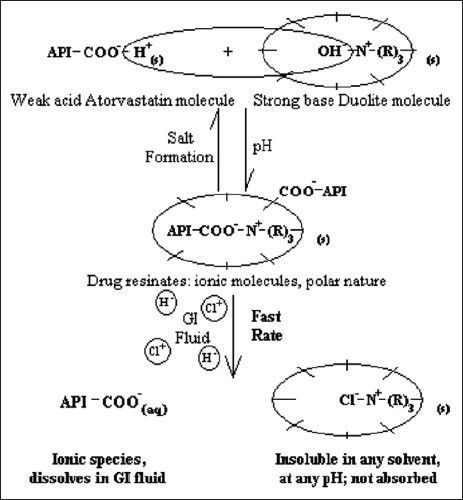
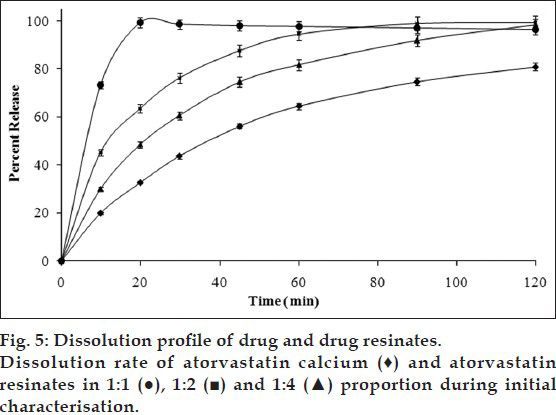
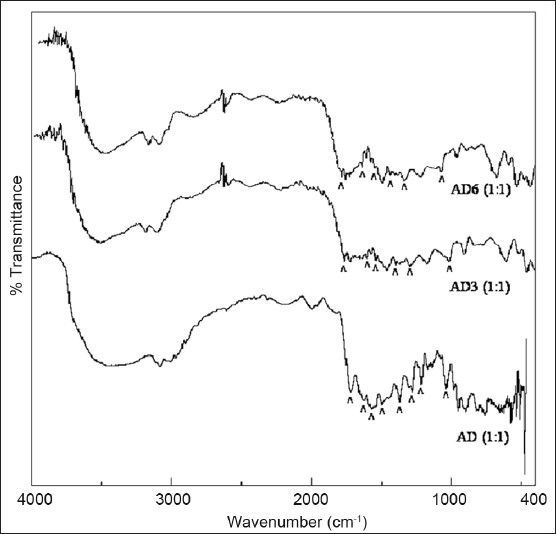
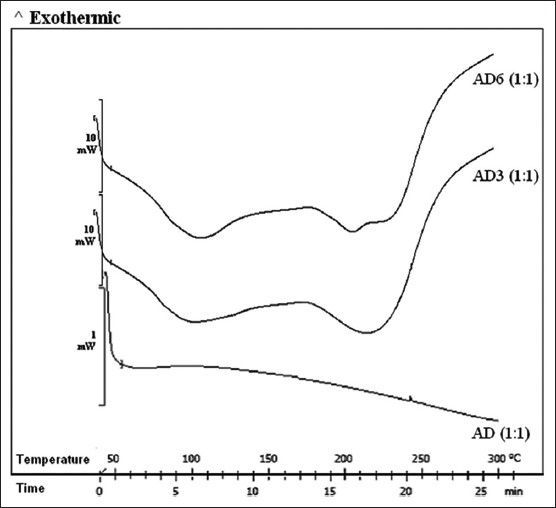
A substantial number of new chemical entities and marketed drugs show poor solubility characteristics and amorphisation is one of the favorable approaches to enhance solubility characteristics of such poorly soluble drugs. Formulation efforts in the present study were devoted to investigate amorphisation of a model poorly soluble drug, atorvastatin calcium by molecular complexation with anion exchange resin, Duolite(®)AP 143/1093 and hence enhancement in its solubility characteristics. Drug resinates in 1:1, 1:2, and 1:4 weight ratios were prepared by simple batch operation and subsequently studied for drug content, residual solvent content, molecular interactions, solid state characterisation and solubility characteristics. During initial characterisation, all the proportions of drug resinates, except 1:1 proportion showed partial amorphisation of the drug, whereas 1:1 proportion showed complete amorphisation of the drug. This proportion reported distinctly enhanced solubility characteristics over pure drug and other proportions. Such amorphisation and solubility enhancement could be attributed to the binding of individual drug molecules to the functional sites of the resin molecules, either partially or completely, resulting in reduction of crystal lattice energy, a main barrier to dissolution. Hydrophilic nature of ion exchange resin matrices also assisted in enhancing dissolution of the drug from the resinates. During accelerated stability study, there was an insignificant decrease in solubility characteristics of the drug and its amorphous form was also found to be stable in 1:1 proportion. Atorvastatin resinates formed in 1:1 weight ratio were in stoichiometric proportion and such drug resinates in stoichiometric proportion showed to have tremendous potential in conversion of crystalline form of drug substances to its amorphous form and subsequent stabilisation. It hence proved to be a very effective, yet simple approach for improving solubility characteristics of poorly soluble actives.
大量新的化学实体和上市药物表现出较差的溶解性特征,而无定形化是增强此类难溶性药物溶解性特征的有利方法之一。本研究的制剂工作致力于研究通过与阴离子交换树脂Duolite(®)AP 143/1093进行分子络合来使模型难溶性药物阿托伐他汀钙无定形化,从而增强其溶解性特征。通过简单的分批操作制备了重量比为1:1、1:2和1:4的药物树脂酸盐,随后对其药物含量、残留溶剂含量、分子相互作用、固态表征和溶解性特征进行了研究。在初始表征过程中,除1:1比例外,所有比例的药物树脂酸盐均显示药物部分无定形化,而1:1比例显示药物完全无定形化。该比例的药物树脂酸盐相对于纯药物和其他比例具有明显增强的溶解性特征。这种无定形化和溶解性增强可归因于单个药物分子部分或完全与树脂分子的功能位点结合,导致晶格能降低,而晶格能是溶解的主要障碍。离子交换树脂基质的亲水性也有助于增强药物从树脂酸盐中的溶解。在加速稳定性研究中,药物的溶解性特征仅有微不足道的下降,并且发现其无定形形式在1:1比例下也是稳定的。以1:1重量比形成的阿托伐他汀树脂酸盐为化学计量比例,这种化学计量比例的药物树脂酸盐在将药物物质的结晶形式转化为无定形形式并随后使其稳定化方面显示出巨大潜力。因此,它被证明是一种非常有效且简单的方法,可用于改善难溶性活性成分的溶解性特征。