Department of Nephrology, Molecular Cell Lab for Kidney Disease, Ren Ji Hospital, School of Medicine, Shanghai Jiao Tong University, Shanghai, China.
PLoS One. 2014 Jan 3;9(1):e84131. doi: 10.1371/journal.pone.0084131. eCollection 2014.
Urinary Kidney Injury Molecule 1 (KIM-1) is a proximal tubular injury biomarker for early detection of acute kidney injury (AKI), with variable performance characteristics depending on clinical and population settings.
Meta-analysis was performed to assess the diagnostic value of urinary KIM-1 in AKI. Relevant studies were searched from MEDLINE, EMBASE, Pubmed, Elsevier Science Direct, Scopus, Web of Science, Google Scholar and Cochrane Library. Meta-analysis methods were used to pool sensitivity and specificity and to construct summary receiver operating characteristic (SROC) curves.
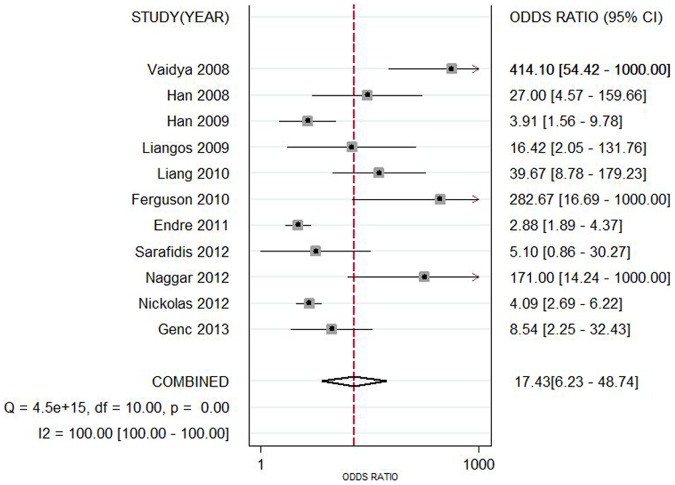
A total of 2979 patients from 11 eligible studies were enrolled in the analysis. Five prospective cohorts, two cross-sectional and four case-control studies were identified for meta-analysis. The estimated sensitivity of urinary KIM-1 for the diagnosis of AKI was 74.0% (95% CI, 61.0%-84.0%), and specificity was 86.0% (95% CI, 74.0%-93.0%). The SROC analysis showed an area under the curve of 0.86(0.83-0.89). Subgroup analysis suggested that population settings and detection time were the key factors affecting the efficiency of KIM-1 for AKI diagnosis.
Various population settings, different definition of AKI and Serum creatinine level used as the standard might have influence on AKI diagnosis. The relatively small number of studies and heterogeneity between them also affected the evaluation.
Urinary KIM-1 may be a promising biomarker for early detection of AKI with considerable predictive value, especially for cardiac surgery patients, and its potential value needs to be validated in large studies and across a broader scope of clinical settings.
尿肾损伤分子 1(KIM-1)是一种用于早期检测急性肾损伤(AKI)的近端肾小管损伤生物标志物,其性能特征因临床和人群环境而异。
进行荟萃分析以评估尿 KIM-1 在 AKI 中的诊断价值。从 MEDLINE、EMBASE、PubMed、Elsevier Science Direct、Scopus、Web of Science、Google Scholar 和 Cochrane Library 中搜索相关研究。使用荟萃分析方法汇总灵敏度和特异性,并构建汇总受试者工作特征(SROC)曲线。
共纳入了 11 项研究中的 2979 名患者。确定了五项前瞻性队列研究、两项横断面研究和四项病例对照研究进行荟萃分析。尿 KIM-1 诊断 AKI 的估计灵敏度为 74.0%(95%CI,61.0%-84.0%),特异性为 86.0%(95%CI,74.0%-93.0%)。SROC 分析显示曲线下面积为 0.86(0.83-0.89)。亚组分析表明,人群环境和检测时间是影响 KIM-1 对 AKI 诊断效率的关键因素。
不同的人群环境、AKI 的不同定义以及用作标准的血清肌酐水平可能会影响 AKI 的诊断。研究数量相对较少,研究之间存在异质性也会影响评估。
尿 KIM-1 可能是一种很有前途的早期检测 AKI 的生物标志物,具有相当大的预测价值,特别是对于心脏手术患者,其潜在价值需要在更大规模的研究和更广泛的临床环境中进行验证。