School of Life Sciences and Technology, Institut Teknologi Bandung, Bandung, Jawa Barat, Indonesia.
PLoS One. 2014 Jan 3;9(1):e84692. doi: 10.1371/journal.pone.0084692. eCollection 2014.
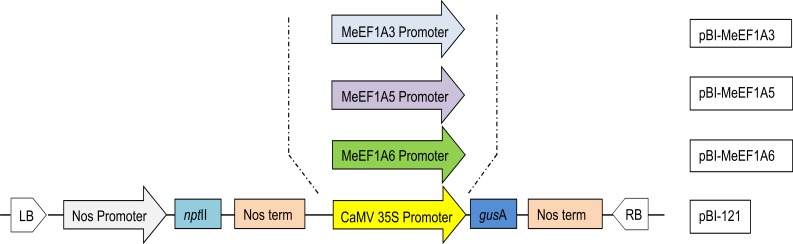
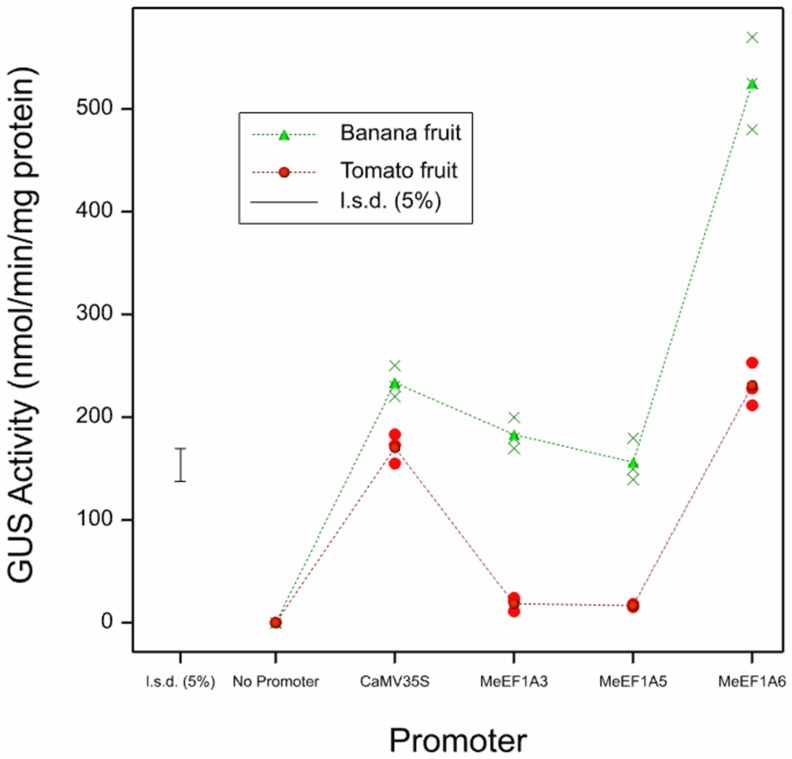
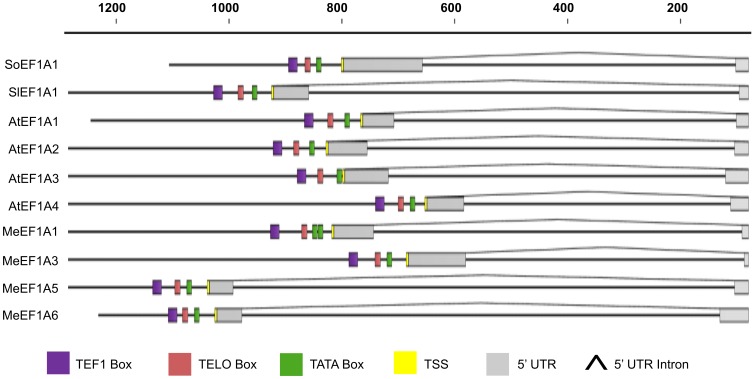
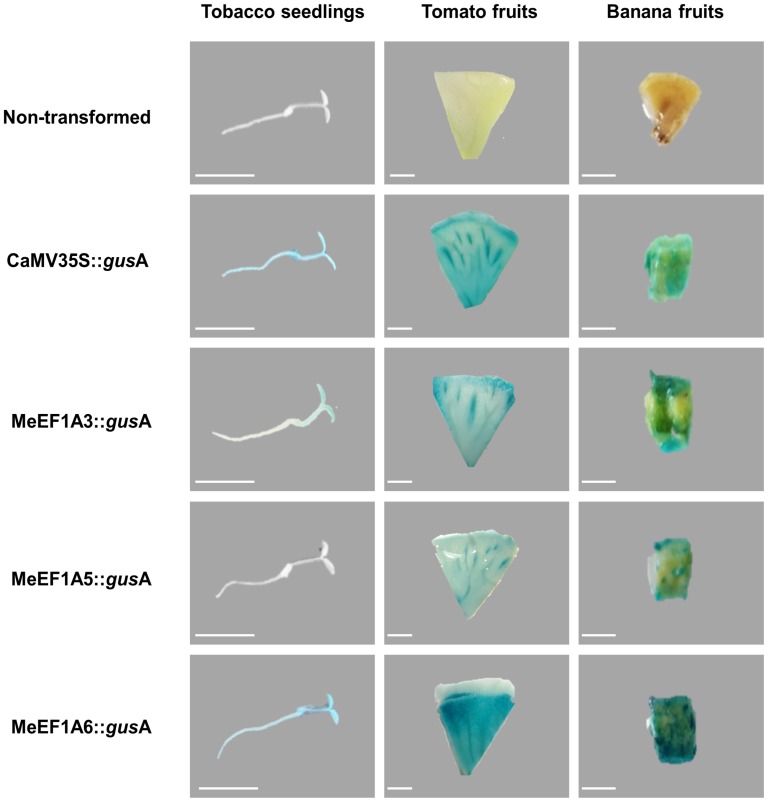
In plant genetic engineering, the identification of gene promoters leading to particular expression patterns is crucial for the development of new genetically modified plant generations. This research was conducted in order to isolate and characterize several new promoters from cassava (Manihot esculenta Crantz) elongation factor 1 alpha (EF1A) gene family.Three promoters MeEF1A3, MeEF1A5 and MeEF1A6 were successfully isolated [corrected]. Sequence analyses showed that all of the promoters contain three conserved putative cis-acting elements which are located upstream of the transcription start site. These elements are included a TEF1, a TELO and TATA boxes. In addition, all of the promoters also have the 5'UTR intron but with a different lengths. These promoters were constructed translationally with gusA reporter gene (promoter::gusA fusion) in pBI-121 binary vector to build a new binary vector using Overlap Extension PCR Cloning (OEPC) technique. Transient expression assay that was done by using agroinfiltration method was used to show functionality of these promoters. Qualitative and quantitative analysis from GUS assay showed that these promoters were functional and conferred a specific activity in tobacco seedlings (Nicotiana tabacum), tomato fruits (Solanum lycopersicum) and banana fruits (Musa acuminata). We hypothesized that MeEF1A6 could be categorized as a constitutive promoter because it was able to drive the gene expression in all transformed tissue described in here and also comparable to CaMV35S. On the other hand, MeEF1A3 drove specific expression in the aerial parts of seedlings such as hypocotyl and cotyledon thus MeEF1A5 drove specific expression in fruit tissue. The results obtained from transient analysis showed that these promoters had a distinct activity although they came from same gene family. The DNA sequences identified here are new promoters potentially use for genetic engineering in cassava or other plants.
在植物基因工程中,鉴定导致特定表达模式的基因启动子对于开发新的遗传改良植物世代至关重要。本研究旨在从木薯(Manihot esculenta Crantz)伸长因子 1α(EF1A)基因家族中分离和表征几种新的启动子。成功分离了三个启动子 MeEF1A3、MeEF1A5 和 MeEF1A6。序列分析表明,所有启动子都包含三个位于转录起始位点上游的保守假定顺式作用元件。这些元件包括 TEF1、TELO 和 TATA 盒。此外,所有启动子还具有 5'UTR 内含子,但长度不同。这些启动子通过重叠延伸 PCR 克隆(OEPC)技术与 gusA 报告基因(启动子::gusA 融合)在 pBI-121 二元载体中构建翻译,构建了一个新的二元载体。使用农杆菌浸润法进行的瞬时表达分析用于显示这些启动子的功能。通过 GUS 测定进行的定性和定量分析表明,这些启动子具有功能,并在烟草幼苗(Nicotiana tabacum)、番茄果实(Solanum lycopersicum)和香蕉果实(Musa acuminata)中赋予了特定的活性。我们假设 MeEF1A6 可以归类为组成型启动子,因为它能够在本文中描述的所有转化组织中驱动基因表达,并且与 CaMV35S 相当。另一方面,MeEF1A3 在幼苗的地上部分(如下胚轴和子叶)中驱动特异性表达,而 MeEF1A5 在果实组织中驱动特异性表达。瞬时分析的结果表明,尽管它们来自相同的基因家族,但这些启动子具有不同的活性。这里鉴定的 DNA 序列是潜在用于木薯或其他植物遗传工程的新启动子。