Chessa Luciana, Leuzzi Vincenzo, Plebani Alessandro, Soresina Annarosa, Micheli Roberto, D'Agnano Daniela, Venturi Tullia, Molinaro Anna, Fazzi Elisa, Marini Mirella, Ferremi Leali Pierino, Quinti Isabella, Cavaliere Filomena Monica, Girelli Gabriella, Pietrogrande Maria Cristina, Finocchi Andrea, Tabolli Stefano, Abeni Damiano, Magnani Mauro
Department of Pediatrics and Child Neurology and Psychiatry, Sapienza Università di Roma, via dei Sabelli 108, 00185 Roma, Italy.
Orphanet J Rare Dis. 2014 Jan 9;9:5. doi: 10.1186/1750-1172-9-5.
Ataxia Teleangiectasia [AT] is a rare neurodegenerative disease characterized by early onset ataxia, oculocutaneous teleangiectasias, immunodeficiency, recurrent infections, radiosensitivity and proneness to cancer. No therapies are available for this devastating disease. Recent observational studies in few patients showed beneficial effects of short term treatment with betamethasone. To avoid the characteristic side effects of long-term administration of steroids we developed a method for encapsulation of dexamethasone sodium phosphate (DSP) into autologous erythrocytes (EryDex) allowing slow release of dexamethasone for up to one month after dosing. Aims of the study were: the assessment of the effect of EryDex in improving neurological symptoms and adaptive behaviour of AT patients; the safety and tolerability of the therapy.
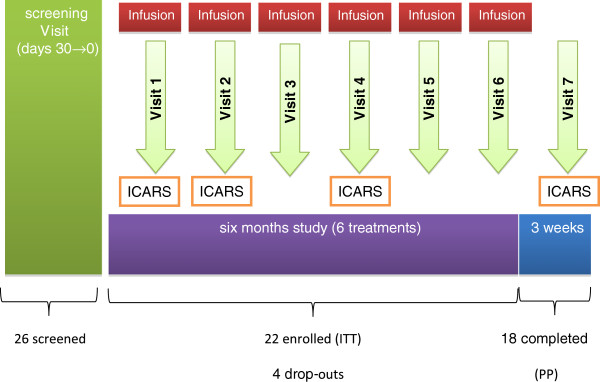
Twenty two patients (F:M=1; mean age 11.2 ± 3.5) with a confirmed diagnosis of AT and a preserved or partially supported gait were enrolled for the study. The subjects underwent for six months a monthly infusion of EryDex. Ataxia was assessed by the International Cooperative Ataxia Rating Scale (ICARS) and the adaptive behavior by Vineland Adaptive Behavior Scales (VABS). Clinical evaluations were performed at baseline and 1, 3, and 6 months.
An improvement in ICARS (reduction of the score) was detected in the intention-to-treat (ITT) population (n=22; p=0.02) as well as in patients completing the study (per protocol PP) (n=18; p=0.01), with a mean reduction of 4 points (ITT) or 5.2 points (PP). When compared to baseline, a significant improvement were also found in VABS (increase of the score) (p<0.0001, ITT, RMANOVA), with statistically significant increases at 3 and 6 months (p<0.0001). A large inter-patient variability in the incorporation of DSP into erythrocytes was observed, with an evident positive effect of higher infusion dose on ICARS score decline. Moreover a more marked improvement was found in less neurologically impaired patients. Finally, a 19 month-extension study involving a subgroup of patients suggested that Erydex treatment can possibly delay the natural progression of the disease.EryDex was well tolerated; the most frequent side effects were common AT pathologies.
EryDex treatment led to a significant improvement in neurological symptoms, without association with the typical steroid side effects.
Current Controlled Trial 2010-022315-19SpA.
共济失调毛细血管扩张症(AT)是一种罕见的神经退行性疾病,其特征为早发性共济失调、眼皮肤毛细血管扩张、免疫缺陷、反复感染、放射敏感性和易患癌症。目前尚无针对这种毁灭性疾病的治疗方法。最近对少数患者的观察性研究显示,短期使用倍他米松治疗有有益效果。为避免长期使用类固醇的典型副作用,我们开发了一种将地塞米松磷酸钠(DSP)封装到自体红细胞(EryDex)中的方法,使地塞米松在给药后能缓慢释放长达一个月。本研究的目的是:评估EryDex对改善AT患者神经症状和适应性行为的效果;评估该治疗的安全性和耐受性。
22例确诊为AT且步态保留或部分受支持的患者(女∶男 = 1∶1;平均年龄11.2±3.5岁)纳入本研究。受试者接受为期6个月每月一次的EryDex输注。共济失调通过国际合作共济失调评定量表(ICARS)评估,适应性行为通过文兰适应性行为量表(VABS)评估。在基线以及第1、3和6个月进行临床评估。
在意向性治疗(ITT)人群(n = 22;p = 0.0)以及完成研究的患者(符合方案PP)(n = 18;p = 0.01)中均检测到ICARS评分改善(分数降低),ITT人群平均降低4分,PP人群平均降低5.2分。与基线相比,VABS评分也有显著改善(分数增加)(p<0.0001,ITT,重复测量方差分析),在第3和6个月有统计学显著增加(p<0.0001)。观察到患者间DSP掺入红细胞的情况存在很大差异,较高输注剂量对ICARS评分下降有明显的积极影响。此外,神经功能损害较轻的患者改善更为明显。最后,一项涉及部分患者亚组的为期19个月的扩展研究表明,EryDex治疗可能会延缓疾病的自然进展。EryDex耐受性良好;最常见的副作用是常见的AT病理表现。
EryDex治疗使神经症状有显著改善,且未出现典型的类固醇副作用。
当前受控试验2010 - 022315 - 19SpA。