Laboratory of Plant Molecular Physiology, Division of Life Science, Graduate School of Science and Engineering, Saitama University, Shimo-Okubo 255, Sakura-Ku, Saitama, 338-8570 Japan.
Plant Cell Physiol. 2014 Feb;55(2):358-69. doi: 10.1093/pcp/pcu004. Epub 2014 Jan 8.
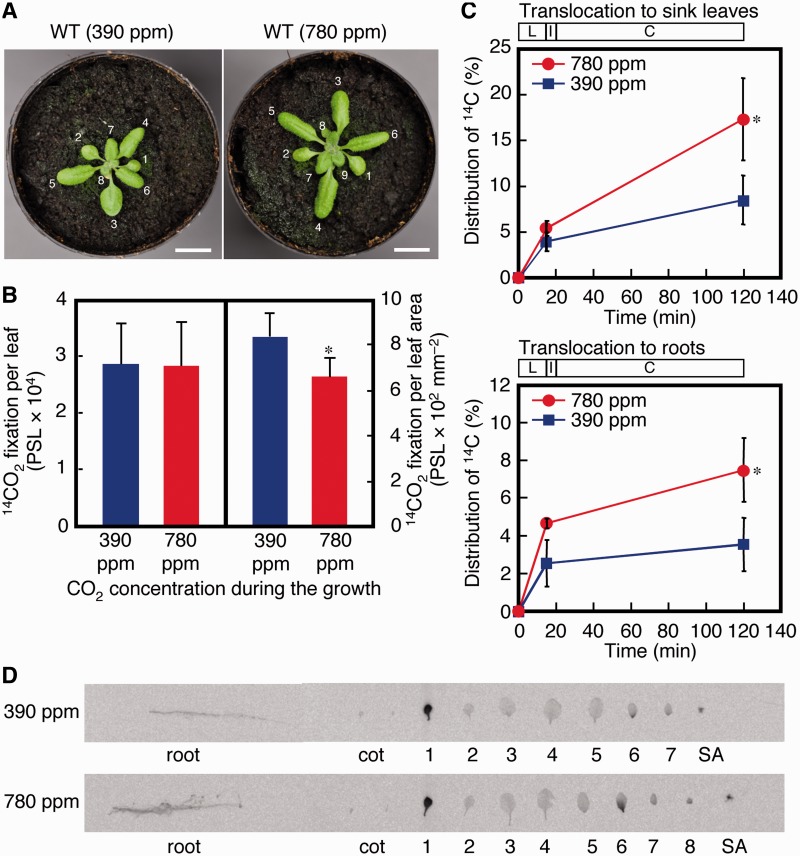
Using 18-day-old Arabidopsis thaliana seedlings grown under increased (780 p.p.m., experimental plants) or ambient (390 p.p.m., control plants) CO2 conditions, we evaluated (14)CO2 photoassimilation in and translocation from representative source leaves. The total (14)CO2 photoassimilation amounts increased in the third leaves of the experimental plants in comparison with that found for the third leaves of the control plants, but the rates were comparable for the first leaves of the two groups. In contrast, translocation of labeled assimilates doubled in the first leaves of the experimental group, whereas translocation was, at best, passively enhanced even though photoassimilation increased in their third leaves. The transcript levels of the companion cell-specific sucrose:H(+) symporter gene SUC2 were not significantly affected in the two groups of plants, whereas those of the sucrose effluxer gene SWEET12 and the sieve element-targeted sucrose:H(+) symporter gene SUT4 were up-regulated in the experimental plants, suggesting up-regulation of SUT4-dependent apoplastic phloem loading. Compared with SUC2, SUT4 is a minor component that is expressed in companion cells but functions in sieve elements after transfer through plasmodesmata. The number of aniline blue-stained spots for plasmodesma-associated callose in the midrib wall increased in the first leaf of the experimental plants but was comparable in the third leaf between the experimental and control plants. These results suggest that A. thaliana responds to greater than normal concentrations of CO2 differentially in the first and third leaves in regards to photoassimilation, assimilate translocation and plasmodesmal biogenesis.
使用在高浓度(780ppm,实验植株)或正常浓度(390ppm,对照植株)CO2 条件下生长的 18 天大的拟南芥幼苗,我们评估了来自代表性源叶的(14)CO2 光合作用同化和转运。与对照植株的第三片叶相比,实验植株的第三片叶中的总(14)CO2 光合作用同化量增加,但两组的第一片叶的同化速率相当。相比之下,实验组的第一片叶中的标记同化产物的转运量增加了一倍,而即使其第三片叶中的光合作用增强,同化产物的转运也只是被动增强。在两组植物中,伴细胞特异性蔗糖:H+ 共运蛋白基因 SUC2 的转录水平没有显著变化,而蔗糖外排蛋白基因 SWEET12 和筛管靶向蔗糖:H+ 共运蛋白基因 SUT4 的转录水平在实验植株中上调,表明 SUT4 依赖性质外体韧皮部装载的上调。与 SUC2 相比,SUT4 是一个次要成分,在伴细胞中表达,但在穿过胞间连丝转移到筛管后发挥作用。实验组第一片叶中与质膜相关的胼胝质的苯胺蓝染色斑点数量增加,但实验组和对照组的第三片中的胼胝质数量相当。这些结果表明,拟南芥在光合作用同化、同化产物转运和质膜形成方面,对高于正常浓度的 CO2 的第一和第三片叶的反应存在差异。