Hosseinifar Mohammad, Akbari Mohammad, Behtash Hamid, Amiri Mohsen, Sarrafzadeh Javad
Department of Physical Therapy, Tehran University of Medical Sciences, Iran.
Department of Orthopedy, Tehran University of Medical Sciences, Iran.
J Phys Ther Sci. 2013 Dec;25(12):1541-5. doi: 10.1589/jpts.25.1541. Epub 2014 Jan 8.
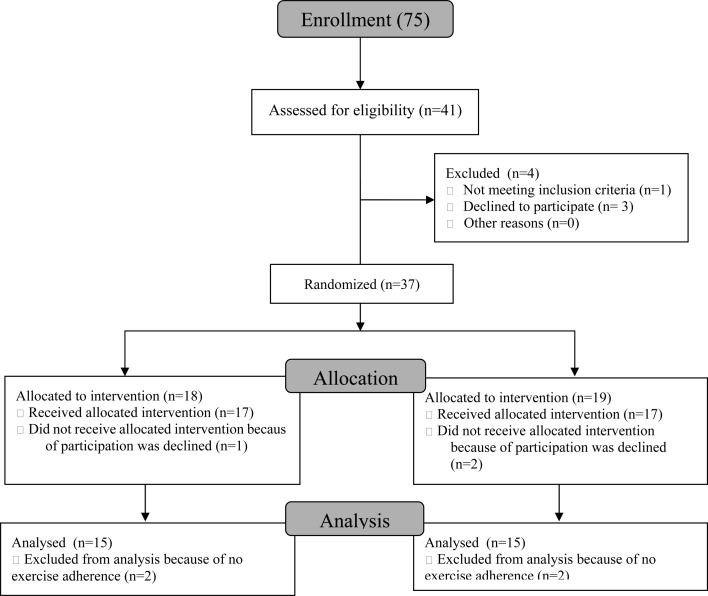
[Purpose] This study compared the effectiveness of stabilization and McKenzie exercises on pain, disability, and thickness of the transverse abdominis and multifidus muscles in patients with nonspecific chronic low back pain. [Subjects] Thirty patients were randomly assigned into two groups: the McKenzie and stabilization exercise groups. [Methods] Before and after intervention, pain, disability, and thickness of the transverse abdominis and multifidus muscles were evaluated by visual analogue scale, functional rating index, and sonography, respectively. The training program was 18 scheduled sessions of individual training for both groups. [Results] After interventions, the pain score decreased in both groups. The disability score decreased only in the stabilization group. The thickness of the left multifidus was significantly increased during resting and contracting states in the stabilization group. The thickness of the right transverse abdominis during the abdominal draw-in maneuver, and thickness of the left transverse abdominis during the active straight leg raising maneuver were significantly increased in the stabilization group. The intensity of pain, disability score, thickness of the right transverse abdominis during the abdominal draw-in manouver, and thickness of the left transverse abdominis during active straight leg raising in the stabilization group were greater than those on the Mackenzie. [Conclusion] Stabilization exercises are more effective than McKenzie exercises in improving the intensity of pain and function score and in increasing the thickness of the transverse abdominis muscle.
[目的] 本研究比较了稳定性训练和麦肯基疗法对非特异性慢性下腰痛患者疼痛、功能障碍以及腹横肌和多裂肌厚度的影响。[对象] 30例患者被随机分为两组:麦肯基疗法组和稳定性训练组。[方法] 干预前后,分别采用视觉模拟评分法、功能评定指数和超声检查评估疼痛、功能障碍以及腹横肌和多裂肌的厚度。两组的训练计划均为18节个人训练课程。[结果] 干预后,两组的疼痛评分均降低。功能障碍评分仅在稳定性训练组降低。稳定性训练组左侧多裂肌在静息和收缩状态下的厚度显著增加。稳定性训练组在收腹动作时右侧腹横肌的厚度以及在主动直腿抬高动作时左侧腹横肌的厚度显著增加。稳定性训练组的疼痛强度、功能障碍评分、收腹动作时右侧腹横肌的厚度以及主动直腿抬高时左侧腹横肌的厚度均高于麦肯基疗法组。[结论] 在改善疼痛强度和功能评分以及增加腹横肌厚度方面,稳定性训练比麦肯基疗法更有效。