Key Laboratory of Exercise and Health Sciences of Ministry of Education, Shanghai University of Sport, Shanghai, China.
School of Physical Education (Main Campus), Zhengzhou University, Zhengzhou, China.
J Orthop Surg Res. 2024 Jan 3;19(1):1. doi: 10.1186/s13018-023-04392-2.
To tackle non-specific low back pain (NSLBP) among patients and find the most effective solution and to quantitatively synthesize the overall effect of motor control training (MCT) compared with Pilates, McKenzie method, and physical therapy (PT) in pain and physical function.
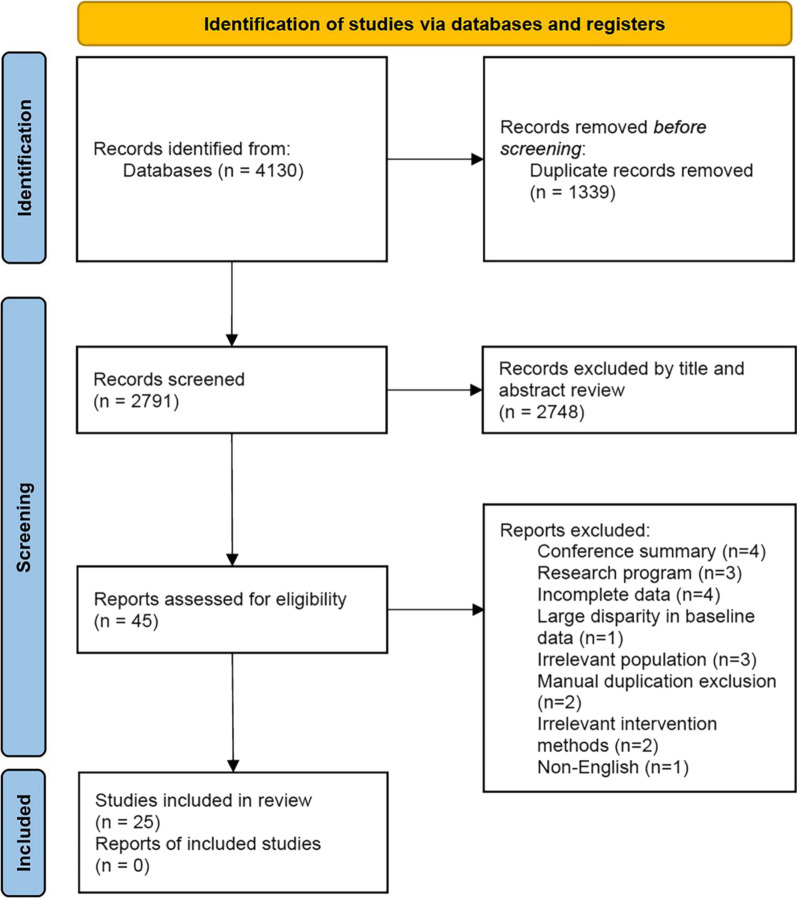
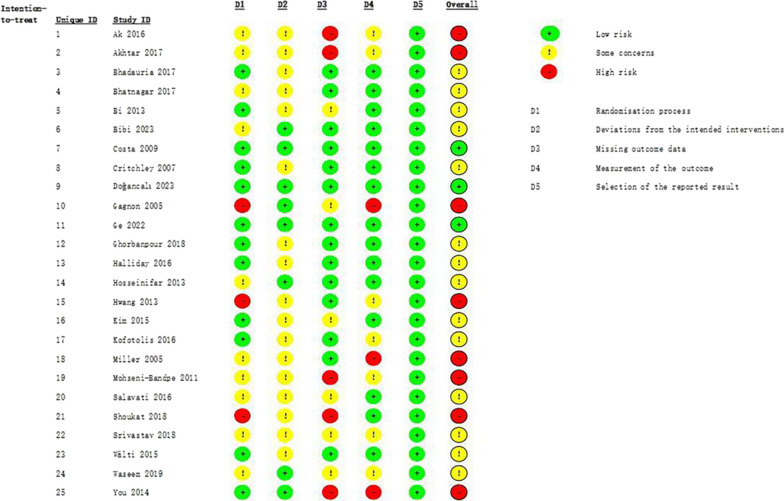
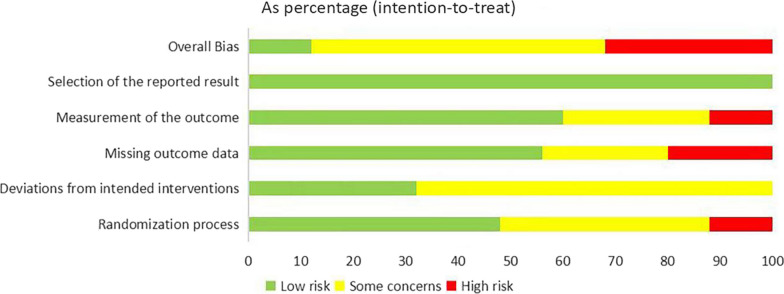
Randomized controlled trials (RCTs) of four types of intervention (MCT, Pilates, McKenzie method, and PT) for LBP were collected by searching PubMed, Web of Science, EBSCOhost (Cochrane Central Register of Controlled Trials), and Scopus databases from the establishment of the database to September 30, 2023. The risk of bias was evaluated for included studies using the Revised Cochrane Risk of Bias tool for randomized trials (RoB 2.0). Taking pain and physical function in the experimental and control groups as outcome indicators, subgroup analysis was performed according to the intervention method to calculate the standardized mean difference (SMD) and 95% confidence interval (CI).
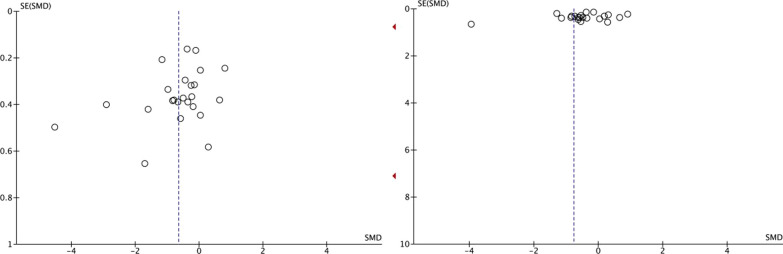
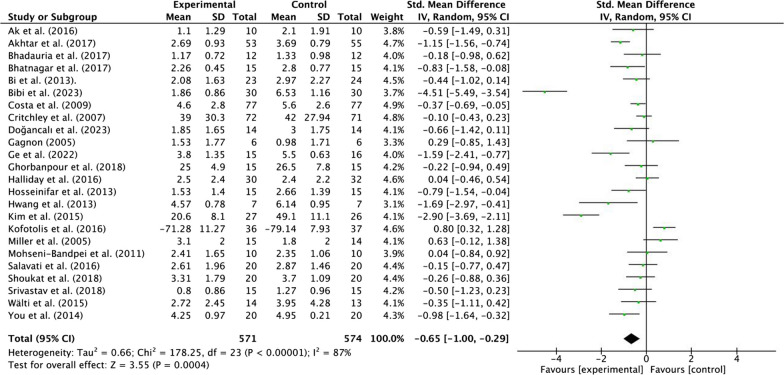
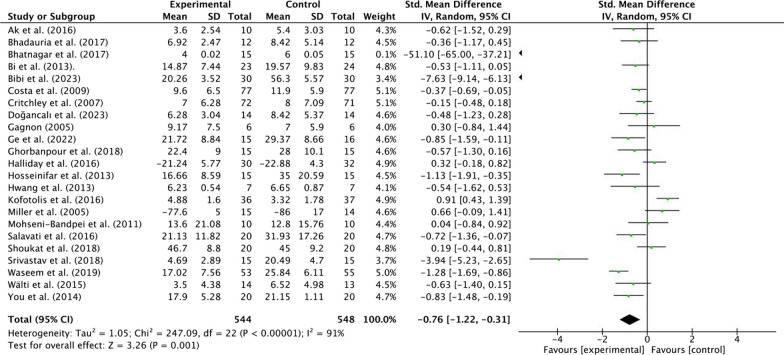
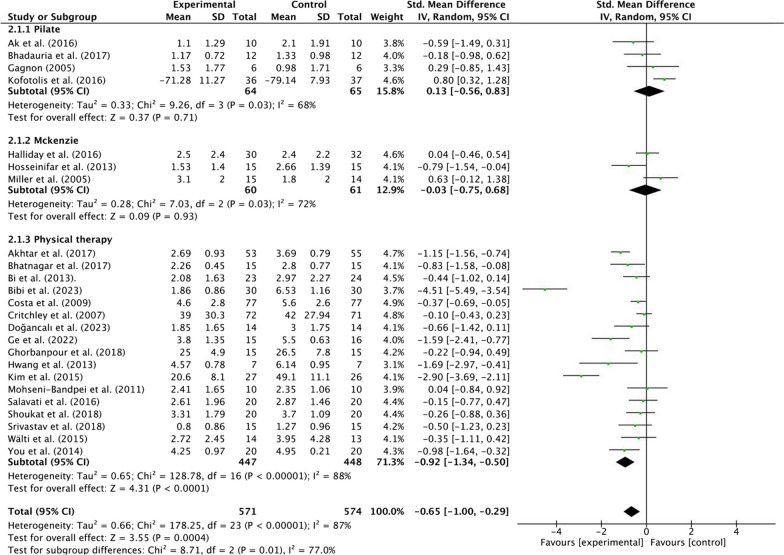
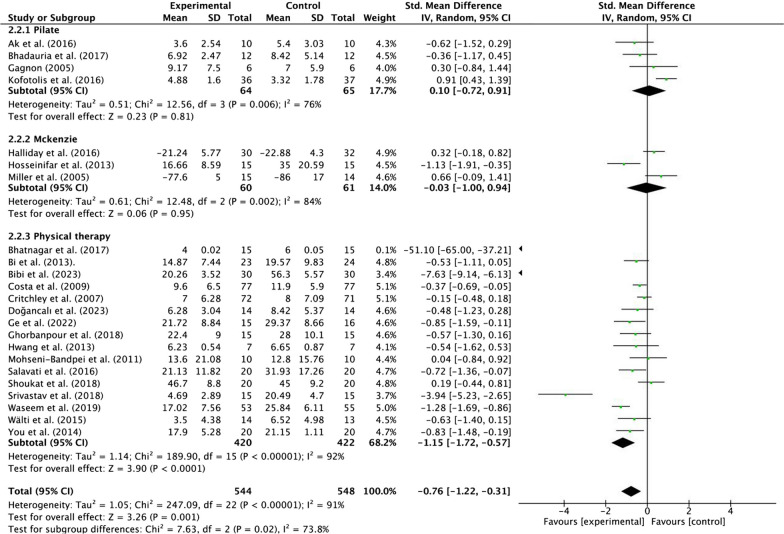
A total of 25 RCTs, including 1253 patients, were included. Meta-analysis showed that MCT effectively relieved pain [SMD = -0.65, 95% CI (- 1.00, - 0.29), p < 0.01] and improved physical function [SMD = -0.76, 95% CI (- 1.22, - 0.31), p < 0.01] comparing with other 3 types of intervention. Subgroup analysis suggested that MCT could alleviate pain [SMD = -0.92, 95% CI (- 1.34, - 0.50), p < 0.01] and improve physical function [SMD = -1.15, 95% CI (- 1.72, - 0.57), p < 0.01] compared with PT, but it had no statistical significance compared with Pilates [pain: SMD = 0.13, 95% CI (- 0.56, 0.83), p = 0.71; physical function: SMD = 0.10, 95% CI (- 0.72, 0.91), p = 0.81] and the McKenzie method [pain: SMD = -0.03, 95% CI (- 0.75, 0.68), p = 0.93; physical function: SMD = -0.03, 95% CI (- 1.00, 0.94), p = 0.95].
MCT can effectively relieve pain and improve physical function in patients with NSLBP. It is more effective compared with PT for LBP, while no differences were detected between MCT and Pilates, as well as McKenzie method. Therefore, MCT, Pilates, and the McKenzie method should be encouraged as exercise interventions for NSLBP rehabilitation.
针对非特异性下腰痛(NSLBP)患者,寻找最有效的解决方案,并定量综合比较运动控制训练(MCT)与普拉提、麦肯基疗法和物理疗法(PT)在疼痛和身体功能方面的整体效果。
通过检索 PubMed、Web of Science、EBSCOhost(Cochrane 对照试验中心注册库)和 Scopus 数据库,收集了四种干预措施(MCT、普拉提、麦肯基疗法和 PT)治疗 LBP 的随机对照试验(RCT),数据库建立至 2023 年 9 月 30 日。使用修订后的 Cochrane 随机对照试验偏倚风险工具(RoB 2.0)对纳入的研究进行偏倚风险评估。以实验组和对照组的疼痛和身体功能为结局指标,根据干预方法进行亚组分析,计算标准化均数差(SMD)和 95%置信区间(CI)。
共纳入 25 项 RCT,包括 1253 名患者。Meta 分析显示,与其他 3 种干预措施相比,MCT 能有效缓解疼痛[SMD=-0.65,95%CI(-1.00,-0.29),p<0.01]和改善身体功能[SMD=-0.76,95%CI(-1.22,-0.31),p<0.01]。亚组分析表明,MCT 能缓解疼痛[SMD=-0.92,95%CI(-1.34,-0.50),p<0.01]和改善身体功能[SMD=-1.15,95%CI(-1.72,-0.57),p<0.01],与 PT 相比,但与普拉提相比无统计学意义[疼痛:SMD=0.13,95%CI(-0.56,0.83),p=0.71;身体功能:SMD=0.10,95%CI(-0.72,0.91),p=0.81]和麦肯基方法[疼痛:SMD=-0.03,95%CI(-0.75,0.68),p=0.93;身体功能:SMD=-0.03,95%CI(-1.00,0.94),p=0.95]。
MCT 可有效缓解 NSLBP 患者的疼痛并改善身体功能。与 PT 相比,它对 LBP 更有效,而 MCT 与普拉提和麦肯基方法之间没有差异。因此,应鼓励 MCT、普拉提和麦肯基方法作为 NSLBP 康复的运动干预措施。