
应力和应变在发育过程中提供位置和方向线索。
Stress and strain provide positional and directional cues in development.
作者信息
Bozorg Behruz, Krupinski Pawel, Jönsson Henrik
机构信息
Computational Biology & Biological Physics, Lund University, Lund, Sweden.
Computational Biology & Biological Physics, Lund University, Lund, Sweden ; Sainsbury Laboratory, Cambridge University, Cambridge, United Kingdom.
出版信息
PLoS Comput Biol. 2014 Jan;10(1):e1003410. doi: 10.1371/journal.pcbi.1003410. Epub 2014 Jan 9.
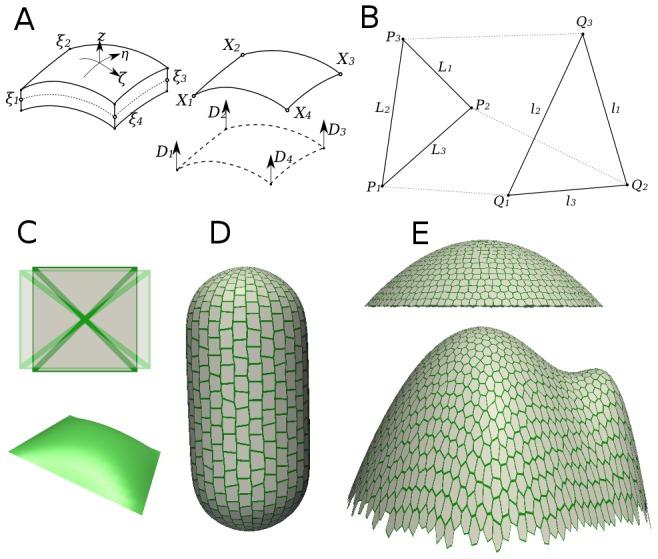
The morphogenesis of organs necessarily involves mechanical interactions and changes in mechanical properties of a tissue. A long standing question is how such changes are directed on a cellular scale while being coordinated at a tissular scale. Growing evidence suggests that mechanical cues are participating in the control of growth and morphogenesis during development. We introduce a mechanical model that represents the deposition of cellulose fibers in primary plant walls. In the model both the degree of material anisotropy and the anisotropy direction are regulated by stress anisotropy. We show that the finite element shell model and the simpler triangular biquadratic springs approach provide equally adequate descriptions of cell mechanics in tissue pressure simulations of the epidermis. In a growing organ, where circumferentially organized fibers act as a main controller of longitudinal growth, we show that the fiber direction can be correlated with both the maximal stress direction and the direction orthogonal to the maximal strain direction. However, when dynamic updates of the fiber direction are introduced, the mechanical stress provides a robust directional cue for the circumferential organization of the fibers, whereas the orthogonal to maximal strain model leads to an unstable situation where the fibers reorient longitudinally. Our investigation of the more complex shape and growth patterns in the shoot apical meristem where new organs are initiated shows that a stress based feedback on fiber directions is capable of reproducing the main features of in vivo cellulose fiber directions, deformations and material properties in different regions of the shoot. In particular, we show that this purely mechanical model can create radially distinct regions such that cells expand slowly and isotropically in the central zone while cells at the periphery expand more quickly and in the radial direction, which is a well established growth pattern in the meristem.
器官的形态发生必然涉及组织的机械相互作用和机械性能变化。一个长期存在的问题是,这些变化如何在细胞尺度上得到引导,同时在组织尺度上实现协调。越来越多的证据表明,机械信号参与了发育过程中生长和形态发生的控制。我们引入了一个机械模型,该模型描述了纤维素纤维在植物初生细胞壁中的沉积。在该模型中,材料各向异性程度和各向异性方向均由应力各向异性调节。我们表明,在表皮组织压力模拟中,有限元壳模型和更简单的三角形双二次弹簧方法对细胞力学提供了同样充分的描述。在一个生长中的器官中,周向排列的纤维作为纵向生长的主要控制因素,我们表明纤维方向可以与最大应力方向以及与最大应变方向正交的方向相关。然而,当引入纤维方向的动态更新时,机械应力为纤维的周向组织提供了一个稳健的方向线索,而与最大应变正交的模型则导致一种不稳定的情况,即纤维纵向重新定向。我们对茎尖分生组织中更复杂的形状和生长模式(新器官在此处起始)的研究表明,基于应力的纤维方向反馈能够重现茎不同区域体内纤维素纤维方向、变形和材料特性的主要特征。特别是,我们表明这个纯机械模型可以创建径向不同的区域,使得中央区域的细胞缓慢且各向同性地扩展,而周边区域的细胞扩展得更快且沿径向扩展,这是分生组织中一种成熟的生长模式。



 Zotero 插件