From Sanquin Research, 1066 CX Amsterdam, The Netherlands, and Landsteiner Laboratory, Academic Medical Centre, University of Amsterdam, 1105 AZ, The Netherlands.
J Biol Chem. 2014 Feb 28;289(9):6098-109. doi: 10.1074/jbc.M113.541813. Epub 2014 Jan 14.
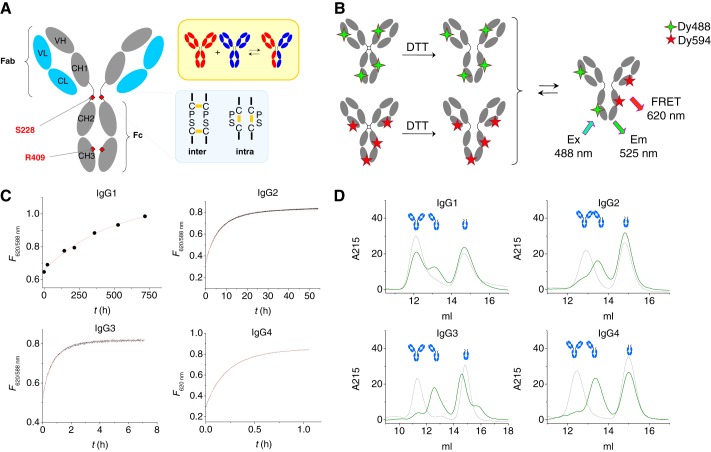
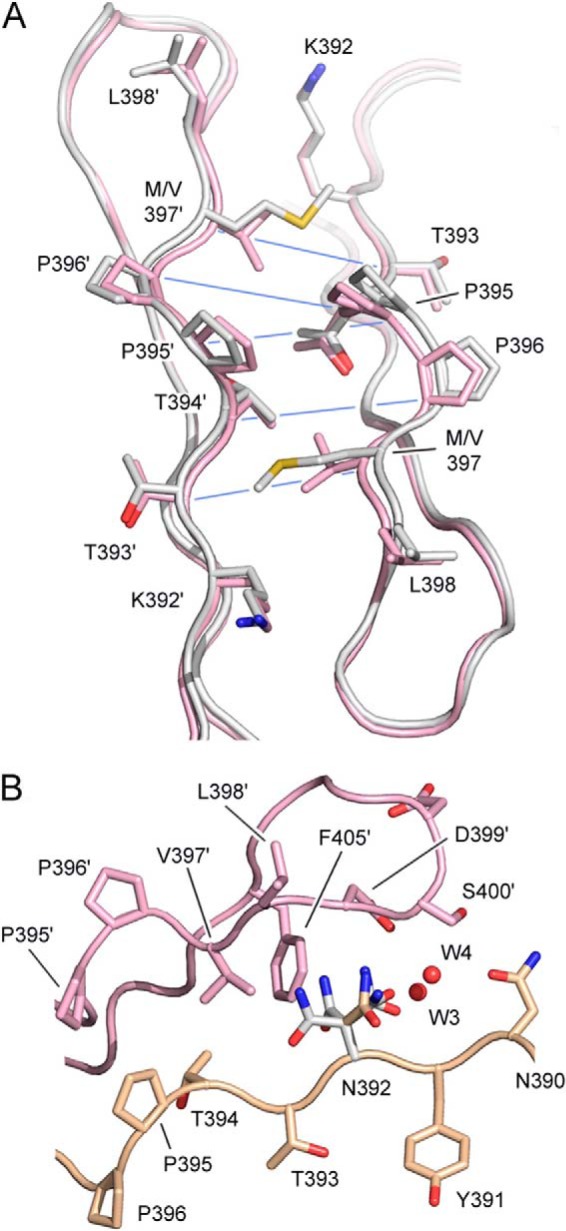
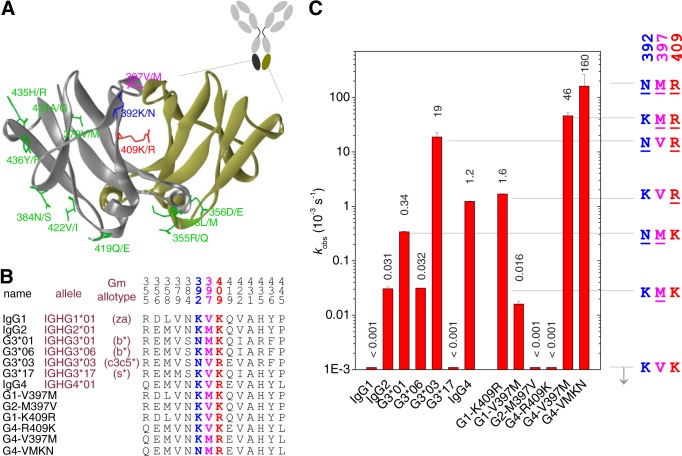
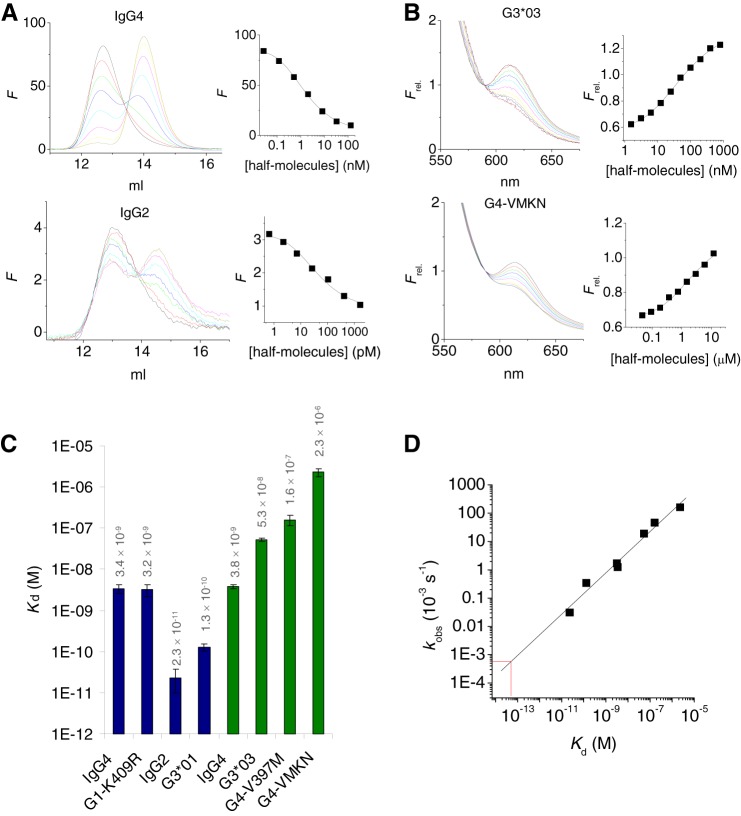
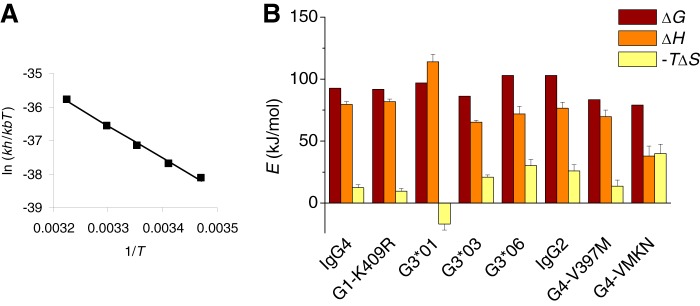
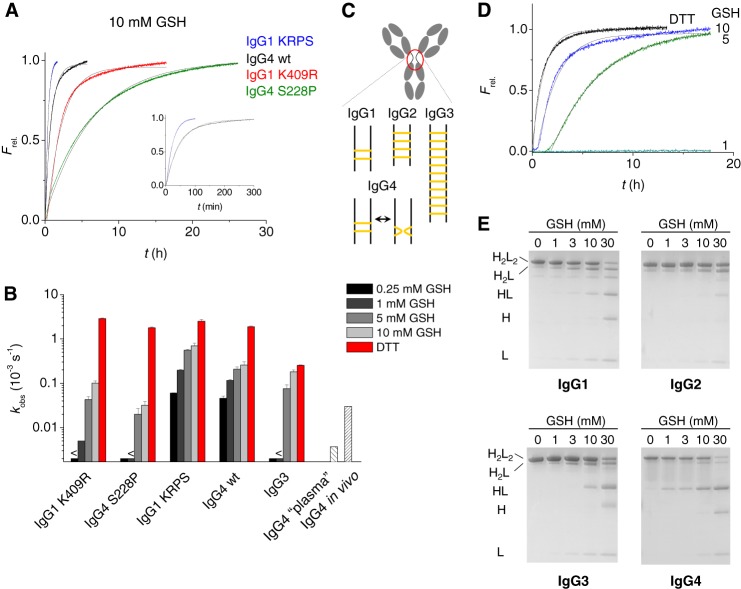
Interdomain interactions between the CH3 domains of antibody heavy chains are the first step in antibody assembly and are of prime importance for maintaining the native structure of IgG. For human IgG4 it was shown that CH3-CH3 interactions are weak, resulting in the potential for half-molecule exchange ("Fab arm exchange"). Here we systematically investigated non-covalent interchain interactions for CH3 domains in the other human subclasses, including polymorphisms (allotypes), using real-time monitoring of Fab arm exchange with a FRET-based kinetic assay. We identified structural variation between human IgG subclasses and allotypes at three amino acid positions (Lys/Asn-392, Val/Met-397, Lys/Arg-409) to alter the strength of inter-domain interactions by >6 orders of magnitude. Each substitution affected the interactions independent from the other substitutions in terms of affinity, but the enthalpic and entropic contributions were non-additive, suggesting a complex interplay. Allotypic variation in IgG3 resulted in widely different CH3 interaction strengths that were even weaker for IgG3 than for IgG4 in the case of allotype G3m(c3c5*/6,24*), whereas G3m(s*/15*) was equally stable to IgG1. These interactions are sufficiently strong to maintain the structural integrity of IgG1 during its normal life span; for IgG2 and IgG3 the inter-heavy chain disulfide bonds are essential to prevent half-molecule dissociation, whereas the labile hinge disulfide bonds favor half-molecule exchange in vivo for IgG4.
抗体重链 CH3 结构域之间的域间相互作用是抗体组装的第一步,对于维持 IgG 的天然结构至关重要。对于人 IgG4,已经表明 CH3-CH3 相互作用较弱,从而导致半分子交换(“Fab 臂交换”)的潜力。在这里,我们使用基于 FRET 的动力学测定法,系统地研究了其他人类亚类的 CH3 结构域中的非共价链间相互作用,包括多态性(同种异型)。我们确定了人类 IgG 亚类和同种异型之间在三个氨基酸位置(Lys/Asn-392、Val/Met-397、Lys/Arg-409)的结构变异,从而改变了结构域间相互作用的强度>6 个数量级。每个取代都独立于其他取代影响亲和力,但焓和熵贡献是非加性的,表明存在复杂的相互作用。IgG3 的同种异型变异导致 CH3 相互作用强度差异很大,在同种异型 G3m(c3c5*/6,24*)的情况下,IgG3 的相互作用强度甚至比 IgG4 还要弱,而 G3m(s*/15*)与 IgG1 同样稳定。这些相互作用足以在其正常寿命内维持 IgG1 的结构完整性;对于 IgG2 和 IgG3,重链间二硫键对于防止半分子解离至关重要,而不稳定的铰链二硫键有利于 IgG4 体内的半分子交换。