Department of Primary and Community Care, Radboud University Nijmegen Medical Center, Nijmegen, The Netherlands ; Department of Health Services Research and Policy, London School of Hygiene and Tropical Medicine, London, United Kingdom.
International Clinical Trials Registry Platform (ICTRP), Department of Ethics and Social Determinants of Health (ESD), World Health Organization, Geneva, Switzerland.
PLoS One. 2014 Jan 10;9(1):e84727. doi: 10.1371/journal.pone.0084727. eCollection 2014.
The benefits of clinical trials registration include improved transparency on clinical trials for healthcare workers and patients, increased accountability of trialists, the potential to address publication bias and selective reporting, and possibilities for research collaboration and prioritization. However, poor quality of information in registered records of trials has been found to undermine these benefits in the past. Trialists' increasing experience with trial registration and recent developments in registration systems may have positively affected data quality. This study was conducted to investigate whether the quality of registration has improved.
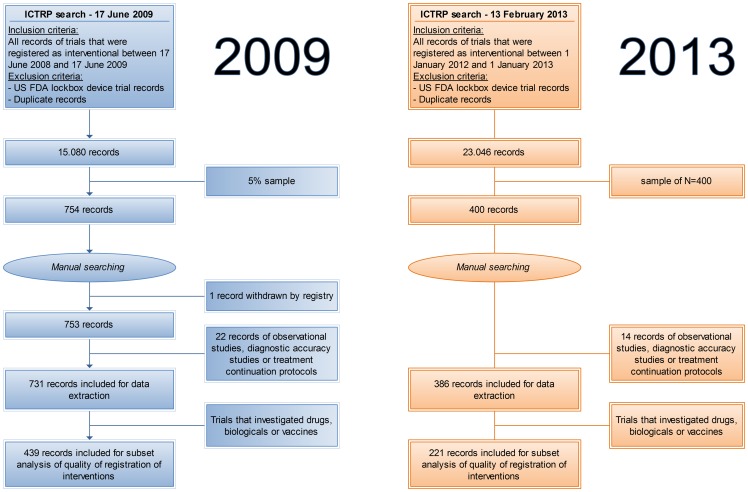
We repeated a study from 2009, using the same methods and the same research team. A random sample of 400 records of clinical trials that were registered between 01/01/2012 and 01/01/2013 was taken from the International Clinical Trials Registry Platform (ICTRP) and assessed for the quality of information on 1) contact details, 2) interventions and 3) primary outcomes. Results were compared to the equivalent assessments from our previous study.
There was a small and not statistically significant increase from 81.0% to 85.5% in the percentage of records that provided a name of a contact person. There was a significant increase from 68.7% to 74.9% in the number of records that provided either an email address or a telephone number. There was a significant increase from 44.2% to 51.9% in the number of intervention arms that were complete in registering intervention specifics. There was a significant increase from 38.2% to 57.6% in the number of primary outcomes that were specific measures with a meaningful timeframe. Approximately half of all trials continued to be retrospectively registered.
There have been small but significant improvements in the quality of registration since 2009. Important problems with quality remain and continue to constitute an impediment to the meaningful utilization of registered trial information.
临床试验注册的益处包括提高医护人员和患者对临床试验的透明度、增加试验人员的责任、解决发表偏倚和选择性报告的可能性,以及促进研究合作和优先级排序的可能性。然而,过去发现注册试验记录中的信息质量差会破坏这些益处。试验人员对试验注册的经验日益丰富以及注册系统的最新发展可能对数据质量产生了积极影响。本研究旨在调查注册质量是否有所提高。
我们重复了 2009 年的一项研究,使用相同的方法和相同的研究团队。从国际临床试验注册平台(ICTRP)中随机抽取了 2012 年 1 月 1 日至 2013 年 1 月 1 日期间注册的 400 项临床试验记录,评估了 1)联系方式、2)干预措施和 3)主要结局的信息质量。结果与我们之前研究的等效评估进行了比较。
提供联系人姓名的记录比例从 81.0%略有增加到 85.5%,但没有统计学意义。提供电子邮件地址或电话号码的记录数量从 68.7%增加到 74.9%,有显著增加。注册干预具体内容的干预臂数量从 44.2%增加到 51.9%,有显著增加。具有有意义时间框架的具体措施的主要结局数量从 38.2%增加到 57.6%,有显著增加。大约一半的试验仍为回顾性注册。
自 2009 年以来,注册质量有了微小但显著的提高。质量方面仍然存在重要问题,继续构成对已注册试验信息的有效利用的障碍。