Neuroscience Department, Developmental Cognitive Neuroscience, Karolinska Institutet Stockholm, Sweden.
Front Hum Neurosci. 2014 Jan 7;7:926. doi: 10.3389/fnhum.2013.00926.
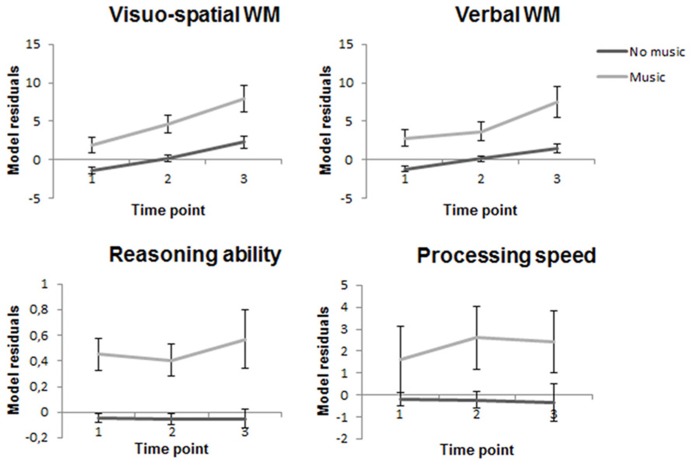
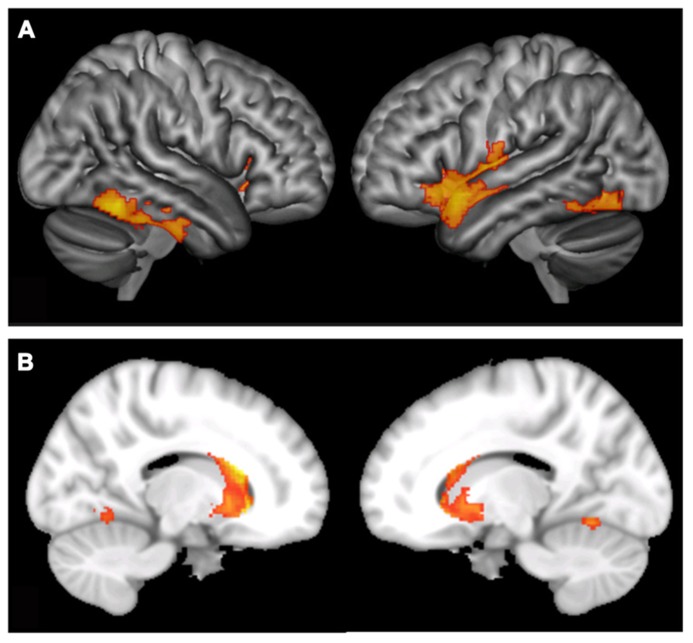
Practicing a musical instrument is associated with cognitive benefits and structural brain changes in correlational and interventional trials; however, the effect of musical training on cognition during childhood is still unclear. In this longitudinal study of child development we analyzed the association between musical practice and performance on reasoning, processing speed and working memory (WM) during development. Subjects (n = 352) between the ages of 6 and 25 years participated in neuropsychological assessments and neuroimaging investigations (n = 64) on two or three occasions, 2 years apart. Mixed model regression showed that musical practice had an overall positive association with WM capacity (visuo-spatial WM, F = 4.59, p = 0.033, verbal WM, F = 9.69, p = 0.002), processing speed, (F = 4.91, p = 0.027) and reasoning (Raven's progressive matrices, F = 28.34, p < 0.001) across all three time points, after correcting for the effect of parental education and other after school activities. Music players also had larger gray matter volume in the temporo-occipital and insular cortex (p = 0.008), areas previously reported to be related to musical notation reading. The change in WM between the time points was proportional to the weekly hours spent on music practice for both WM tests (VSWM, β = 0.351, p = 0.003, verbal WM, β = 0.261, p = 0.006) but this was not significant for reasoning ability (β = 0.021, p = 0.090). These effects remained when controlling for parental education and other after school activities. In conclusion, these results indicate that music practice positively affects WM development and support the importance of practice for the development of WM during childhood and adolescence.
练习乐器与认知益处和结构脑变化相关,在相关和干预试验中;然而,音乐训练对儿童期认知的影响仍不清楚。在这项儿童发展的纵向研究中,我们分析了音乐练习与推理、加工速度和工作记忆(WM)在发展过程中的关系。研究对象(年龄在 6 至 25 岁之间)在两次或三次(相隔 2 年)神经心理学评估和神经影像学研究(n = 64)中参与,混合模型回归显示,音乐练习与 WM 能力(视空间 WM,F = 4.59,p = 0.033,语言 WM,F = 9.69,p = 0.002)、加工速度(F = 4.91,p = 0.027)和推理(Raven 的渐进矩阵,F = 28.34,p < 0.001)均呈正相关,在纠正了父母教育和其他课外活动的影响后。音乐演奏者的颞顶叶和脑岛皮层的灰质体积也更大(p = 0.008),这些区域先前与音乐符号阅读有关。WM 测试之间 WM 变化与每周音乐练习时间成正比(VSWM,β = 0.351,p = 0.003,语言 WM,β = 0.261,p = 0.006),但这对推理能力没有显著影响(β = 0.021,p = 0.090)。在控制父母教育和其他课外活动后,这些结果仍然存在。总之,这些结果表明,音乐练习对 WM 发展有积极影响,并支持练习对儿童和青少年期 WM 发展的重要性。