Department of Veterinary Medicine, University of Bari, Valenzano, Bari, Italy.
Parasit Vectors. 2014 Jan 20;7:2. doi: 10.1186/1756-3305-7-2.
Ticks belonging to the Rhipicephalus sanguineus group are amongst the most important vectors of pathogenic microorganisms to dogs and humans. However, the taxonomy of this species group is still the subject of debate, especially because there is no type specimen or reliable morphological description for Rhipicephalus sanguineus sensu stricto. Recently, a comprehensive morphological and genetic study on representative tick specimens from Europe, Africa, Americas, and Oceania, revealed the existence of at least four morphologically and genetically distinct species under the name 'R. sanguineus' infesting dogs from different countries.
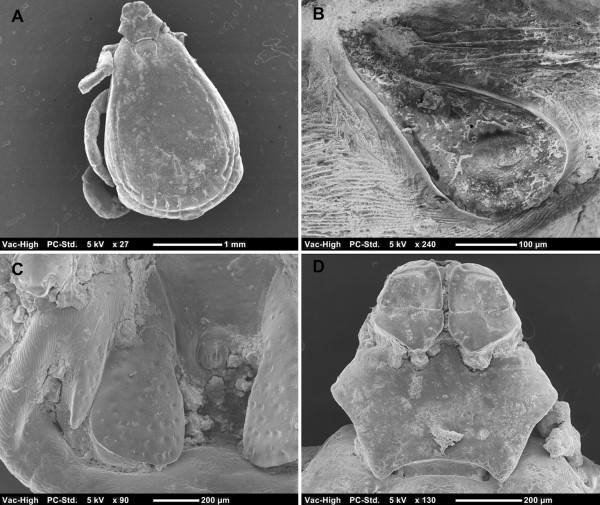
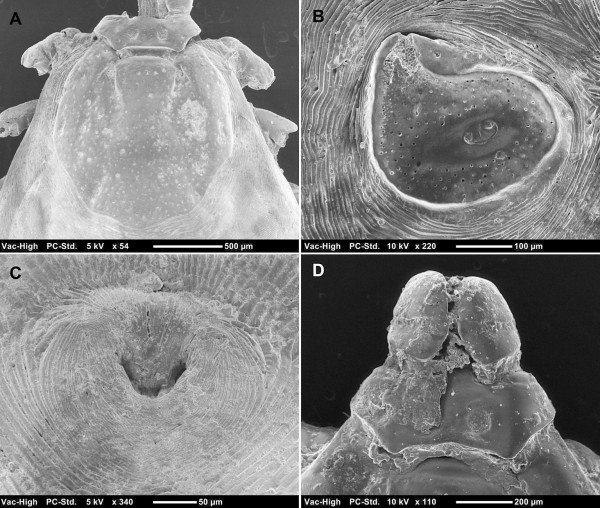
Herein, we examined morphologically tick specimens retrieved on a dog mummy from Ancient Egypt (ca. 1st century - 4th century A.D.). The dog mummy and associated ticks were found during an archaeological expedition conducted in El Deir.
Scanning electron micrographs allowed us to assess their identity as belonging to the R. sanguineus group. In addition on the basis of the scutal punctation pattern, spiracular plates, width of dorsal tail of spiracular plates relative to the adjacent festoon, female genital aperture, male adanal plates and accessory shields, these ticks were tentatively identified as Rhipicephalus sp. II (=temperate species).
It can be concluded that R. sanguineus group ticks have infested dogs living in the Mediterranean region since ancient times. This finding represents the oldest record of ticks on any animal species and adds a new piece in the complex puzzle regarding tick parasitism on dogs and humans and their role as vectors of pathogens.
属于 Rhipicephalus sanguineus 组的蜱是犬和人类最重要的致病微生物载体之一。然而,该物种组的分类仍然存在争议,尤其是因为没有 Rhipicephalus sanguineus sensu stricto 的模式标本或可靠的形态描述。最近,对来自欧洲、非洲、美洲和大洋洲的代表性蜱标本进行了全面的形态学和遗传学研究,结果表明,在以 'R. sanguineus' 命名的、寄生在来自不同国家的犬身上的蜱中,至少存在四种形态和遗传上明显不同的物种。
本文中,我们检查了在古埃及(公元 1 世纪至 4 世纪)的一只狗木乃伊身上发现的蜱标本的形态。这只狗木乃伊和相关的蜱虫是在 El Deir 进行的一次考古探险中发现的。
扫描电子显微镜照片允许我们评估它们属于 R. sanguineus 组的身份。此外,根据盾片的点状图案、气门板、气门板背面尾的宽度相对于相邻的褶皱、雌性生殖器开口、雄性肛侧板和副侧板,这些蜱虫被初步鉴定为 Rhipicephalus sp. II(=温带物种)。
可以得出结论,自古代以来,R. sanguineus 组的蜱已经寄生在生活在地中海地区的犬身上。这一发现代表了任何动物物种上的蜱的最古老记录,并为有关犬和人类的蜱寄生及其作为病原体载体的作用的复杂难题增添了新的内容。