• 文献检索
  • 文档翻译
  • 深度研究
  • 学术资讯
  • Suppr Zotero 插件Zotero 插件
  • 邀请有礼
  • 套餐&价格
  • 历史记录
应用&插件
Suppr Zotero 插件Zotero 插件浏览器插件Mac 客户端Windows 客户端微信小程序
定价
高级版会员购买积分包购买API积分包
服务
文献检索文档翻译深度研究API 文档MCP 服务
关于我们
关于 Suppr公司介绍联系我们用户协议隐私条款
关注我们

Suppr 超能文献

核心技术专利:CN118964589B侵权必究
粤ICP备2023148730 号-1Suppr @ 2026

文献检索

告别复杂PubMed语法,用中文像聊天一样搜索,搜遍4000万医学文献。AI智能推荐,让科研检索更轻松。

立即免费搜索

文件翻译

保留排版,准确专业,支持PDF/Word/PPT等文件格式,支持 12+语言互译。

免费翻译文档

深度研究

AI帮你快速写综述,25分钟生成高质量综述,智能提取关键信息,辅助科研写作。

立即免费体验

互联网监测在突发公共卫生事件防控中的重要性:来自甲型H7N9禽流感疫情期间一项数字流行病学研究的证据

Importance of Internet surveillance in public health emergency control and prevention: evidence from a digital epidemiologic study during avian influenza A H7N9 outbreaks.

作者信息

Gu Hua, Chen Bin, Zhu Honghong, Jiang Tao, Wang Xinyi, Chen Lei, Jiang Zhenggang, Zheng Dawei, Jiang Jianmin

机构信息

Zhejiang Provincial Center for Disease Control and Prevention, Hangzhou, China.

出版信息

J Med Internet Res. 2014 Jan 17;16(1):e20. doi: 10.2196/jmir.2911.

DOI:10.2196/jmir.2911
PMID:24440770
原文链接:https://pmc.ncbi.nlm.nih.gov/articles/PMC3906895/
Abstract

BACKGROUND

Outbreaks of human infection with a new avian influenza A H7N9 virus occurred in China in the spring of 2013. Control and prevention of a new human infectious disease outbreak can be strongly affected by public reaction and social impact through the Internet and social media.

OBJECTIVE

This study aimed to investigate the potential roles of Internet surveillance in control and prevention of the human H7N9 outbreaks.

METHODS

Official data for the human H7N9 outbreaks were collected via the China National Health and Family Planning Committee website from March 31 to April 24, 2013. We obtained daily posted and forwarded number of blogs for the keyword "H7N9" from Sina microblog website and a daily Baidu Attention Index (BAI) from Baidu website, which reflected public attention to the outbreak. Rumors identified and confirmed by the authorities were collected from Baidu search engine.

RESULTS

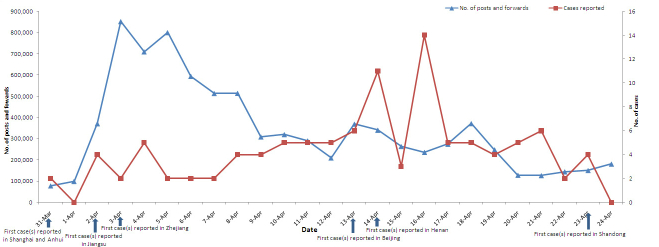
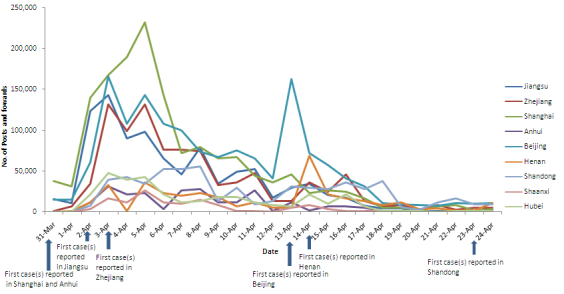
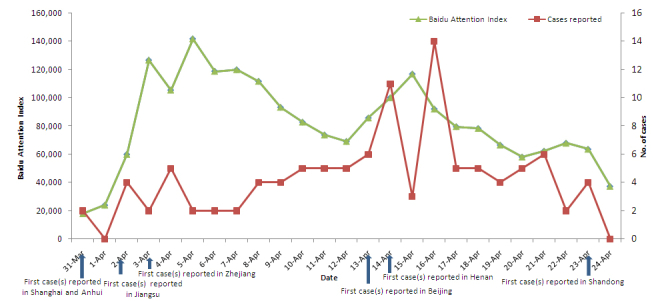
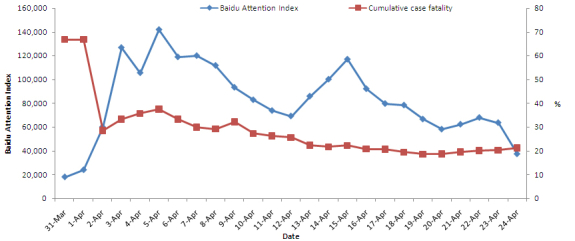
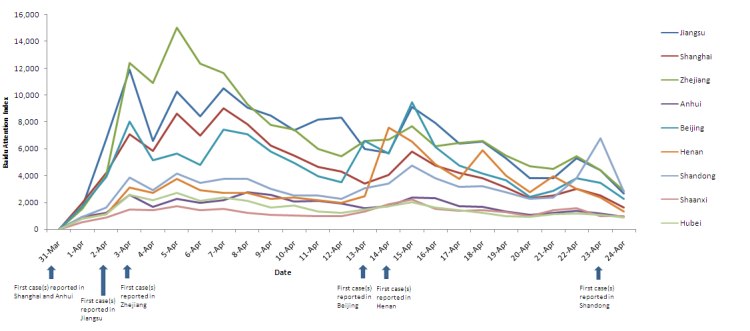
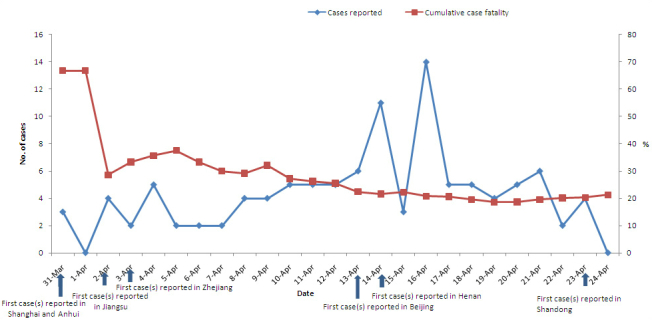
Both daily posted and forwarded number and BAI for keyword H7N9 increased quickly during the first 3 days of the outbreaks and remained at a high level for 5 days. The total daily posted and forwarded number for H7N9 on Sina microblog peaked at 850,000 on April 3, from zero blogs before March 31, increasing to 97,726 on April 1 and to 370,607 on April 2, and remaining above 500,000 from April 5-8 before declining to 208,524 on April 12. The total daily BAI showed a similar pattern of change to the total daily posted and forwarded number over time from March 31 to April 12. When the outbreak locations spread, especially into other areas of the same province/city and the capital, Beijing, daily posted and forwarded number and BAI increased again to a peak at 368,500 and 116,911, respectively. The median daily BAI during the studied 25 days was significantly higher among the 7 provinces/cities with reported human H7N9 cases than the 2 provinces without any cases (P<.001). So were the median daily posted and forwarded number and daily BAI in each province/city except Anhui province. We retrieved a total of 32 confirmed rumors spread across 19 provinces/cities in China. In all, 84% (27/32) of rumors were disseminated and transmitted by social media.

CONCLUSIONS

The first 3 days of an epidemic is a critical period for the authorities to take appropriate action through Internet surveillance to prevent and control the epidemic, including preparation of personnel, technology, and other resources; information release; collection of public opinion and reaction; and clarification, prevention, and control of rumors. Internet surveillance can be used as an efficient and economical tool to prevent and control public health emergencies, such as H7N9 outbreaks.

摘要

背景

2013年春季中国出现了人感染新型甲型H7N9禽流感病毒疫情。新型人类传染病疫情的防控会受到公众通过互联网和社交媒体做出的反应及产生的社会影响的强烈影响。

目的

本研究旨在探讨互联网监测在人感染H7N9禽流感疫情防控中的潜在作用。

方法

通过中国国家卫生和计划生育委员会网站收集2013年3月31日至4月24日人感染H7N9禽流感疫情的官方数据。我们从新浪微博网站获取了关键词“H7N9”每日发布和转发的博客数量,以及从百度网站获取了每日百度关注度指数(BAI),该指数反映了公众对疫情的关注。从百度搜索引擎收集经官方确认的谣言。

结果

疫情爆发的前3天,关键词H7N9的每日发布和转发数量以及BAI均迅速增加,并在5天内保持在较高水平。新浪微博上H7N9每日发布和转发的总数在4月3日达到峰值85万条,3月31日前为零博客,4月1日增至97726条,4月2日增至370607条,4月5日至8日保持在50万条以上,4月12日降至208524条。从3月31日至4月12日,每日百度关注度指数的总体变化趋势与每日发布和转发总数相似。当疫情爆发地点扩散,特别是扩散到同一省/市的其他地区以及首都北京时,每日发布和转发数量以及BAI再次上升至峰值,分别为368500条和116911。在报告有人感染H7N9病例的7个省/市中,研究的25天内每日百度关注度指数中位数显著高于无病例的2个省(P<0.001)。除安徽省外,每个省/市的每日发布和转发中位数以及每日百度关注度指数中位数也是如此。我们共检索到在中国19个省/市传播的32条经确认的谣言。其中,84%(27/32)的谣言是通过社交媒体传播的。

结论

疫情爆发的前3天是当局通过互联网监测采取适当行动防控疫情的关键时期,包括人员、技术和其他资源的准备;信息发布;收集公众意见和反应;以及澄清、预防和控制谣言。互联网监测可作为防控公共卫生突发事件(如H7N9疫情)的一种高效且经济的工具。
https://cdn.ncbi.nlm.nih.gov/pmc/blobs/3b2a/3906895/d8e61a4c6654/jmir_v16i1e20_fig8.jpg
https://cdn.ncbi.nlm.nih.gov/pmc/blobs/3b2a/3906895/1f90bd4a9600/jmir_v16i1e20_fig1.jpg
https://cdn.ncbi.nlm.nih.gov/pmc/blobs/3b2a/3906895/9ad9691187ba/jmir_v16i1e20_fig2.jpg
https://cdn.ncbi.nlm.nih.gov/pmc/blobs/3b2a/3906895/af6b49f5bb5b/jmir_v16i1e20_fig3.jpg
https://cdn.ncbi.nlm.nih.gov/pmc/blobs/3b2a/3906895/56b8308aad7e/jmir_v16i1e20_fig4.jpg
https://cdn.ncbi.nlm.nih.gov/pmc/blobs/3b2a/3906895/800eaa0072f1/jmir_v16i1e20_fig5.jpg
https://cdn.ncbi.nlm.nih.gov/pmc/blobs/3b2a/3906895/c510a8c07301/jmir_v16i1e20_fig6.jpg
https://cdn.ncbi.nlm.nih.gov/pmc/blobs/3b2a/3906895/0c84c4085fc2/jmir_v16i1e20_fig7.jpg
https://cdn.ncbi.nlm.nih.gov/pmc/blobs/3b2a/3906895/d8e61a4c6654/jmir_v16i1e20_fig8.jpg
https://cdn.ncbi.nlm.nih.gov/pmc/blobs/3b2a/3906895/1f90bd4a9600/jmir_v16i1e20_fig1.jpg
https://cdn.ncbi.nlm.nih.gov/pmc/blobs/3b2a/3906895/9ad9691187ba/jmir_v16i1e20_fig2.jpg
https://cdn.ncbi.nlm.nih.gov/pmc/blobs/3b2a/3906895/af6b49f5bb5b/jmir_v16i1e20_fig3.jpg
https://cdn.ncbi.nlm.nih.gov/pmc/blobs/3b2a/3906895/56b8308aad7e/jmir_v16i1e20_fig4.jpg
https://cdn.ncbi.nlm.nih.gov/pmc/blobs/3b2a/3906895/800eaa0072f1/jmir_v16i1e20_fig5.jpg
https://cdn.ncbi.nlm.nih.gov/pmc/blobs/3b2a/3906895/c510a8c07301/jmir_v16i1e20_fig6.jpg
https://cdn.ncbi.nlm.nih.gov/pmc/blobs/3b2a/3906895/0c84c4085fc2/jmir_v16i1e20_fig7.jpg
https://cdn.ncbi.nlm.nih.gov/pmc/blobs/3b2a/3906895/d8e61a4c6654/jmir_v16i1e20_fig8.jpg

相似文献

1
Importance of Internet surveillance in public health emergency control and prevention: evidence from a digital epidemiologic study during avian influenza A H7N9 outbreaks.互联网监测在突发公共卫生事件防控中的重要性:来自甲型H7N9禽流感疫情期间一项数字流行病学研究的证据
J Med Internet Res. 2014 Jan 17;16(1):e20. doi: 10.2196/jmir.2911.
2
Correlation between reported human infection with avian influenza A H7N9 virus and cyber user awareness: what can we learn from digital epidemiology?报告的人类感染甲型H7N9禽流感病毒与网络用户认知之间的相关性:我们能从数字流行病学中学到什么?
Int J Infect Dis. 2014 May;22:1-3. doi: 10.1016/j.ijid.2013.11.013. Epub 2014 Feb 25.
3
Assessing cyber-user awareness of an emerging infectious disease: evidence from human infections with avian influenza A H7N9 in Zhejiang, China.评估网络用户对新发传染病的认知:来自中国浙江人感染甲型H7N9禽流感的证据。
Int J Infect Dis. 2015 Nov;40:34-6. doi: 10.1016/j.ijid.2015.09.017. Epub 2015 Sep 30.
4
Avian Influenza A (H7N9) and related Internet search query data in China.中国的甲型 H7N9 禽流感及相关网络搜索查询数据。
Sci Rep. 2019 Jul 18;9(1):10434. doi: 10.1038/s41598-019-46898-y.
5
Genesis and Spread of Newly Emerged Highly Pathogenic H7N9 Avian Viruses in Mainland China.中国大陆新出现的高致病性H7N9禽流感病毒的起源与传播
J Virol. 2017 Nov 14;91(23). doi: 10.1128/JVI.01277-17. Print 2017 Dec 1.
6
Surveillance of Avian H7N9 Virus in Various Environments of Zhejiang Province, China before and after Live Poultry Markets Were Closed in 2013-2014.2013 - 2014年活禽市场关闭前后中国浙江省不同环境中H7N9禽流感病毒的监测
PLoS One. 2015 Aug 26;10(8):e0135718. doi: 10.1371/journal.pone.0135718. eCollection 2015.
7
An internet-based epidemiological investigation of the outbreak of H7N9 Avian influenza A in China since early 2013.自2013年初以来中国H7N9甲型禽流感疫情的基于互联网的流行病学调查。
J Med Internet Res. 2014 Sep 25;16(9):e221. doi: 10.2196/jmir.3763.
8
Effect of closure of live poultry markets on poultry-to-person transmission of avian influenza A H7N9 virus: an ecological study.活禽市场关闭对人感染甲型 H7N9 禽流感病毒的禽类传播影响:一项生态学研究。
Lancet. 2014 Feb 8;383(9916):541-8. doi: 10.1016/S0140-6736(13)61904-2. Epub 2013 Oct 31.
9
Transmission potential of influenza A/H7N9, February to May 2013, China.2013 年 2 月至 5 月期间中国甲型 H7N9 流感的传播潜力。
BMC Med. 2013 Oct 2;11:214. doi: 10.1186/1741-7015-11-214.
10
Human infection with avian influenza A(H7N9) virus re-emerges in China in winter 2013.人感染甲型流感病毒 H7N9 病毒在中国冬季再次出现 2013 年。
Euro Surveill. 2013 Oct 24;18(43):20616. doi: 10.2807/1560-7917.es2013.18.43.20616.

引用本文的文献

1
Measuring the burden of infodemics with a research toolkit for connecting information exposure, trust, and health behaviours.使用一个用于连接信息暴露、信任和健康行为的研究工具包来衡量信息疫情的负担。
Arch Public Health. 2023 Jun 5;81(1):102. doi: 10.1186/s13690-023-01101-7.
2
An exploratory study to understand how people use Twitter to share experiences or information about spinal stenosis.一项探索性研究,旨在了解人们如何使用 Twitter 分享关于椎管狭窄的经验或信息。
Chiropr Man Therap. 2022 Dec 28;30(1):61. doi: 10.1186/s12998-022-00465-x.
3
Quantifying Media Effects, Its Content, and Role in Promoting Community Awareness of Chikungunya Epidemic in Bangladesh.

本文引用的文献

1
Influenza A (H7N9) and the importance of digital epidemiology.甲型H7N9流感与数字流行病学的重要性
N Engl J Med. 2013 Aug 1;369(5):401-4. doi: 10.1056/NEJMp1307752. Epub 2013 Jul 3.
2
Emerging risk of H7N9 influenza in China.中国H7N9流感的新出现风险。
Lancet. 2013 May 4;381(9877):1539-40. doi: 10.1016/S0140-6736(13)60767-9. Epub 2013 Apr 19.
3
Human infection with a novel avian-origin influenza A (H7N9) virus.人感染新型甲型 H7N9 流感病毒。
量化媒体效应、其内容以及在提高孟加拉国社区对基孔肯雅热疫情认识方面的作用。
Epidemiologia (Basel). 2021 Mar 5;2(1):84-94. doi: 10.3390/epidemiologia2010008.
4
Effects of information sources on public preventive behaviors in health emergencies: Evidence from a digital epidemiologic study during the COVID-19 pandemic.信息来源对突发公共卫生事件中公众预防行为的影响:来自 COVID-19 大流行期间数字流行病学研究的证据。
Front Public Health. 2022 Oct 14;10:981649. doi: 10.3389/fpubh.2022.981649. eCollection 2022.
5
How Portuguese Health Entities Used Social Media to Face the Public Health Emergency during COVID-19 Disease.葡萄牙卫生实体如何利用社交媒体应对 COVID-19 疾病期间的公共卫生紧急情况。
Int J Environ Res Public Health. 2022 Sep 21;19(19):11942. doi: 10.3390/ijerph191911942.
6
Microblog data analysis of emotional reactions to COVID-19 in China.微博客数据在中国对 COVID-19 情绪反应的分析。
J Psychosom Res. 2022 Oct;161:110976. doi: 10.1016/j.jpsychores.2022.110976. Epub 2022 Jun 30.
7
Improving the Communication and Credibility of Government Media in Response to Public Health Emergencies: Analysis of Tweets From the WeChat Official Accounts of 10 Chinese Health Commissioners.提高政府媒体应对突发公共卫生事件的沟通和公信力:对 10 位中国卫生局长微信公众号推文的分析。
Front Public Health. 2022 Jul 22;10:900776. doi: 10.3389/fpubh.2022.900776. eCollection 2022.
8
How Italy Tweeted about COVID-19: Detecting Reactions to the Pandemic from Social Media.意大利如何在推特上发布有关 COVID-19 的信息:从社交媒体上检测对大流行病的反应。
Int J Environ Res Public Health. 2022 Jun 24;19(13):7785. doi: 10.3390/ijerph19137785.
9
Digital Marketing: A Unique Multidisciplinary Approach towards the Elimination of Viral Hepatitis.数字营销:一种消除病毒性肝炎的独特多学科方法。
Pathogens. 2022 May 29;11(6):626. doi: 10.3390/pathogens11060626.
10
Public Social Media Discussions on Agricultural Product Safety Incidents: Chinese African Swine Fever Debate on Weibo.关于农产品安全事件的公共社交媒体讨论:微博上的中国非洲猪瘟辩论
Front Psychol. 2022 May 20;13:903760. doi: 10.3389/fpsyg.2022.903760. eCollection 2022.
N Engl J Med. 2013 May 16;368(20):1888-97. doi: 10.1056/NEJMoa1304459. Epub 2013 Apr 11.
4
Integrating social media into emergency-preparedness efforts.将社交媒体融入应急准备工作。
N Engl J Med. 2011 Jul 28;365(4):289-91. doi: 10.1056/NEJMp1103591.
5
The rumouring of SARS during the 2003 epidemic in China.中国 2003 年“非典”疫情期间的谣言传播。
Sociol Health Illn. 2011 Jul;33(5):677-93. doi: 10.1111/j.1467-9566.2011.01329.x. Epub 2011 May 18.
6
The use of Twitter to track levels of disease activity and public concern in the U.S. during the influenza A H1N1 pandemic.利用 Twitter 追踪美国甲型 H1N1 流感大流行期间的疾病活动和公众关注水平。
PLoS One. 2011 May 4;6(5):e19467. doi: 10.1371/journal.pone.0019467.
7
What the public was saying about the H1N1 vaccine: perceptions and issues discussed in on-line comments during the 2009 H1N1 pandemic.公众对 H1N1 疫苗的看法:2009 年 H1N1 大流行期间在线评论中讨论的看法和问题。
PLoS One. 2011 Apr 18;6(4):e18479. doi: 10.1371/journal.pone.0018479.
8
Infodemiology and infoveillance tracking online health information and cyberbehavior for public health.信息流行病学与信息监测:追踪在线健康信息及网络行为以促进公共卫生
Am J Prev Med. 2011 May;40(5 Suppl 2):S154-8. doi: 10.1016/j.amepre.2011.02.006.
9
Perceived risk, anxiety, and behavioural responses of the general public during the early phase of the Influenza A (H1N1) pandemic in the Netherlands: results of three consecutive online surveys.公众对甲型 H1N1 流感大流行早期的感知风险、焦虑和行为反应:荷兰三项连续在线调查的结果。
BMC Public Health. 2011 Jan 3;11:2. doi: 10.1186/1471-2458-11-2.
10
Pandemics in the age of Twitter: content analysis of Tweets during the 2009 H1N1 outbreak.推特时代的大流行疫情:2009 年 H1N1 爆发期间推文的内容分析。
PLoS One. 2010 Nov 29;5(11):e14118. doi: 10.1371/journal.pone.0014118.