Counts Scott E, Alldred Melissa J, Che Shaoli, Ginsberg Stephen D, Mufson Elliott J
Department of Neurological Sciences, Rush University Medical Center, Chicago, IL, USA.
Center for Dementia Research, Nathan Kline Institute, New York University School of Medicine, Orangeburg, NY, USA; Department of Psychiatry, New York University School of Medicine, Orangeburg, NY, USA.
Neuropharmacology. 2014 Apr;79:172-9. doi: 10.1016/j.neuropharm.2013.10.018. Epub 2013 Oct 25.
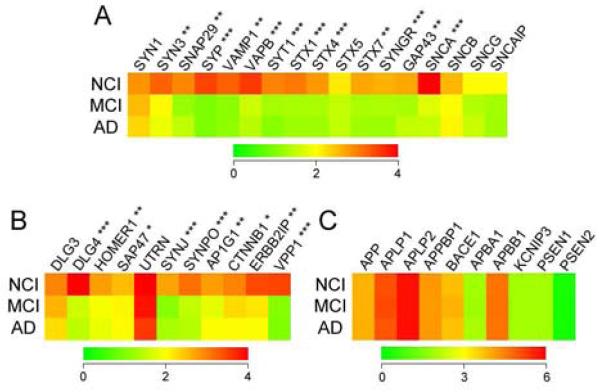
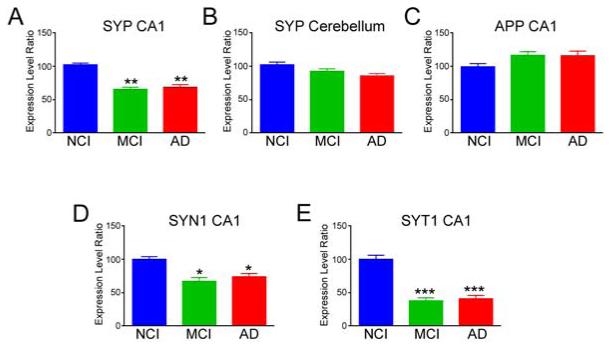
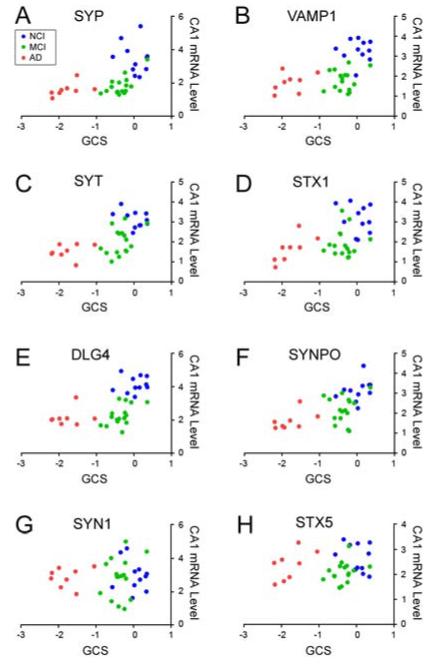
Clinical neuropathologic studies suggest that the selective vulnerability of hippocampal CA1 pyramidal projection neurons plays a key role in the onset of cognitive impairment during the early phases of Alzheimer's disease (AD). Disruption of this neuronal population likely affects hippocampal pre- and postsynaptic efficacy underlying episodic memory circuits. Therefore, identifying perturbations in the expression of synaptic gene products within CA1 neurons prior to frank AD is crucial for the development of disease modifying therapies. Here we used custom-designed microarrays to examine progressive alterations in synaptic gene expression within CA1 neurons in cases harvested from the Rush Religious Orders Study who died with a clinical diagnosis of no cognitive impairment (NCI), mild cognitive impairment (MCI, a putative prodromal AD stage), or mild/moderate AD. Quantitative analysis revealed that 21 out of 28 different transcripts encoding regulators of synaptic function were significantly downregulated (1.4-1.8 fold) in CA1 neurons in MCI and AD compared to NCI, whereas synaptic transcript levels were not significantly different between MCI and AD. The downregulated transcripts encoded regulators of presynaptic vesicle trafficking, including synaptophysin and synaptogyrin, regulators of vesicle docking and fusion/release, such as synaptotagmin and syntaxin 1, and regulators of glutamatergic postsynaptic function, including PSD-95 and synaptopodin. Clinical pathologic correlation analysis revealed that downregulation of these synaptic markers was strongly associated with poorer antemortem cognitive status and postmortem AD pathological criteria such as Braak stage, NIA-Reagan, and CERAD diagnosis. In contrast to the widespread loss of synaptic gene expression observed in CA1 neurons in MCI, transcripts encoding β-amyloid precursor protein (APP), APP family members, and regulators of APP metabolism were not differentially regulated in CA1 neurons across the clinical diagnostic groups. Taken together, these data suggest that CA1 synaptic gene dysregulation occurs early in the cascade of pathogenic molecular events prior to the onset of AD, which may form the basis for novel pharmacological treatment approaches for this dementing disorder. This article is part of a Special Issue entitled 'Neurodegenerative Disorders'.
临床神经病理学研究表明,海马CA1锥体投射神经元的选择性易损性在阿尔茨海默病(AD)早期认知障碍的发生中起关键作用。这一神经元群体的破坏可能会影响情景记忆回路中潜在的海马突触前和突触后效能。因此,在明显的AD出现之前,识别CA1神经元内突触基因产物表达的扰动对于开发疾病修饰疗法至关重要。在这里,我们使用定制设计的微阵列来检查从拉什宗教团体研究中收集的病例中CA1神经元内突触基因表达的渐进性变化,这些病例的临床诊断为无认知障碍(NCI)、轻度认知障碍(MCI,一个假定的AD前驱阶段)或轻度/中度AD。定量分析显示,与NCI相比,在MCI和AD的CA1神经元中,28种不同的编码突触功能调节因子的转录本中有21种显著下调(1.4 - 1.8倍),而MCI和AD之间的突触转录本水平没有显著差异。下调的转录本编码突触前囊泡运输的调节因子,包括突触素和突触旋转蛋白,囊泡对接和融合/释放的调节因子,如突触结合蛋白和 syntaxin 1,以及谷氨酸能突触后功能的调节因子,包括PSD - 95和突触足蛋白。临床病理相关性分析显示,这些突触标记物的下调与生前较差的认知状态以及死后AD病理标准如Braak分期、NIA - Reagan和CERAD诊断密切相关。与MCI中CA1神经元中观察到的突触基因表达广泛丧失相反,编码β - 淀粉样前体蛋白(APP)、APP家族成员和APP代谢调节因子的转录本在临床诊断组的CA1神经元中没有差异调节。综上所述,这些数据表明,CA1突触基因失调发生在AD发病前致病分子事件级联反应的早期,这可能为这种痴呆症的新型药物治疗方法奠定基础。本文是名为“神经退行性疾病”的特刊的一部分。