Grinde Maria T, Skrbo Nirma, Moestue Siver A, Rødland Einar A, Borgan Eldrid, Kristian Alexandr, Sitter Beathe, Bathen Tone F, Børresen-Dale Anne-Lise, Mælandsmo Gunhild M, Engebraaten Olav, Sørlie Therese, Marangoni Elisabetta, Gribbestad Ingrid S
Breast Cancer Res. 2014 Jan 21;16(1):R5. doi: 10.1186/bcr3597.
Dysregulated choline metabolism is a well-known feature of breast cancer, but the underlying mechanisms are not fully understood. In this study, the metabolomic and transcriptomic characteristics of a large panel of human breast cancer xenograft models were mapped, with focus on choline metabolism.
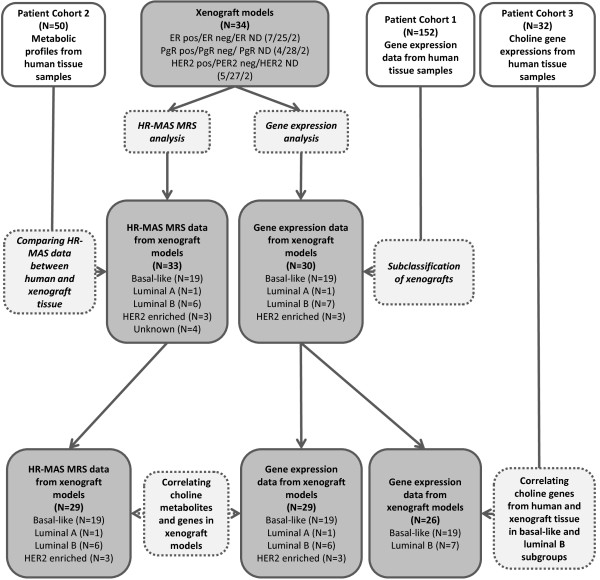
Tumor specimens from 34 patient-derived xenograft models were collected and divided in two. One part was examined using high-resolution magic angle spinning (HR-MAS) MR spectroscopy while another part was analyzed using gene expression microarrays. Expression data of genes encoding proteins in the choline metabolism pathway were analyzed and correlated to the levels of choline (Cho), phosphocholine (PCho) and glycerophosphocholine (GPC) using Pearson's correlation analysis. For comparison purposes, metabolic and gene expression data were collected from human breast tumors belonging to corresponding molecular subgroups.
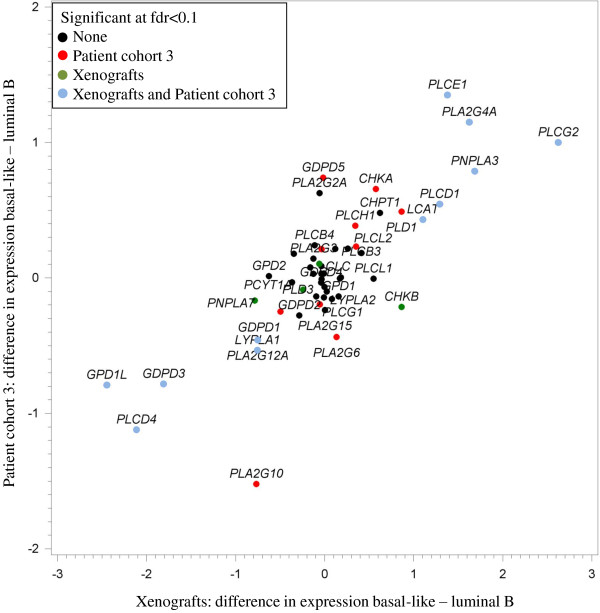
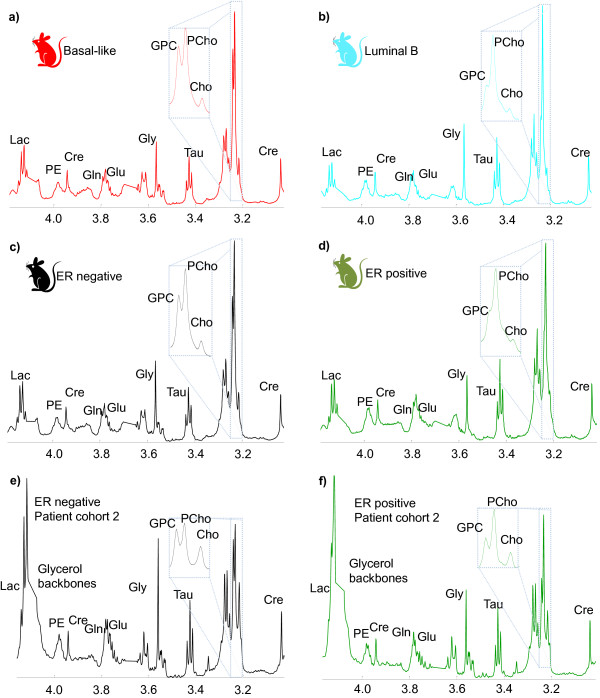
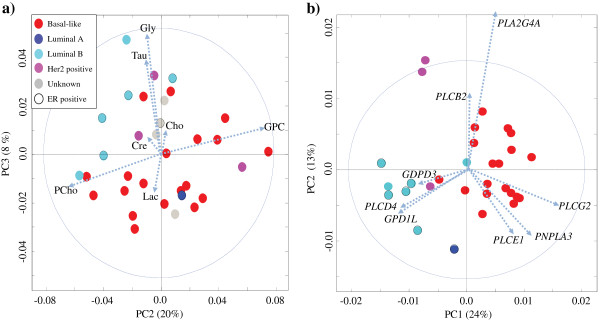
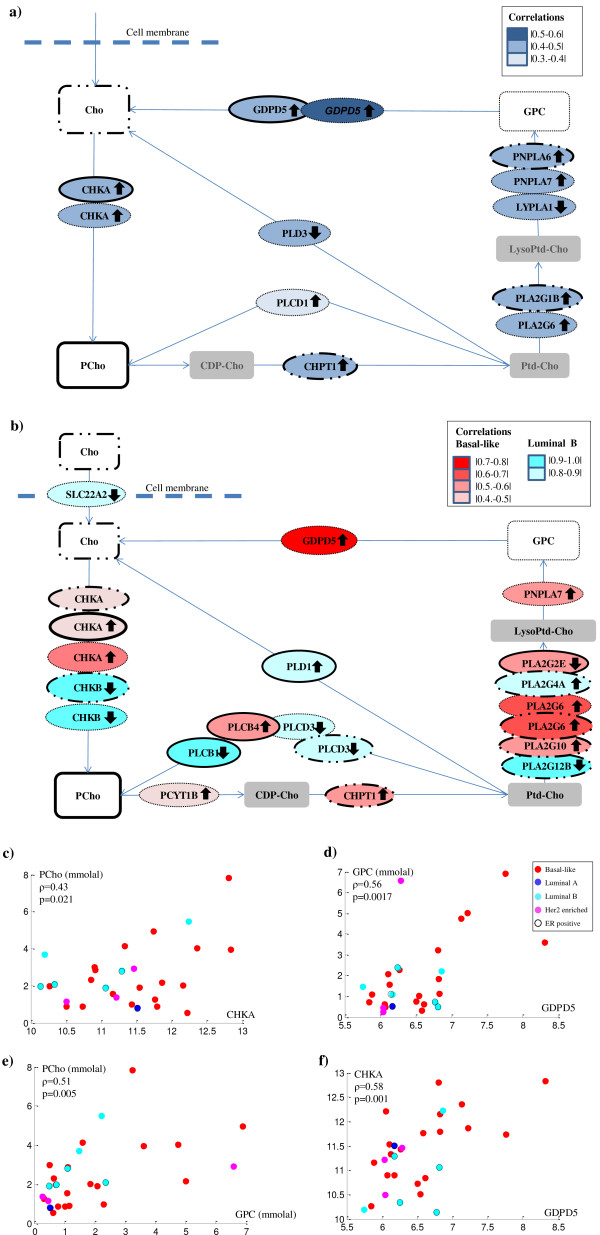
Most of the xenograft models were classified as basal-like (N = 19) or luminal B (N = 7). These two subgroups showed significantly different choline metabolic and gene expression profiles. The luminal B xenografts were characterized by a high PCho/GPC ratio while the basal-like xenografts were characterized by highly variable PCho/GPC ratio. Also, Cho, PCho and GPC levels were correlated to expression of several genes encoding proteins in the choline metabolism pathway, including choline kinase alpha (CHKA) and glycerophosphodiester phosphodiesterase domain containing 5 (GDPD5). These characteristics were similar to those found in human tumor samples.
The higher PCho/GPC ratio found in luminal B compared with most basal-like breast cancer xenograft models and human tissue samples do not correspond to results observed from in vitro studies. It is likely that microenvironmental factors play a role in the in vivo regulation of choline metabolism. Cho, PCho and GPC were correlated to different choline pathway-encoding genes in luminal B compared with basal-like xenografts, suggesting that regulation of choline metabolism may vary between different breast cancer subgroups. The concordance between the metabolic and gene expression profiles from xenograft models with breast cancer tissue samples from patients indicates that these xenografts are representative models of human breast cancer and represent relevant models to study tumor metabolism in vivo.
胆碱代谢失调是乳腺癌的一个众所周知的特征,但其潜在机制尚未完全明确。在本研究中,我们绘制了大量人乳腺癌异种移植模型的代谢组学和转录组学特征,重点关注胆碱代谢。
收集了34个患者来源的异种移植模型的肿瘤标本,并将其分为两部分。一部分使用高分辨率魔角旋转(HR-MAS)磁共振波谱进行检测,另一部分使用基因表达微阵列进行分析。使用Pearson相关分析对胆碱代谢途径中编码蛋白质的基因的表达数据进行分析,并与胆碱(Cho)、磷酸胆碱(PCho)和甘油磷酸胆碱(GPC)的水平进行相关性分析。为了进行比较,从属于相应分子亚组的人乳腺肿瘤中收集代谢和基因表达数据。
大多数异种移植模型被分类为基底样(N = 19)或腔面B型(N = 7)。这两个亚组显示出显著不同的胆碱代谢和基因表达谱。腔面B型异种移植的特征是PCho/GPC比值高,而基底样异种移植的特征是PCho/GPC比值高度可变。此外,Cho、PCho和GPC水平与胆碱代谢途径中几个编码蛋白质的基因的表达相关,包括胆碱激酶α(CHKA)和含甘油磷酸二酯磷酸二酯酶结构域5(GDPD5)。这些特征与在人类肿瘤样本中发现的特征相似。
与大多数基底样乳腺癌异种移植模型和人类组织样本相比,腔面B型中发现的较高PCho/GPC比值与体外研究结果不符。微环境因素可能在胆碱代谢的体内调节中起作用。与基底样异种移植相比,腔面B型中Cho、PCho和GPC与不同的胆碱途径编码基因相关,这表明不同乳腺癌亚组之间胆碱代谢的调节可能有所不同。异种移植模型的代谢和基因表达谱与患者乳腺癌组织样本之间的一致性表明,这些异种移植是人类乳腺癌的代表性模型,是研究体内肿瘤代谢的相关模型。