Diuk-Wasser Maria A, Liu Yuchen, Steeves Tanner K, Folsom-O'Keefe Corrine, Dardick Kenneth R, Lepore Timothy, Bent Stephen J, Usmani-Brown Sahar, Telford Sam R, Fish Durland, Krause Peter J
Emerg Infect Dis. 2014 Feb;20(2):225-31. doi: 10.3201/eid2002.130644.
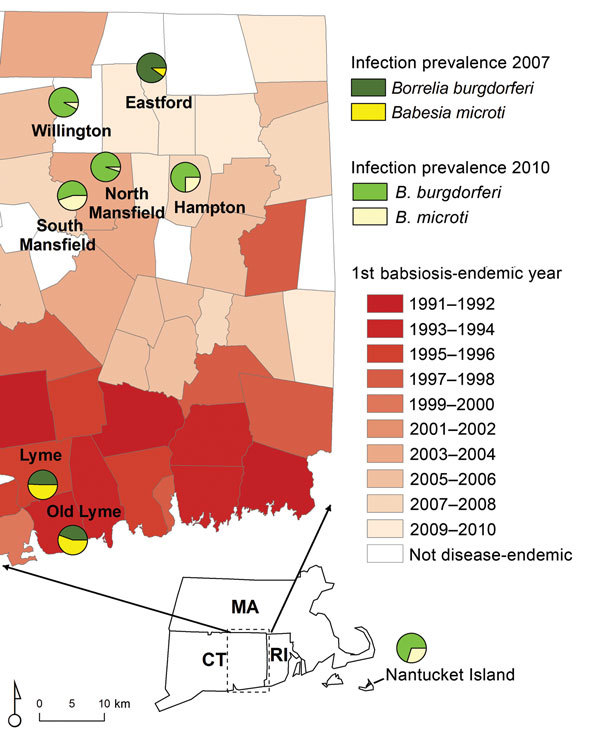
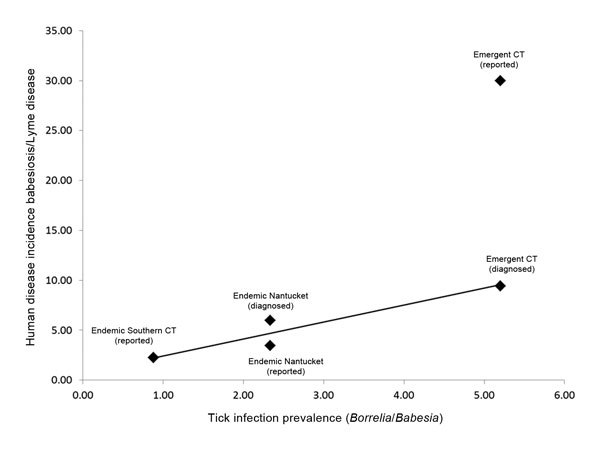
Human babesiosis is an emerging tick-borne disease caused by the intraerythrocytic protozoan Babesia microti. Its geographic distribution is more limited than that of Lyme disease, despite sharing the same tick vector and reservoir hosts. The geographic range of babesiosis is expanding, but knowledge of its range is incomplete and relies exclusively on reports of human cases. We evaluated the utility of tick-based surveillance for monitoring disease expansion by comparing the ratios of the 2 infections in humans and ticks in areas with varying B. microti endemicity. We found a close association between human disease and tick infection ratios in long-established babesiosis-endemic areas but a lower than expected incidence of human babesiosis on the basis of tick infection rates in new disease-endemic areas. This finding suggests that babesiosis at emerging sites is underreported. Vector-based surveillance can provide an early warning system for the emergence of human babesiosis.
人巴贝斯虫病是一种由红细胞内原生动物微小巴贝斯虫引起的新出现的蜱传疾病。尽管与莱姆病共享相同的蜱传播媒介和储存宿主,但其地理分布比莱姆病更有限。巴贝斯虫病的地理范围正在扩大,但对其范围的了解并不完整,且完全依赖于人类病例报告。我们通过比较不同微小巴贝斯虫流行程度地区人类和蜱中这两种感染的比例,评估了基于蜱的监测在监测疾病扩展方面的效用。我们发现在长期存在巴贝斯虫病的流行地区,人类疾病与蜱感染率之间存在密切关联,但在新的疾病流行地区,基于蜱感染率的人类巴贝斯虫病发病率低于预期。这一发现表明,新出现地区的巴贝斯虫病报告不足。基于媒介的监测可为人类巴贝斯虫病的出现提供早期预警系统。