Lachaine Jean, Beauchemin Catherine, Mathurin Karine, Gilbert Dominique, Beillat Maud
Faculty of Pharmacy, University of Montreal, Station Centre-ville, PO Box 6128, H3C 3 J7 Montreal, Quebec, Canada.
BMC Psychiatry. 2014 Jan 22;14:16. doi: 10.1186/1471-244X-14-16.
Bipolar disorder (BPD) is prevalent and is associated with a significant economic burden. Asenapine, the first tetracyclic antipsychotic approved in Canada for the treatment of BPD, has shown a comparable efficacy profile to other atypical antipsychotics. In addition, it is associated with a favourable metabolic profile and minimal weight gain potential. This study aimed to assess the economic impact of asenapine compared to olanzapine in the treatment of BPD in Canada.
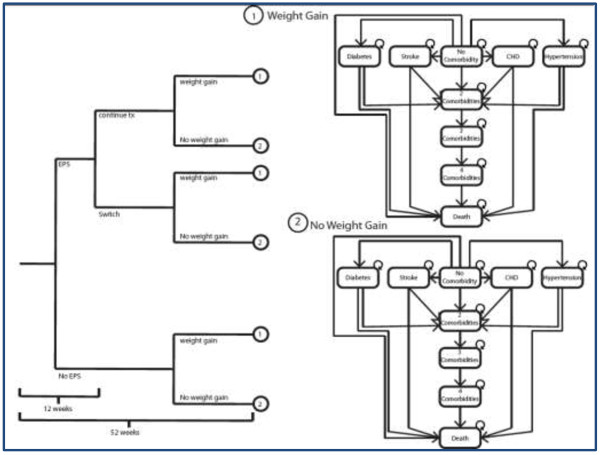
A decision tree combined with a Markov model was constructed to assess the cost-utility of asenapine compared with olanzapine. The decision tree takes into account the occurrence of extrapyramidal symptoms (EPS), the probability of switching to a different antipsychotic, and the probability of gaining weight. The Markov model takes into account long-term metabolic complications including diabetes, hypertension, coronary heart diseases (CHDs), and stroke. Analyses were conducted from both a Canadian Ministry of Health (MoH) and a societal perspective over a five-year time horizon with yearly cycles.
In the treatment of BPD, asenapine is a dominant strategy over olanzapine from both a MoH and a societal perspective. In fact, asenapine is associated with lower costs and more quality-adjusted life years (QALYs). Results of the probabilistic sensitivity analysis indicated that asenapine remains a dominant strategy in 99.2% of the simulations, in both a MoH and a societal perspective, and this result is robust to the many deterministic sensitivity analyses performed.
This economic evaluation demonstrates that asenapine is a cost-effective strategy compared to olanzapine in the treatment of BPD in Canada.
双相情感障碍(BPD)很常见,且会带来巨大的经济负担。阿立哌唑是加拿大首个获批用于治疗双相情感障碍的四环类抗精神病药物,其疗效与其他非典型抗精神病药物相当。此外,它具有良好的代谢特征,体重增加的可能性极小。本研究旨在评估在加拿大治疗双相情感障碍时,阿立哌唑与奥氮平相比的经济影响。
构建了一个结合决策树和马尔可夫模型的方法,以评估阿立哌唑与奥氮平相比的成本效益。决策树考虑了锥体外系症状(EPS)的发生、换用其他抗精神病药物的概率以及体重增加的概率。马尔可夫模型考虑了包括糖尿病、高血压、冠心病(CHD)和中风在内的长期代谢并发症。从加拿大卫生部(MoH)和社会角度进行分析,时间跨度为五年,每年为一个周期。
在治疗双相情感障碍方面,从加拿大卫生部和社会角度来看,阿立哌唑都是优于奥氮平的主要策略。事实上,阿立哌唑成本更低,质量调整生命年(QALY)更多。概率敏感性分析结果表明,从加拿大卫生部和社会角度来看,在99.2%的模拟中,阿立哌唑仍然是主要策略,并且该结果对所进行的许多确定性敏感性分析具有稳健性。
这项经济评估表明,在加拿大治疗双相情感障碍时,与奥氮平相比,阿立哌唑是一种具有成本效益的策略。