Warr Nick, Siggers Pam, Carré Gwenn-Aël, Bogani Debora, Brixey Rachel, Akiyoshi Mika, Tachibana Makoto, Teboul Lydia, Wells Sara, Sanderson Jeremy, Greenfield Andy
Mammalian Genetics Unit and.
Hum Mol Genet. 2014 Jun 1;23(11):3035-44. doi: 10.1093/hmg/ddu020. Epub 2014 Jan 22.
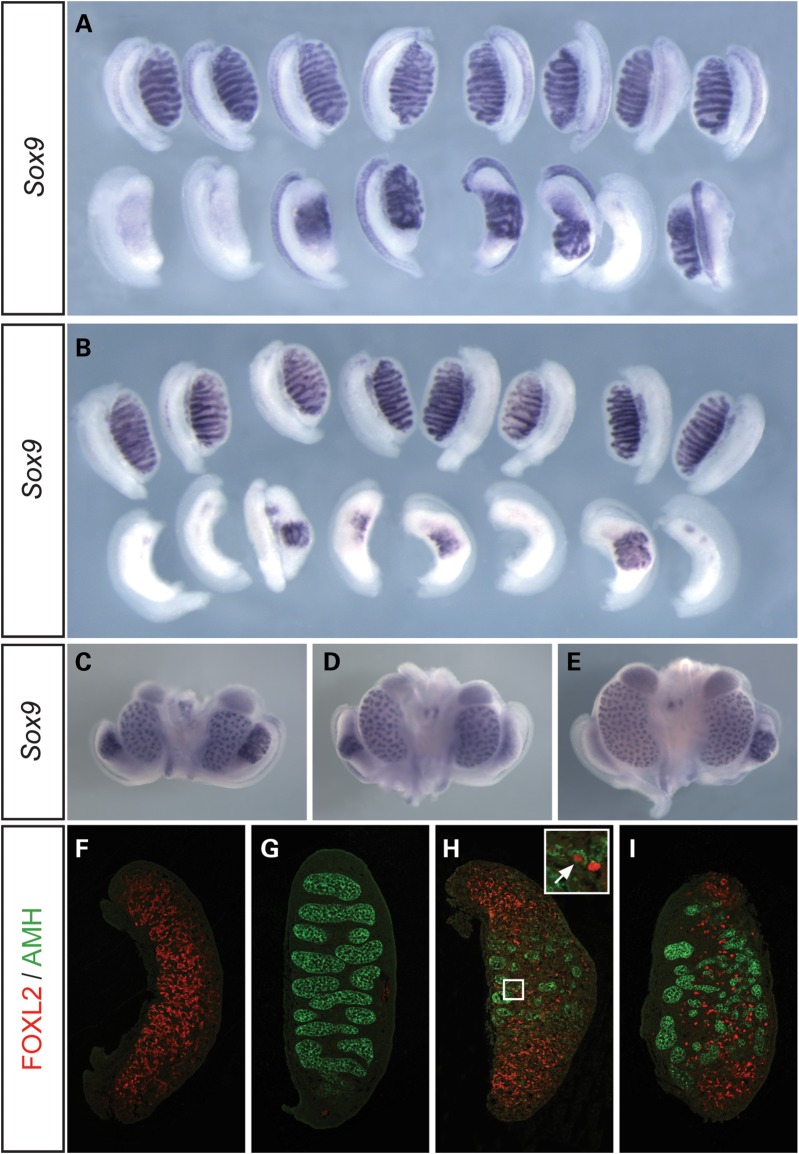
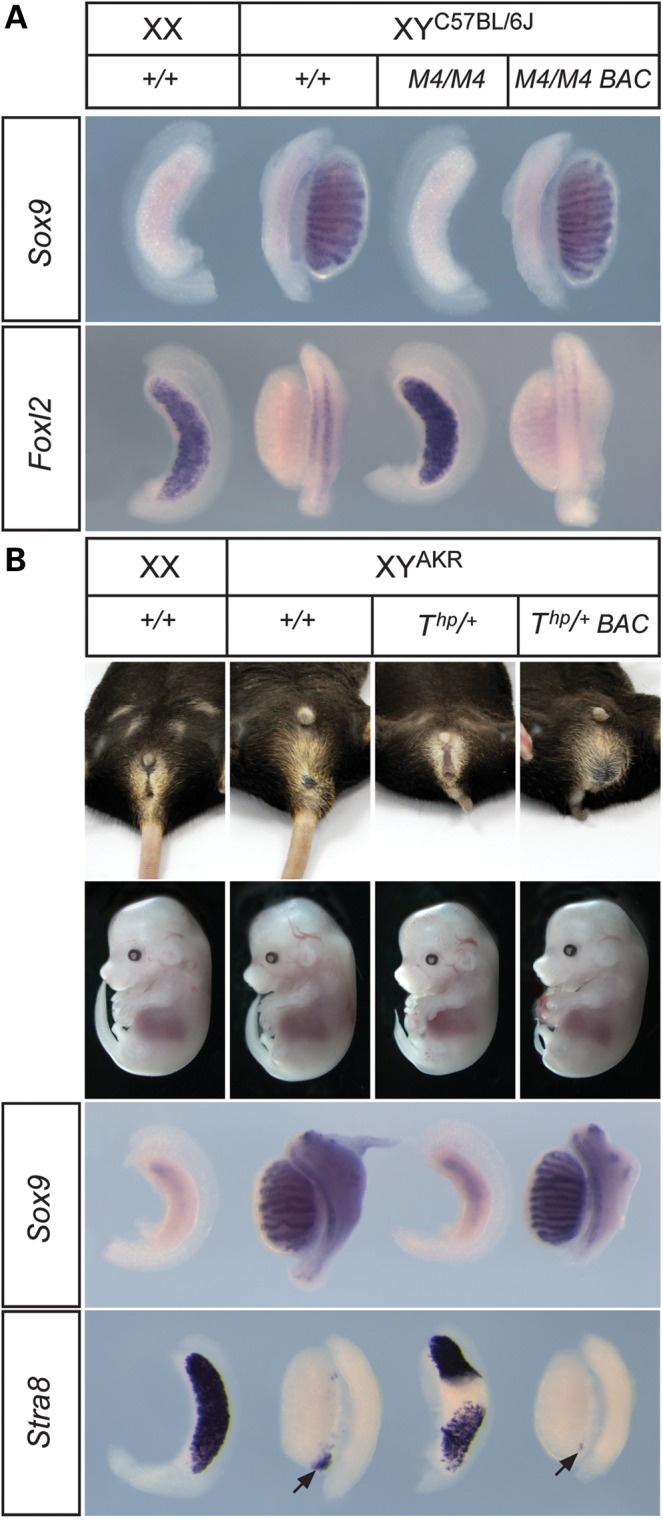
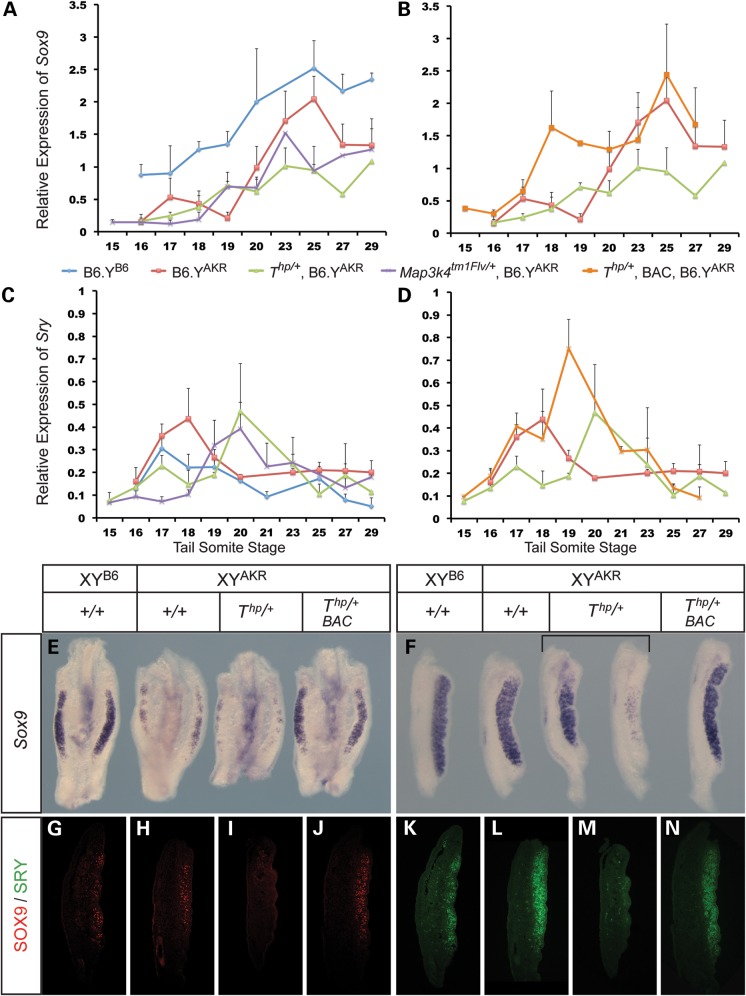
Disorders of sex development in the human population range in severity from mild genital defects to gonadal sex reversal. XY female development has been associated with heterozygous mutations in several genes, including SOX9, WT1 and MAP3K1. In contrast, XY sex reversal in mice usually requires complete absence of testis-determining gene products. One exception to this involves T-associated sex reversal (Tas), a phenomenon characterized by the formation of ovotestes or ovaries in XY mice hemizygous for the hairpin-tail (T(hp)) or T-Orleans (T(Orl)) deletions on proximal mouse chromosome 17. We recently reported that mice heterozygous for a null allele of Map3k4, which resides in the T(hp) deletion, exhibit XY ovotestis development and occasional gonadal sex reversal on the sensitized C57BL/6J-Y(AKR) (B6-Y(AKR)) genetic background, reminiscent of the Tas phenotype. However, these experiments did not exclude the possibility that loss of other loci in the T(hp) deletion, or other effects of the deletion itself, might contribute to Tas. Here, we show that disruption to Sry expression underlies XY gonadal defects in B6-Y(AKR) embryos harbouring the T(hp) deletion and that a functional Map3k4 bacterial artificial chromosome rescues these abnormalities by re-establishing a normal Sry expression profile. These data demonstrate that Map3k4 haploinsufficiency is the cause of T-associated sex reversal and that levels of this signalling molecule are a major determinant of the expression profile of Sry.
人类性发育障碍的严重程度各不相同,从轻度生殖器缺陷到性腺性反转。XY女性发育与包括SOX9、WT1和MAP3K1在内的多个基因的杂合突变有关。相比之下,小鼠中的XY性反转通常需要完全缺失睾丸决定基因产物。一个例外是T相关性反转(Tas),这一现象的特征是在近端小鼠17号染色体上携带发夹尾(T(hp))或奥尔良T(T(Orl))缺失的XY小鼠中形成卵睾或卵巢。我们最近报道,位于T(hp)缺失区域的Map3k4无效等位基因的杂合小鼠,在敏感的C57BL/6J-Y(AKR)(B6-Y(AKR))遗传背景下表现出XY卵睾发育和偶尔的性腺性反转,这让人联想到Tas表型。然而,这些实验并没有排除T(hp)缺失区域中其他位点的缺失或缺失本身的其他影响可能导致Tas的可能性。在这里,我们表明,在携带T(hp)缺失的B6-Y(AKR)胚胎中,XY性腺缺陷的基础是Sry表达的破坏,并且功能性的Map3k4细菌人工染色体通过重新建立正常的Sry表达谱来挽救这些异常。这些数据表明,Map3k4单倍体不足是T相关性反转的原因,并且这种信号分子的水平是Sry表达谱的主要决定因素。