State Key Laboratory of Bioreactor Engineering, East China University of Science and Technology, 130 Meilong Rd., Shanghai, 200237, People's Republic of China.
Engineering Research Centre of Processes System, Ministry of Education, East China University of Science and Technology, 130 Meilong Rd., Shanghai, 200237, People's Republic of China.
Stem Cell Res Ther. 2019 Mar 8;10(1):81. doi: 10.1186/s13287-019-1180-6.
Embryonic Sertoli cells (eSCs) play an important role in sex determination and in male gonad development which makes them a very useful cell type for therapeutic applications. However, the deriving mechanism of Sertoli cells has been unclear and challenging to create a large number of quality eSCs. Therefore, this study aimed to create the eSCs induced from mouse embryonic stem (mES) cells by regulating defined factors and to explore the relevant regulatory mechanism.
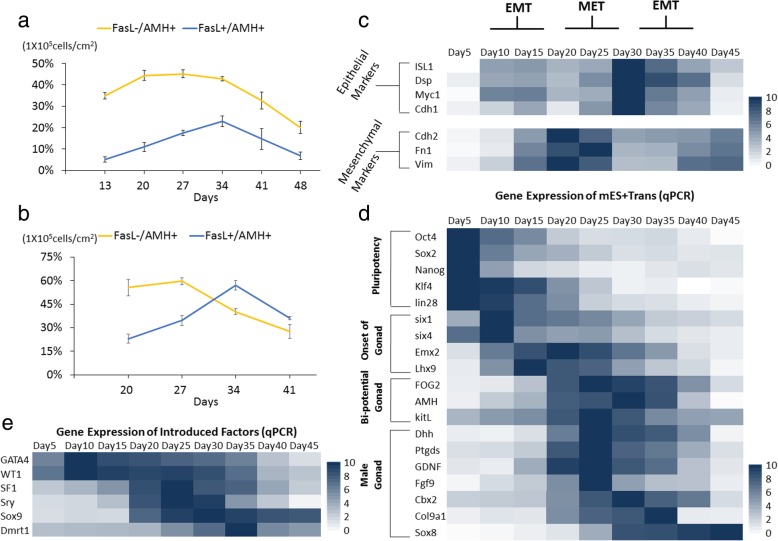
Six inducing factors, Sry, Sox9, SF1, WT1, GATA4, and Dmrt1, were respectively transduced into mES cells by lentiviral infection according to the experimental design. The test groups were identified by development stage-specific markers, AMH, Emx2, SF1, and FasL, using flow cytometry. Induced eSCs were determined by FasL and AMH biomarkers under immunofluorescence, immunocytochemistry, and flow cytometry. Moreover, the pluripotency markers, gonad development-related markers, epithelial markers and mesenchymal markers in test groups were transcriptionally determined by qPCR.
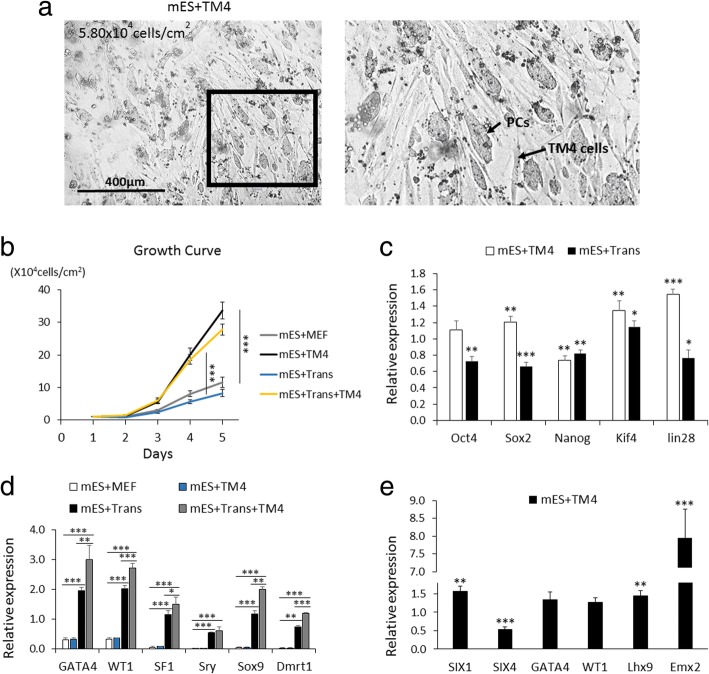
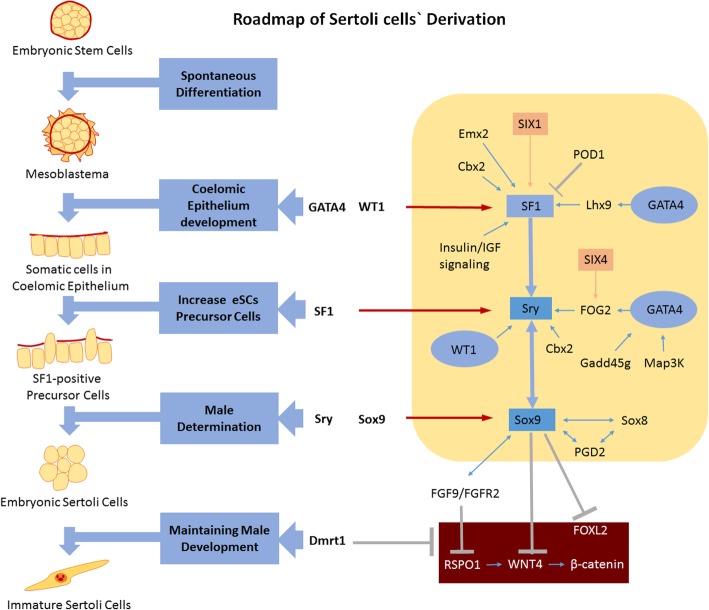
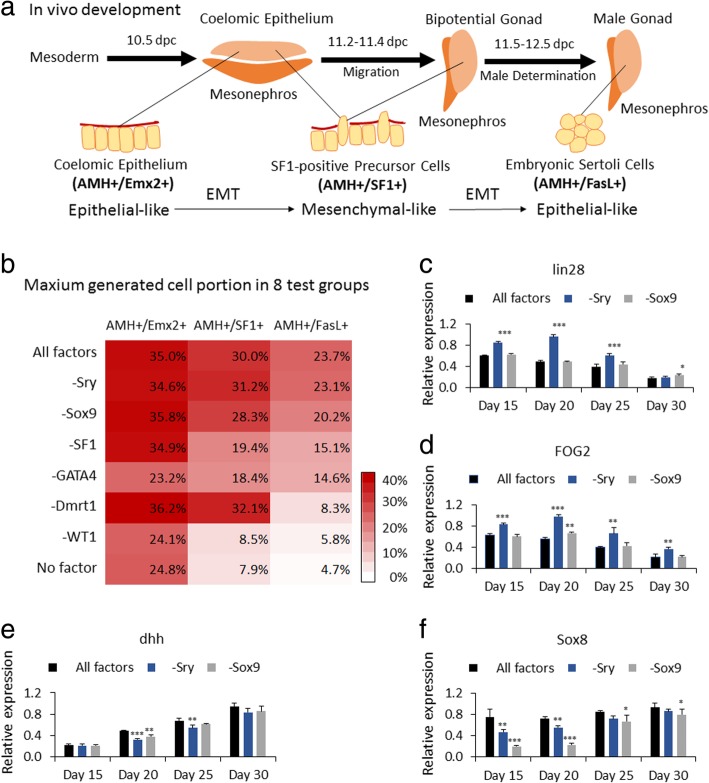
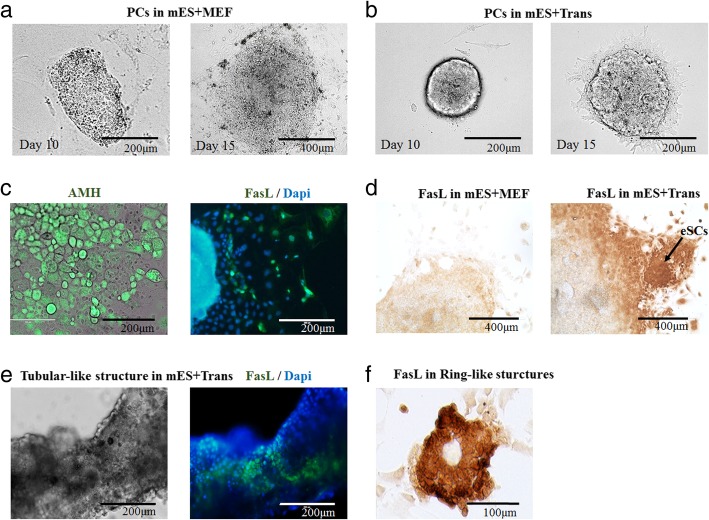
In this study, the co-overexpression of all the six factors effectively produced a large population of eSCs from mES cells in 35 days of culturing. These eSCs were capable of forming tubular-like and ring-like structures with functional performance. The results of flow cytometry indicated that the upregulation of GATA4 and WT1 contributed to the growth of somatic cells in the coelomic epithelium regarded as the main progenitor cells of eSCs. Whereas, SF1 facilitated the development of eSC precursor cells, and Sry and Sox9 promoted the determination of male development. Moreover, the overexpression of Dmrt1 was essential for the maintenance of eSCs and some of their specific surface biomarkers such as FasL. The cellular morphology, biomarker identification, and transcriptomic analysis aided in exploring the regulatory mechanism of deriving eSCs from mES cells.
Conclusively, we have elucidated a differentiation roadmap of eSCs derived from mES cells with a relevant regulatory mechanism. Through co-overexpression of all these six factors, a large population of eSCs was successfully induced occupying 24% of the whole cell population (1 × 10 cells/cm). By adopting this approach, a mass of embryonic Sertoli cells can be generated for the purpose of co-culture technique, organ transplantation, gonadal developmental and sex determination researches.
胚胎性索细胞(eSCs)在性别决定和男性性腺发育中发挥重要作用,这使其成为治疗应用的非常有用的细胞类型。然而,索细胞的衍生机制尚不清楚,并且难以大量生成高质量的 eSCs。因此,本研究旨在通过调节确定的因子从小鼠胚胎干细胞(mES)中创建 eSCs,并探索相关的调节机制。
根据实验设计,通过慢病毒感染将 Sry、Sox9、SF1、WT1、GATA4 和 Dmrt1 这 6 种诱导因子分别转导到 mES 细胞中。通过流式细胞术,用 AMH、Emx2、SF1 和 FasL 等发育阶段特异性标志物鉴定实验组。通过免疫荧光、免疫细胞化学和流式细胞术,用 FasL 和 AMH 生物标志物鉴定诱导的 eSCs。此外,通过 qPCR 转录测定实验组中的多能性标志物、性腺发育相关标志物、上皮标志物和间充质标志物。
在这项研究中,这 6 种因子的共过表达有效地在 35 天的培养中从 mES 细胞中产生了大量的 eSCs。这些 eSCs 能够形成具有功能的管状和环状结构。流式细胞术的结果表明,GATA4 和 WT1 的上调有助于体腔上皮中体细胞的生长,体腔上皮被认为是 eSCs 的主要祖细胞。而 SF1 促进了 eSC 前体细胞的发育,Sry 和 Sox9 则促进了雄性发育的确定。此外,Dmrt1 的过表达对于维持 eSCs 及其一些特定表面标志物(如 FasL)是必要的。细胞形态、生物标志物鉴定和转录组分析有助于探索从 mES 细胞中衍生 eSCs 的调节机制。
总之,我们已经阐明了 mES 细胞衍生 eSCs 的分化路线图和相关的调节机制。通过这 6 种因子的共过表达,成功诱导了大量的 eSCs,占整个细胞群体的 24%(1×10 个细胞/cm)。通过采用这种方法,可以生成大量的胚胎性索细胞,用于共培养技术、器官移植、性腺发育和性别决定研究。