Department of Internal Medicine, Eulji General Hospital, Eulji University College of Medicine, Seoul, Korea.
Department of Internal Medicine, Seoul National University Bundang Hospital, Kyeong-Kido, Korea ; Department of Internal Medicine, Seoul National University, Seoul, Korea.
PLoS One. 2014 Jan 16;9(1):e84052. doi: 10.1371/journal.pone.0084052. eCollection 2014.
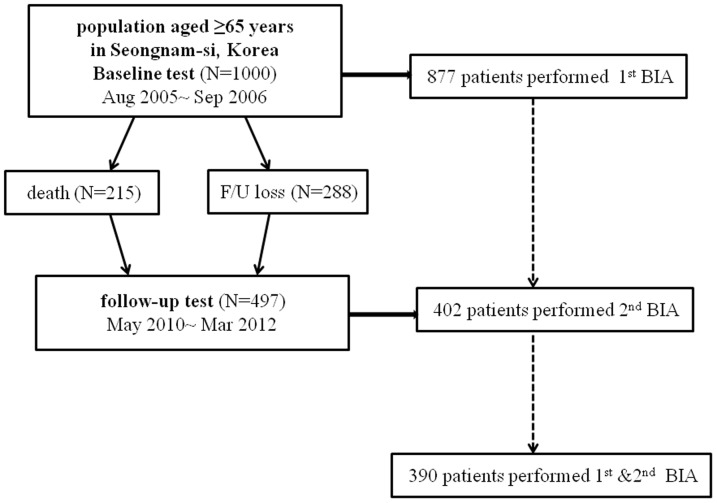
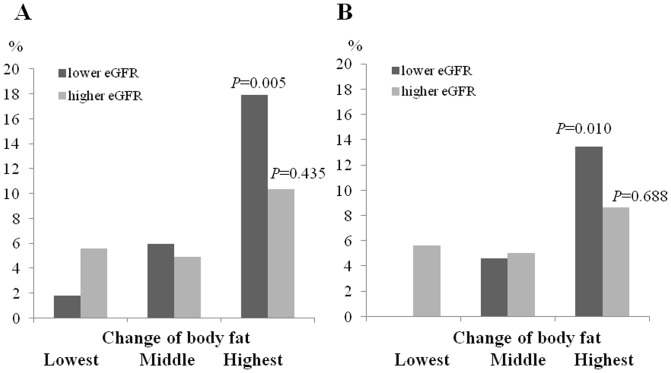
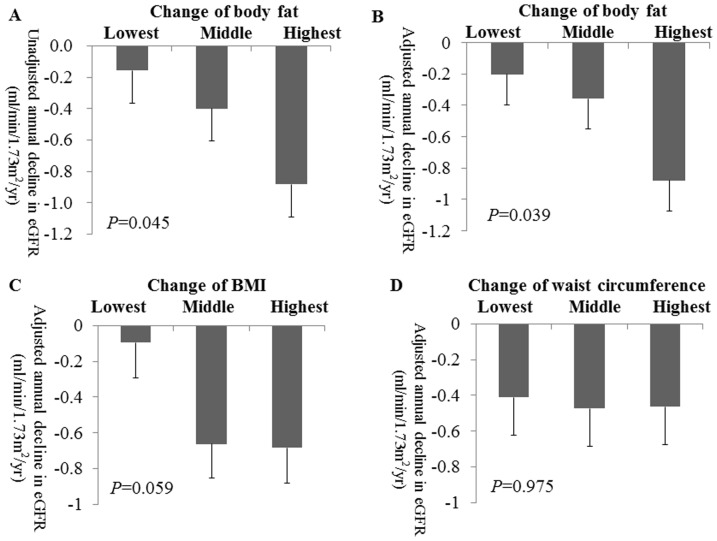
Obesity is a risk factor for chronic kidney disease, and its prevalence among the elderly is increasing. We investigated the effects of changes in body fat percentage (BFP) on the longitudinal changes in the estimated glomerular filtration rate (eGFR) in the elderly. This prospective cohort study included 390 participants aged >65 years who underwent bioelectrical impedance analysis at baseline and follow-up as a part of the Korean Longitudinal Study on Health and Aging. After a median follow-up period of 5.3 years, BFP was significantly higher than that at the start point (P<0.05). Participants who had the largest increase in BFP had the highest BMI and waist circumference (WC) (P<0.001). The highest tertile had the highest white blood cell count and erythrocyte sedimentation rate, incidence of rapid progression, and decline in eGFR >25% (P≤0.017, P = 0.025, P = 0.005, respectively). The lowest tertile had the lowest triglyceride and highest high-density lipoprotein levels (P<0.05). The adjusted decline rate in eGFR was correlated with a change in BFP (P = 0.039), but not with that in BMI or WC. The highest tertile had a 4.875-fold increase in the risk for rapid progression to a decline in eGFR (95% CI: 1.366-17.397) and a 4.931-fold decrease in the risk to a decline in eGFR>25% (95% CI: 1.617-15.037), when compared with the lowest tertile. In subgroup analysis, the incidence of renal outcomes was significantly increased according to the increase in BFP in patients with lower eGFR (P≤0.010). A change in BFP may be associated with inflammation and dyslipidemia development, and longitudinal changes in body fat are related to a decrease in eGFR in the elderly.
肥胖是慢性肾脏病的一个危险因素,其在老年人中的患病率正在增加。我们研究了体脂百分比(BFP)变化对老年人估算肾小球滤过率(eGFR)的纵向变化的影响。这项前瞻性队列研究纳入了 390 名年龄>65 岁的参与者,他们在基线和随访时接受了生物电阻抗分析,这是韩国健康老龄化纵向研究的一部分。在中位随访 5.3 年后,BFP 显著高于起始点(P<0.05)。BFP 增加最多的参与者具有最高的 BMI 和腰围(WC)(P<0.001)。最高三分位组的白细胞计数和红细胞沉降率最高,快速进展发生率最高,eGFR 下降>25%的发生率也最高(P≤0.017,P=0.025,P=0.005)。最低三分位组的甘油三酯最低,高密度脂蛋白水平最高(P<0.05)。eGFR 的调整下降率与 BFP 的变化相关(P=0.039),但与 BMI 或 WC 的变化无关。最高三分位组发生 eGFR 快速下降进展的风险增加 4.875 倍(95%CI:1.366-17.397),发生 eGFR 下降>25%的风险降低 4.931 倍(95%CI:1.617-15.037),与最低三分位组相比。亚组分析显示,在 eGFR 较低的患者中,BFP 的增加与肾脏结局的发生率显著增加相关(P≤0.010)。BFP 的变化可能与炎症和血脂异常的发展有关,而体脂的纵向变化与老年人 eGFR 的下降有关。