Department of Neurology, Peking University First Hospital, Beijing, China.
Department of Clinical Nutrition, Peking University First Hospital, Beijing, China.
PLoS One. 2019 Jul 25;14(7):e0219628. doi: 10.1371/journal.pone.0219628. eCollection 2019.
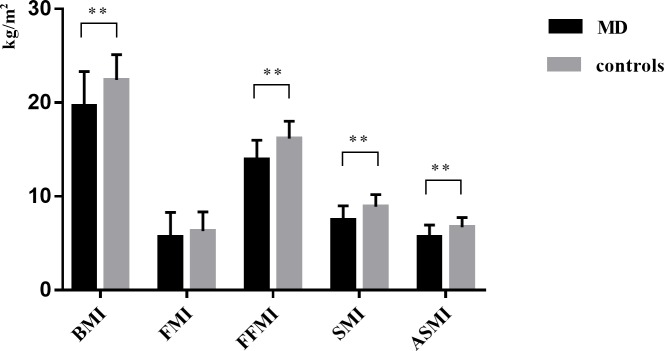
The study aimed to evaluate the body composition of patients with mitochondrial diseases (MD) and correlate it with disease severity. Overall, 89 patients (age ≥ 18 years) with MD were recruited, including 49 with chronic progressive external ophthalmoplegia (CPEO) and 40 with mitochondrial encephalomyopathy with lactate acidosis and stroke-like episodes (MELAS). Body composition, including fat mass index (FMI), fat-free mass index (FFMI), skeletal muscle mass index (SMI), and appendicular skeletal muscle mass index (ASMI), were examined using multifrequency bioelectric impedance analysis. Clinical assessments, including muscle strength, usual gait speed, and disease severity determined by the Newcastle Mitochondrial Disease Adult Scale score (NMDAS), were performed. The comparisons between patients group and age- and gender-matched healthy controls, as well as the correlations between anthropometric measurements, body composition, and disease severity were analyzed. Height, weight, body mass index (BMI), FFMI, SMI, and ASMI were significantly lower in patients with MD than in healthy controls. Notably, low muscle mass was noted in 69.7% (62/89) of MD patients, with 22 patients also presenting with compromised physical performance as indicated by decreased gait speed, resulting in 24.7% satisfied the sarcopenia diagnostic criteria. Disease severity was more negatively correlated with ASMI than it was with height, weight, and BMI. Subgroup analysis showed that in the MELAS subgroup, disease severity was negatively correlated with height, weight, and ASMI; whereas in the CPEO subgroup, it was only negatively correlated with ASMI and SMI. Additionally, ASMI was positively associated with muscle strength. Altogether, compared with BMI, ASMI is a more sensitive biomarker predicting disease severity of MD, both in MELAS and CPEO patients.
本研究旨在评估线粒体疾病(MD)患者的身体成分,并将其与疾病严重程度相关联。共招募了 89 名年龄≥18 岁的 MD 患者,其中 49 名为慢性进行性眼外肌麻痹(CPEO),40 名为线粒体脑肌病伴高乳酸血症和卒中样发作(MELAS)。使用多频生物电阻抗分析检查身体成分,包括脂肪量指数(FMI)、去脂体重指数(FFMI)、骨骼肌质量指数(SMI)和四肢骨骼肌质量指数(ASMI)。通过肌肉力量、常用步速和新堡线粒体疾病成人量表评分(NMDAS)确定的疾病严重程度进行临床评估。分析患者组与年龄和性别匹配的健康对照组之间的差异,以及人体测量指标、身体成分和疾病严重程度之间的相关性。MD 患者的身高、体重、体重指数(BMI)、FFMI、SMI 和 ASMI 均显著低于健康对照组。值得注意的是,69.7%(62/89)的 MD 患者存在肌肉量减少,其中 22 名患者因步速下降而出现身体活动能力受损,符合肌少症诊断标准的患者占 24.7%。疾病严重程度与 ASMI 的相关性比与身高、体重和 BMI 的相关性更负。亚组分析显示,在 MELAS 亚组中,疾病严重程度与身高、体重和 ASMI 呈负相关;而在 CPEO 亚组中,仅与 ASMI 和 SMI 呈负相关。此外,ASMI 与肌肉力量呈正相关。总的来说,与 BMI 相比,ASMI 是预测 MD 疾病严重程度的更敏感的生物标志物,无论是在 MELAS 还是 CPEO 患者中。