Higginbotham Sarah, Wong Weng Ruh, Linington Roger G, Spadafora Carmenza, Iturrado Liliana, Arnold A Elizabeth
Smithsonian Tropical Research Institute, Panama, Republic of Panama.
Department of Chemistry and Biochemistry, University of California Santa Cruz, Santa Cruz, California, United States of America.
PLoS One. 2014 Jan 15;9(1):e84549. doi: 10.1371/journal.pone.0084549. eCollection 2014.
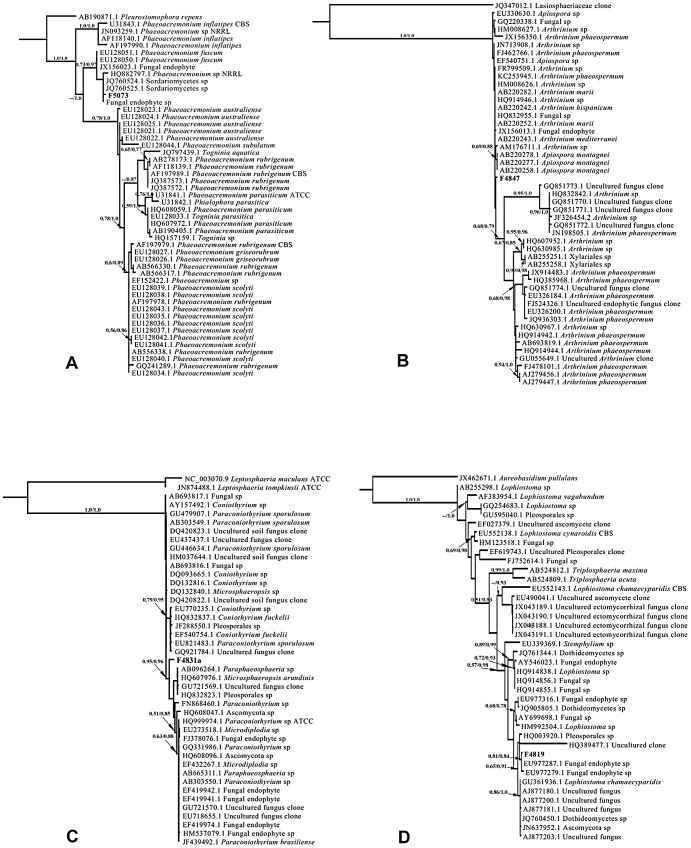
The extraordinary biological diversity of tropical forests harbors a rich chemical diversity with enormous potential as a source of novel bioactive compounds. Of particular interest are new environments for microbial discovery. Sloths--arboreal mammals commonly found in the lowland forests of Panama--carry a wide variety of micro- and macro-organisms on their coarse outer hair. Here we report for the first time the isolation of diverse and bioactive strains of fungi from sloth hair, and their taxonomic placement. Eighty-four isolates of fungi were obtained in culture from the surface of hair that was collected from living three-toed sloths (Bradypus variegatus, Bradypodidae) in Soberanía National Park, Republic of Panama. Phylogenetic analyses revealed a diverse group of Ascomycota belonging to 28 distinct operational taxonomic units (OTUs), several of which are divergent from previously known taxa. Seventy-four isolates were cultivated in liquid broth and crude extracts were tested for bioactivity in vitro. We found a broad range of activities against strains of the parasites that cause malaria (Plasmodium falciparum) and Chagas disease (Trypanosoma cruzi), and against the human breast cancer cell line MCF-7. Fifty fungal extracts were tested for antibacterial activity in a new antibiotic profile screen called BioMAP; of these, 20 were active against at least one bacterial strain, and one had an unusual pattern of bioactivity against Gram-negative bacteria that suggests a potentially new mode of action. Together our results reveal the importance of exploring novel environments for bioactive fungi, and demonstrate for the first time the taxonomic composition and bioactivity of fungi from sloth hair.
热带森林非凡的生物多样性蕴藏着丰富的化学多样性,作为新型生物活性化合物的来源具有巨大潜力。特别令人感兴趣的是微生物发现的新环境。树懒——常见于巴拿马低地森林的树栖哺乳动物——在其粗糙的外毛上携带着各种各样的微生物和大型生物。在此,我们首次报告从树懒毛发中分离出多种具有生物活性的真菌菌株及其分类定位。从巴拿马共和国索贝拉尼亚国家公园生活的三趾树懒(Bradypus variegatus,树懒科)身上采集的毛发表面,通过培养获得了84株真菌分离株。系统发育分析显示,这些真菌属于子囊菌门,分为28个不同的操作分类单元(OTU),其中几个与先前已知的分类群不同。74株分离株在液体肉汤中培养,并对粗提物进行体外生物活性测试。我们发现这些提取物对导致疟疾的寄生虫(恶性疟原虫)和恰加斯病的寄生虫(克氏锥虫)菌株以及人类乳腺癌细胞系MCF - 7具有广泛的活性。在一项名为BioMAP的新型抗生素谱筛选中,对50种真菌提取物进行了抗菌活性测试;其中,20种对至少一种细菌菌株有活性,一种对革兰氏阴性菌具有不同寻常的生物活性模式,这表明可能存在一种新的作用方式。我们的研究结果共同揭示了探索新型生物活性真菌环境的重要性,并首次展示了树懒毛发真菌的分类组成和生物活性。