Poonacha Vachan, Poonacha Seema, Salagundi Basavaraj, Rupesh P L, Raghavan Rohit
MDS, Senior Lecturer. Dept. of Prosthodontics, Coorg Institute of Dental Sciences, Virajpet, S-Coorg, Karnataka India.
MDS, Senior Lecturer. Dept. of Conservative Dentistry And Endodontics, Coorg Institute of Dental Sciences, Virajpet, S-Coorg, Karnataka India.
J Clin Exp Dent. 2013 Dec 1;5(5):e212-7. doi: 10.4317/jced.51136.
To evaluate and compare the flexural strength and the elastic moduli of three provisional crown materials (methyl methacrylate based autopolymerized resin, bis acryl composite based autopolymerized resin and urethane dimethacrylate based light polymerized resin) after storing in artificial saliva and testing at intervals of 24 hours and 7 days.
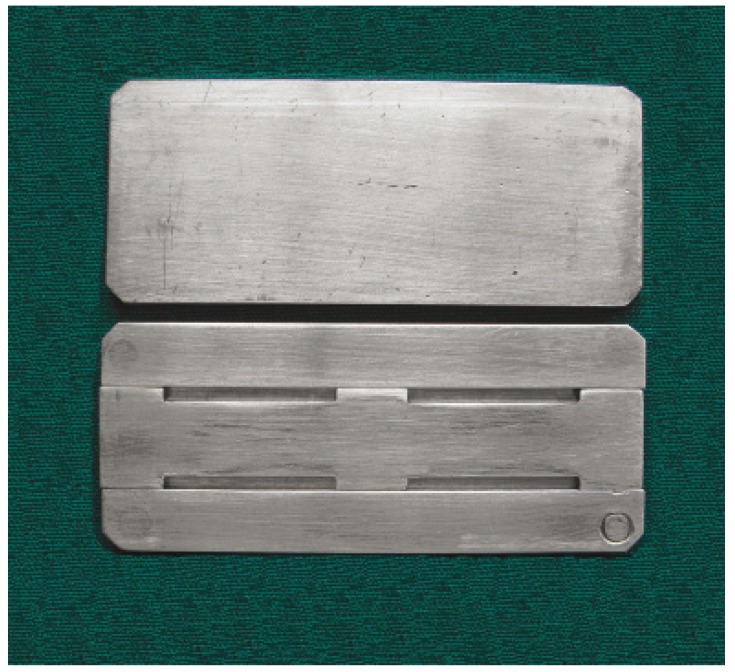
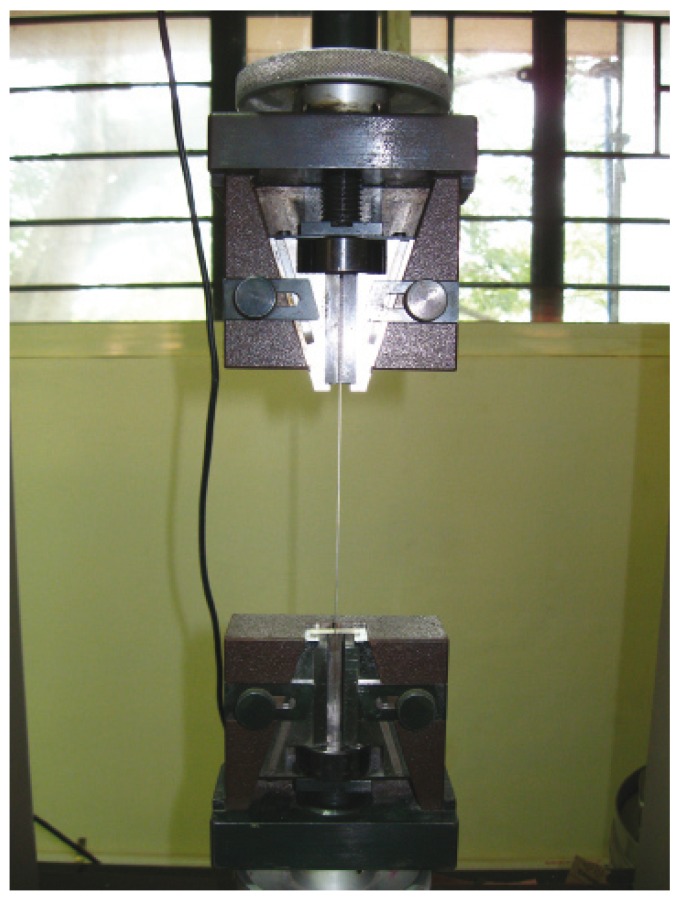
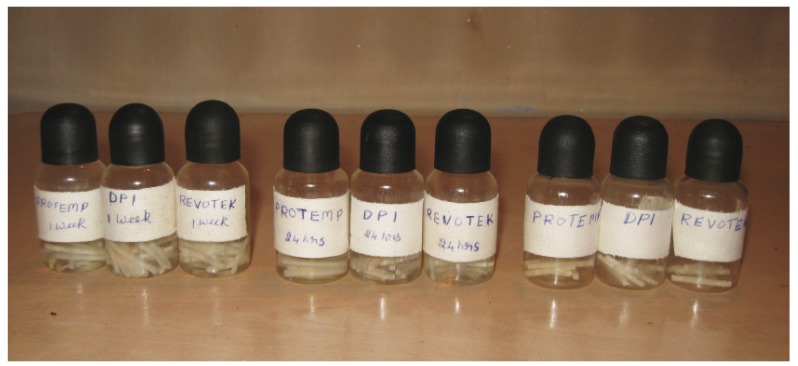
A metal master mould with four slots of dimensions 25x2x2 mm was fabricated to obtain samples of standard dimensions. A total of 135 specimens were thus obtained with 45 each of three provisional materials. Further 15 samples of each group were tested after storing for one hour at room temperature and again at intervals of 24 hours and 7 days after storing in artificial saliva. Three point flexural tests were carried out in the universal testing machine to calculate the flexural strength and the elastic modulus. The changes were calculated and data was analyzed with Fisher's test and ANOVA.
The flexural strength of the methyl methacrylate resin reduced significantly while bis-acrylic composite resin showed a significant increase in its flexural strength after storing in artificial saliva for 24 hours and the values of both remained constant thereafter. Contrary to these findings, light polymerized resin showed a significant decrease in flexural strength after storing in artificial saliva for 24 hours and then significantly increased in flexural strength after 7 days. However the changes in the values for elastic modulus of respective materials were statistically insignificant.
Methacrylate based autopolymerizing resin showed the highest flexural strength and elastic moduli after fabrication and after storing in artificial saliva and for 24 hours and 7 days. Bis-acrylic composite resin showed the least flexural strength and elastic moduli. Key words:Provisional restorations, interim restorations, Methyl Methacrylate, composite restoration, flexural strength, elastic moduli.
评估并比较三种临时冠材料(甲基丙烯酸甲酯基自凝树脂、双丙烯酸复合树脂基自凝树脂和聚氨酯二甲基丙烯酸酯基光固化树脂)在人工唾液中储存后,以及在24小时和7天的间隔时间进行测试后的弯曲强度和弹性模量。
制作一个带有四个尺寸为25×2×2毫米狭槽的金属母模,以获得标准尺寸的样本。由此共获得135个标本,三种临时材料各45个。每组再取15个样本,在室温下储存一小时后进行测试,在人工唾液中储存后,再分别在24小时和7天的间隔时间进行测试。在万能试验机上进行三点弯曲试验,以计算弯曲强度和弹性模量。计算变化量,并使用Fisher检验和方差分析对数据进行分析。
甲基丙烯酸甲酯树脂的弯曲强度显著降低,而双丙烯酸复合树脂在人工唾液中储存24小时后弯曲强度显著增加,此后两者的值保持不变。与这些结果相反,光固化树脂在人工唾液中储存24小时后弯曲强度显著降低,然后在7天后弯曲强度显著增加。然而,各材料弹性模量值的变化在统计学上不显著。
甲基丙烯酸酯基自凝树脂在制作后以及在人工唾液中储存24小时和7天后,显示出最高的弯曲强度和弹性模量。双丙烯酸复合树脂显示出最低的弯曲强度和弹性模量。关键词:临时修复体、临时修复、甲基丙烯酸甲酯、复合修复、弯曲强度、弹性模量。