Department of Kansei Science, Kyushu University, 4-9-1, Shiobaru, Minami-ku, Fukuoka 815-8540, Japan.
J Physiol Anthropol. 2014 Jan 24;33(1):4. doi: 10.1186/1880-6805-33-4.
Empathy is deeply linked with the ability to adapt to human social environments. The present study investigated the relationship between the empathy trait and attention elicited by discriminating facial expressions.
Event-related potentials were measured while 32 participants (17 men and 15 women) discriminated facial expressions (happy or angry) and colors of flowers (yellow or purple) under an oddball paradigm. The empathy trait of participants was measured using the Interpersonal Reactivity Index (Davis, 1980).
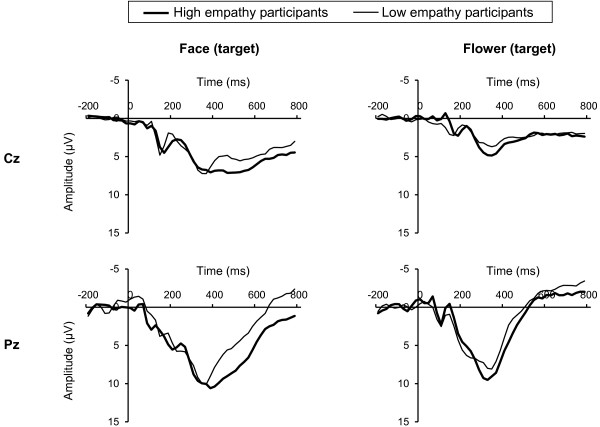
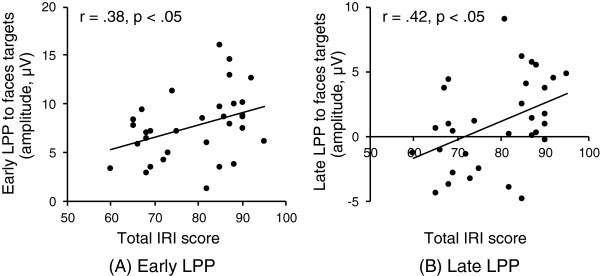
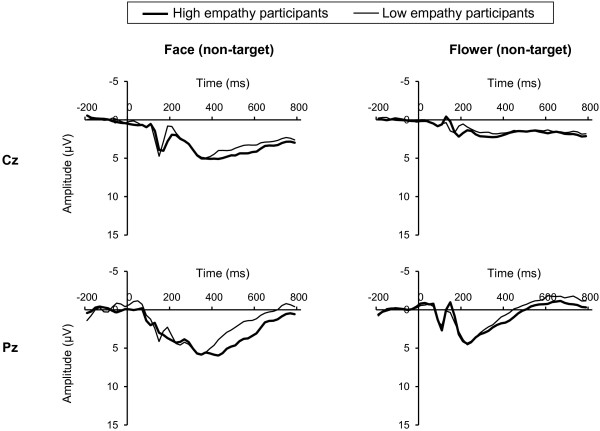
The empathy trait correlated positively with both the early portion (300 to 600 ms after stimulus onset) and late portion (600 to 800 ms after stimulus onset) of late positive potential (LPP) amplitude elicited by faces, but not with LPP elicited by flowers.
This result suggests that, compared to people with low empathy, people with high empathy pay more attention when discriminating facial expressions. The present study suggests that differences exist in methods of adapting to social environments between people with high and low empathy.
同理心与适应人类社会环境的能力密切相关。本研究探讨了同理心特质与区分面部表情时引起的注意力之间的关系。
在 32 名参与者(17 名男性和 15 名女性)进行的一项奇偶刺激范式实验中,测量了事件相关电位,参与者需要区分面部表情(快乐或愤怒)和花朵颜色(黄色或紫色)。参与者的同理心特质使用人际反应性指数(Davis,1980)进行测量。
同理心特质与面孔引起的晚期正电位(LPP)振幅的早期部分(刺激后 300 至 600 毫秒)和晚期部分(刺激后 600 至 800 毫秒)呈正相关,但与花朵引起的 LPP 不相关。
与同理心较低的人相比,同理心较高的人在区分面部表情时会更加关注。本研究表明,同理心较高和同理心较低的人在适应社会环境的方法上存在差异。