Institute of Electronics, Silesian University of Technology, Gliwice, 44-100, Poland.
Nanoscale Res Lett. 2014 Jan 25;9(1):43. doi: 10.1186/1556-276X-9-43.
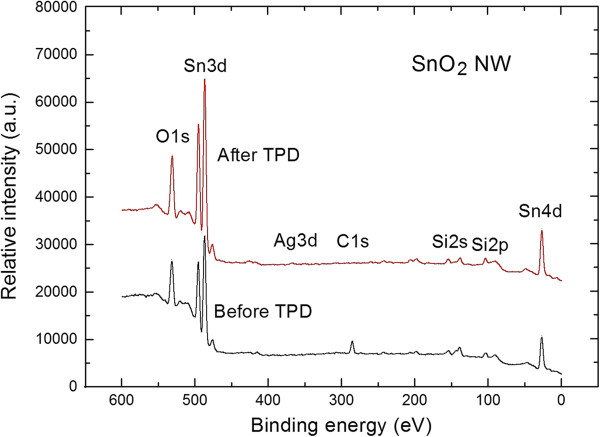
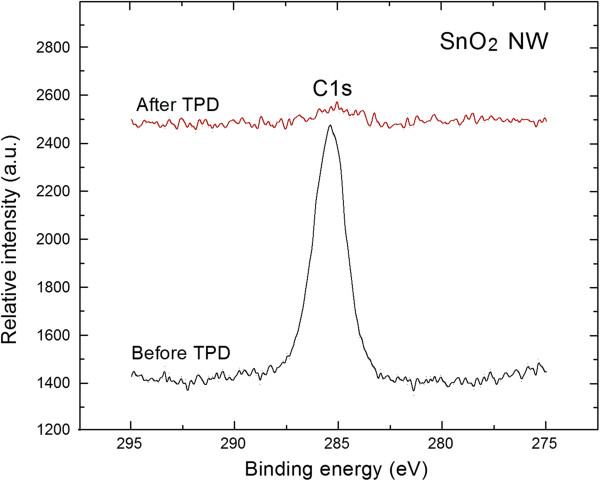
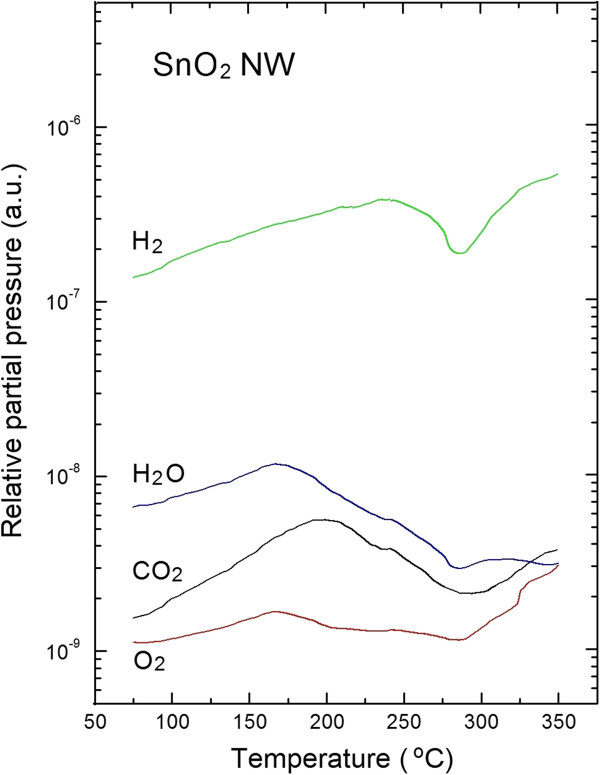
In this paper we investigate the surface chemistry, including surface contaminations, of SnO2 nanowires deposited on Ag-covered Si substrate by vapor phase deposition (VPD), thanks to x-ray photoelectron spectroscopy (XPS) in combination with thermal desorption spectroscopy (TDS). Air-exposed SnO2 nanowires are slightly non-stoichiometric, and a huge amount of C contaminations is observed at their surface. After the thermal physical desorption (TPD) process, SnO2 nanowires become almost stoichiometric without any surface C contaminations. This is probably related to the fact that C contaminations, as well as residual gases from air, are weakly bounded to the crystalline SnO2 nanowires and can be easily removed from their surface. The obtained results gave us insight on the interpretation of the aging effect of SnO2 nanowires that is of great importance for their potential application in the development of novel chemical nanosensor devices.
本文通过 X 射线光电子能谱(XPS)结合热脱附光谱(TDS)研究了通过气相沉积(VPD)沉积在 Ag 覆盖的 Si 衬底上的 SnO2 纳米线的表面化学性质,包括表面污染。暴露在空气中的 SnO2 纳米线略微非化学计量,并且在其表面观察到大量的 C 污染。经过热物理脱附(TPD)过程后,SnO2 纳米线几乎达到化学计量,没有任何表面 C 污染。这可能与以下事实有关:C 污染以及来自空气的残余气体与结晶 SnO2 纳米线的结合较弱,并且可以很容易地从其表面去除。所得结果使我们深入了解了 SnO2 纳米线老化效应的解释,这对于它们在新型化学纳米传感器器件的开发中的潜在应用非常重要。