Aihara Ikkyu, Mizumoto Takeshi, Otsuka Takuma, Awano Hiromitsu, Nagira Kohei, Okuno Hiroshi G, Aihara Kazuyuki
Brain Science Institute, RIKEN, Saitama 351-0198, Japan.
Graduate School of Informatics, Kyoto University, Kyoto 606-8501, Japan.
Sci Rep. 2014 Jan 27;4:3891. doi: 10.1038/srep03891.
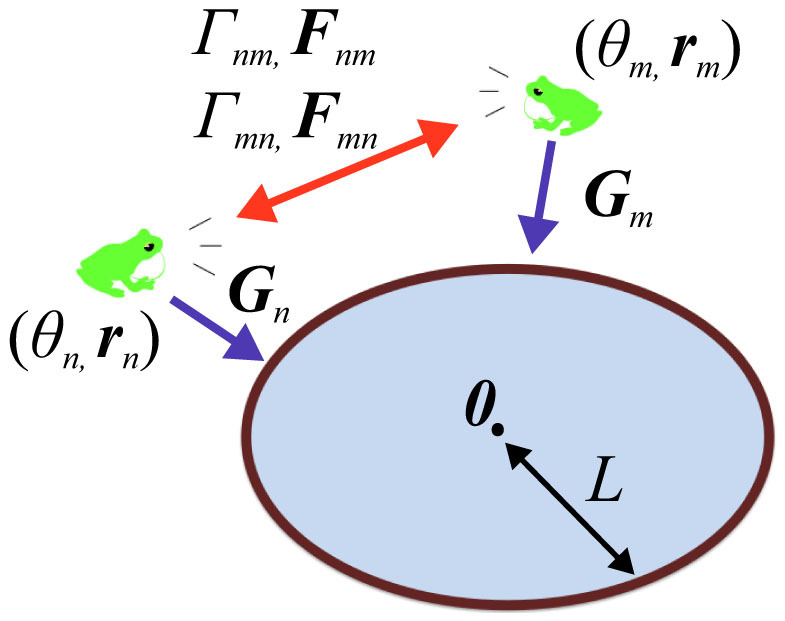
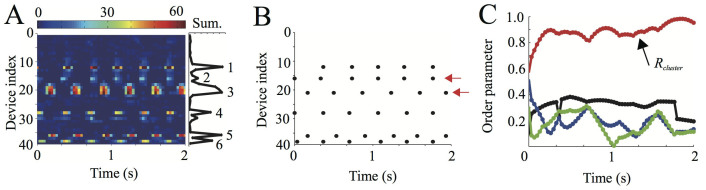
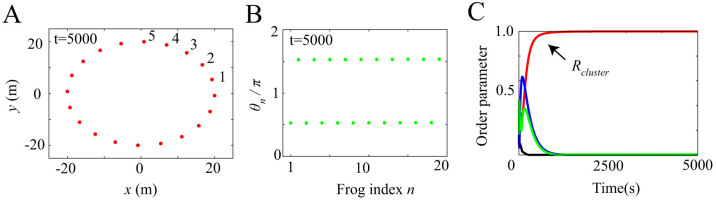
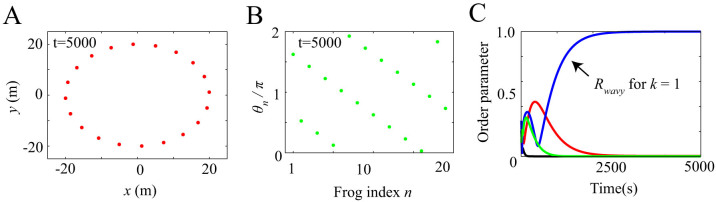
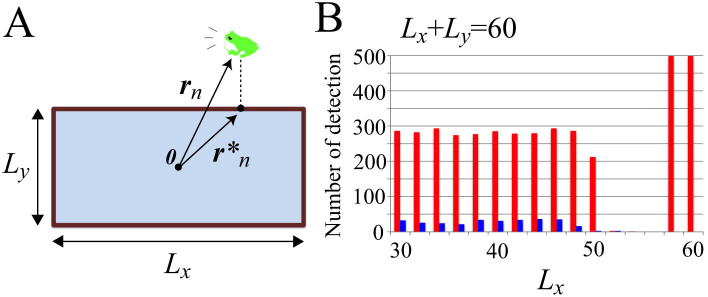
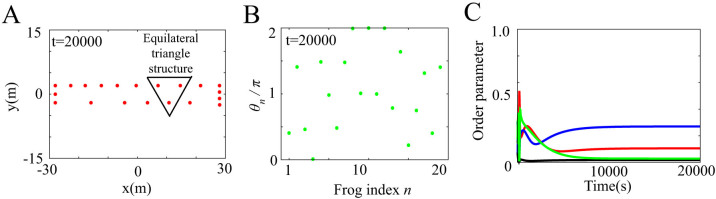
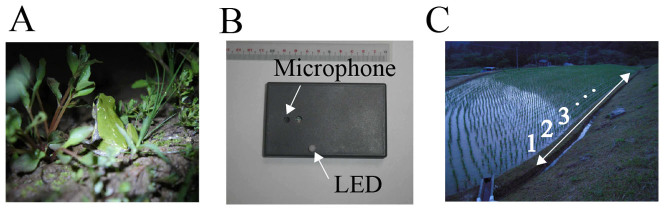
This paper reports theoretical and experimental studies on spatio-temporal dynamics in the choruses of male Japanese tree frogs. First, we theoretically model their calling times and positions as a system of coupled mobile oscillators. Numerical simulation of the model as well as calculation of the order parameters show that the spatio-temporal dynamics exhibits bistability between two-cluster antisynchronization and wavy antisynchronization, by assuming that the frogs are attracted to the edge of a simple circular breeding site. Second, we change the shape of the breeding site from the circle to rectangles including a straight line, and evaluate the stability of two-cluster and wavy antisynchronization. Numerical simulation shows that two-cluster antisynchronization is more frequently observed than wavy antisynchronization. Finally, we recorded frog choruses at an actual paddy field using our sound-imaging method. Analysis of the video demonstrated a consistent result with the aforementioned simulation: namely, two-cluster antisynchronization was more frequently realized.
本文报道了对雄性日本树蛙鸣叫群体时空动态的理论和实验研究。首先,我们将它们的鸣叫时间和位置理论建模为一个耦合移动振荡器系统。通过假设青蛙被吸引到一个简单圆形繁殖地的边缘,对该模型的数值模拟以及序参量的计算表明,时空动态在双簇反同步和波状反同步之间呈现双稳性。其次,我们将繁殖地的形状从圆形改变为包括直线的矩形,并评估双簇和波状反同步的稳定性。数值模拟表明,双簇反同步比波状反同步更常被观察到。最后,我们使用我们的声成像方法在实际稻田中记录了蛙鸣群体。视频分析显示了与上述模拟一致的结果:即双簇反同步更常实现。