Tyrolean Cancer Research Institute, , Innsbruck, Austria.
J Clin Pathol. 2014 May;67(5):408-14. doi: 10.1136/jclinpath-2013-201932. Epub 2014 Jan 24.
Regulated intramembrane proteolysis has been shown to be an important mechanism for oncogenic activation of epithelial cell adhesion molecule (EpCAM) through nuclear translocation of the intracellular domain EpICD. Recent studies have identified new membrane-bound EpCAM variants. To evaluate the prevalence of two membranous EpCAM variants in human tumours, we performed a large-scale expression analysis using specific antibodies against the extracellular domain EpEX (MOC-31 clone) and the intracellular domain EpICD (9-2 clone) of the EpCAM antigen by immunohistochemistry.
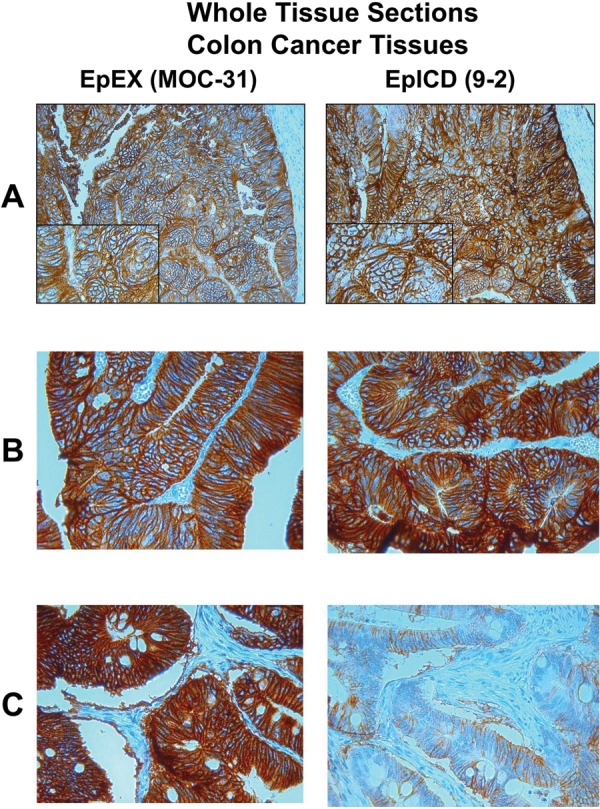
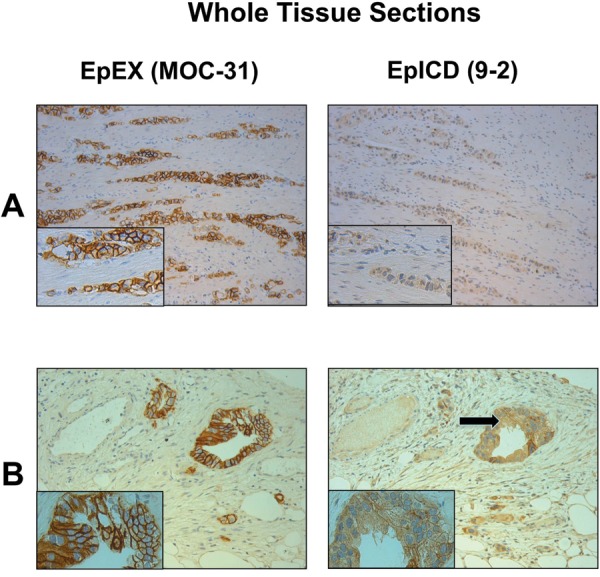
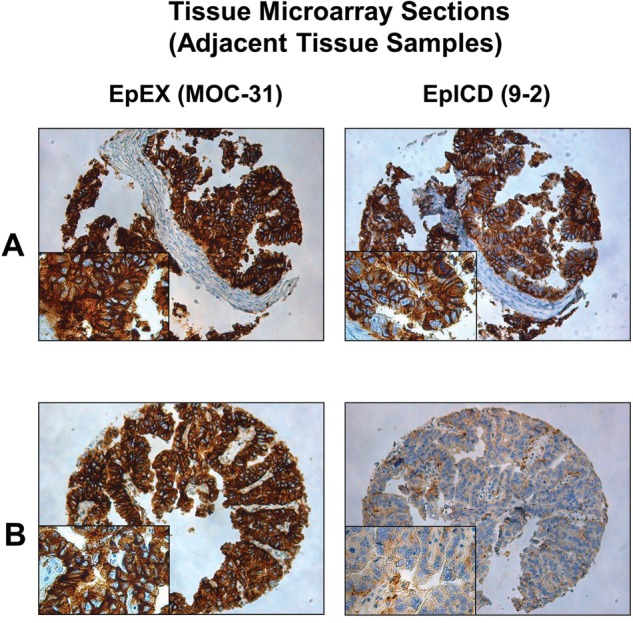
Two multi-tissue microarrays (TMA) series containing 1564 tissue samples each of 53 different histological tumour types were stained and compared. One TMA was stained for EpEX and one for EpICD. Membranous full-length EpCAM (EpCAM(MF)) expression in tissues was defined by the expression of EpEX and EpICD, while the truncated variant of EpCAM (EpCAM(MT)) was characterised by a significant loss of membranous EpICD expression compared with EpEX expression.
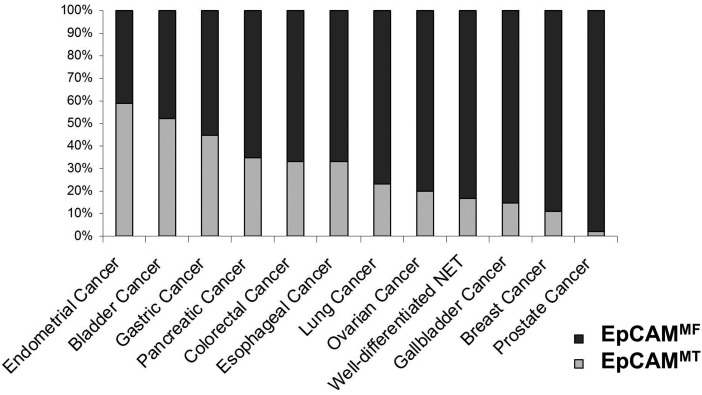
We defined tumours with high EpCAM(MT) expression (ie, cancers of the endometrium and bladder), tumours with intermediate (ie, gastric, pancreatic, colorectal and oesophageal cancer) and tumours with low rates of expression of the EpCAM(MT) variant (ie, lung, ovarian, gallbladder, breast and prostate cancer).
Our results indicate that loss of membranous EpICD expression is a common event in human epithelial carcinomas, arguing for the expression of different degrees of EpCAM(MF) and EpCAM(MT) variants across the most important tumour entities. Future studies evaluating the prognostic and predictive role of these variants in human malignancies, especially in patients treated with EpCAM-specific antibodies, are clearly warranted.
调节性跨膜蛋白水解已被证明是一种重要的机制,通过细胞内结构域 EpICD 的核转位,使上皮细胞黏附分子(EpCAM)致癌激活。最近的研究已经确定了新的膜结合 EpCAM 变体。为了评估两种膜结合 EpCAM 变体在人类肿瘤中的普遍性,我们使用针对 EpCAM 抗原的细胞外结构域 EpEX(MOC-31 克隆)和细胞内结构域 EpICD(9-2 克隆)的特异性抗体,通过免疫组织化学进行了大规模的表达分析。
我们使用针对 EpCAM 抗原的细胞外结构域 EpEX(MOC-31 克隆)和细胞内结构域 EpICD(9-2 克隆)的特异性抗体,对包含 53 种不同组织学肿瘤类型的每个包含 1564 个组织样本的两个多组织微阵列(TMA)系列进行染色和比较。一个 TMA 用于染色 EpEX,另一个用于染色 EpICD。组织中全长 EpCAM(EpCAM(MF))的表达通过 EpEX 和 EpICD 的表达来定义,而 EpCAM 的截断变体(EpCAM(MT))的特征是与 EpEX 表达相比,膜结合的 EpICD 表达显著丢失。
我们定义了 EpCAM(MT)高表达的肿瘤(即子宫内膜癌和膀胱癌)、EpCAM(MT)中表达的肿瘤(即胃癌、胰腺癌、结直肠癌和食管癌)和 EpCAM(MT)低表达的肿瘤(即肺癌、卵巢癌、胆囊癌、乳腺癌和前列腺癌)。
我们的结果表明,膜结合 EpICD 表达的丧失是人类上皮癌的常见事件,这表明在大多数重要的肿瘤实体中表达不同程度的 EpCAM(MF)和 EpCAM(MT)变体。未来研究评估这些变体在人类恶性肿瘤中的预后和预测作用,特别是在接受 EpCAM 特异性抗体治疗的患者中,显然是有必要的。