Laboratory of Experimental Oncology, Tyrolean Cancer Research Institute, Innsbruck, Austria.
BMC Cancer. 2012 Oct 30;12:501. doi: 10.1186/1471-2407-12-501.
The epithelial cell adhesion molecule (EpCAM) has been shown to be overexpressed in breast cancer and stem cells and has emerged as an attractive target for immunotherapy of breast cancer patients. This study analyzes the effects of EpCAM on breast cancer cell lines with epithelial or mesenchymal phenotype.
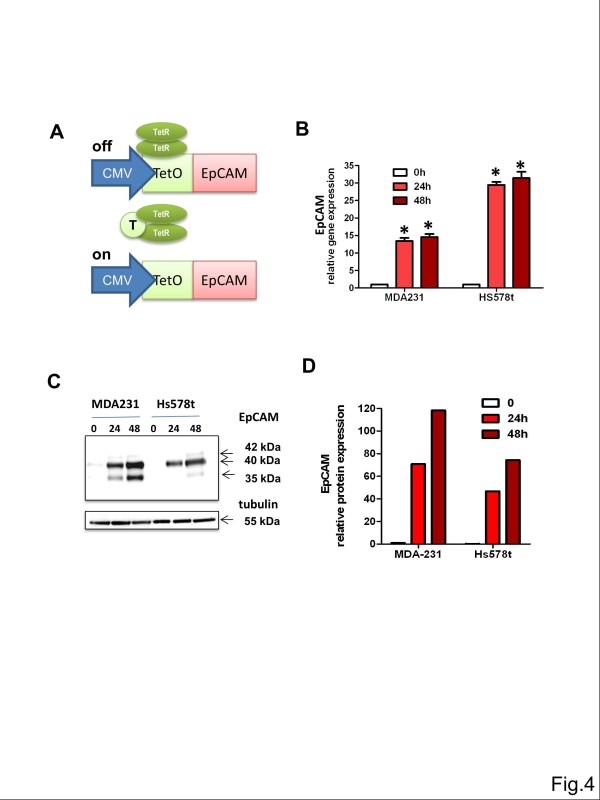
For this purpose, shRNA-mediated knockdown of EpCAM gene expression was performed in EpCAMhigh breast cancer cell lines with epithelial phenotype (MCF-7, T47D and SkBR3). Moreover, EpCAMlow breast carcinoma cell lines with mesenchymal phenotype (MDA-MB-231, Hs578t) and inducible overexpression of EpCAM were used to study effects on proliferation, migration and in vivo growth.
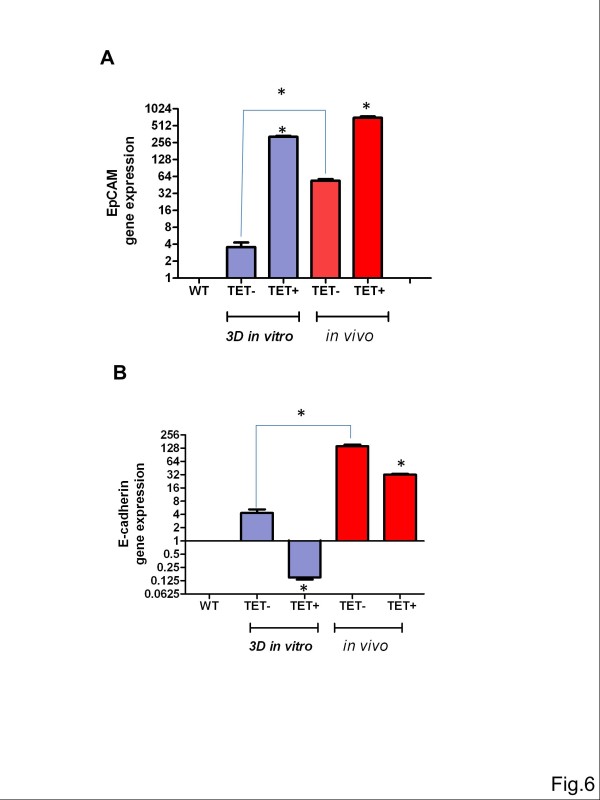
In comparison to non-specific silencing controls (n/s-crtl) knockdown of EpCAM (E#2) in EpCAMhigh cell lines resulted in reduced cell proliferation under serum-reduced culture conditions. Moreover, DNA synthesis under 3D culture conditions in collagen was significantly reduced. Xenografts of MCF-7 and T47D cells with knockdown of EpCAM formed smaller tumors that were less invasive. EpCAMlow cell lines with tetracycline-inducible overexpression of EpCAM showed no increased cell proliferation or migration under serum-reduced growth conditions. MDA-MB-231 xenografts with EpCAM overexpression showed reduced invasion into host tissue and more infiltrates of chicken granulocytes.
The role of EpCAM in breast cancer strongly depends on the epithelial or mesenchymal phenotype of tumor cells. Cancer cells with epithelial phenotype need EpCAM as a growth- and invasion-promoting factor, whereas tumor cells with a mesenchymal phenotype are independent of EpCAM in invasion processes and tumor progression. These findings might have clinical implications for EpCAM-based targeting strategies in patients with invasive breast cancer.
上皮细胞黏附分子(EpCAM)在乳腺癌和干细胞中过度表达,已成为乳腺癌患者免疫治疗的一个有吸引力的靶点。本研究分析了 EpCAM 对具有上皮或间充质表型的乳腺癌细胞系的影响。
为此,在具有上皮表型的 EpCAM 高乳腺癌细胞系(MCF-7、T47D 和 SkBR3)中,通过 shRNA 介导的 EpCAM 基因表达敲低。此外,还使用 EpCAM 低表达的具有间充质表型的乳腺癌细胞系(MDA-MB-231、Hs578t)和诱导型过表达 EpCAM 来研究对增殖、迁移和体内生长的影响。
与非特异性沉默对照(n/s-crtl)相比,EpCAM 高细胞系中 EpCAM 的敲低(E#2)导致在血清减少的培养条件下细胞增殖减少。此外,在胶原中 3D 培养条件下的 DNA 合成显著减少。具有 EpCAM 敲低的 MCF-7 和 T47D 细胞的异种移植物形成的肿瘤较小,侵袭性较低。具有四环素诱导型 EpCAM 过表达的 EpCAM 低细胞系在血清减少的生长条件下,细胞增殖或迁移没有增加。EpCAM 过表达的 MDA-MB-231 异种移植物显示宿主组织浸润减少,鸡粒细胞浸润增多。
EpCAM 在乳腺癌中的作用强烈依赖于肿瘤细胞的上皮或间充质表型。具有上皮表型的癌细胞需要 EpCAM 作为促进生长和侵袭的因子,而具有间充质表型的肿瘤细胞在侵袭过程和肿瘤进展中不依赖于 EpCAM。这些发现可能对基于 EpCAM 的侵袭性乳腺癌患者靶向治疗策略具有临床意义。