Department of Neurology, Samsung Medical Center, Sungkyunkwan University School of Medicine, Seoul, Korea.
Department of Neurology, Soonchunhyang University College of Medicine, Seoul, Korea.
J Clin Neurol. 2014 Jan;10(1):50-4. doi: 10.3988/jcn.2014.10.1.50. Epub 2014 Jan 6.
Given the diverse phenotypes including combined non-dyskinetic symptoms in patients harboring mutations of the gene encoding proline-rich transmembrane protein 2 (PRRT2), the clinical significance of these mutations in paroxysmal kinesigenic dyskinesia (PKD) is questionable. In this study, we investigated the clinical characteristics of PKD patients with PRRT2 mutations.
Familial and sporadic PKD patients were enrolled and PRRT2 gene sequencing was performed. Demographic and clinical data were compared between PKD patients with and without a PRRT2 mutation.
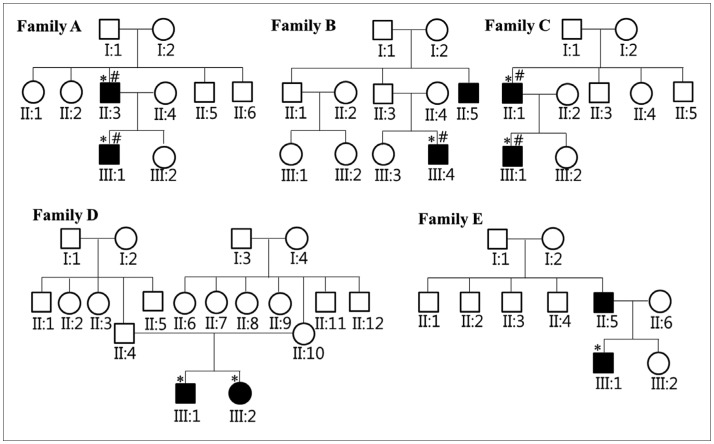
Among the enrolled PKD patients (8 patients from 5 PKD families and 19 sporadic patients), PRRT2 mutations were detected in 3 PKD families (60%) and 2 sporadic cases (10.5%). All familial patients with a PRRT2 gene mutation had the c.649dupC mutation, which is the most commonly reported mutation. Two uncommon mutations (c.649delC and c.629dupC) were detected only in the sporadic cases. PKD patients with PRRT2 mutation were younger at symptom onset and had more non-dyskinetic symptoms than those without PRRT2 mutation. However, the characteristics of dyskinetic movement did not differ between the two groups.
This is the first study of PRRT2 mutations in Korea. The presence of a PRRT2 mutation was more strongly related to familial PKD, and was clinically related with earlier age of onset and common non-dyskinetic symptoms in PKD patients.
由于携带富含脯氨酸的跨膜蛋白 2(PRRT2)基因突变的患者表现出多种表型,包括运动障碍外的非运动症状,这些突变在发作性运动诱发性运动障碍(PKD)中的临床意义尚存在争议。本研究旨在探讨携带 PRRT2 突变的 PKD 患者的临床特征。
纳入家族性和散发性 PKD 患者,并进行 PRRT2 基因测序。比较 PKD 患者中有无 PRRT2 突变与临床特征的关系。
在纳入的 PKD 患者(5 个 PKD 家系的 8 例患者和 19 例散发性患者)中,在 3 个 PKD 家系(60%)和 2 例散发性病例(10.5%)中检测到 PRRT2 基因突变。所有携带 PRRT2 基因突变的家族性患者均携带 c.649dupC 突变,这是最常见的突变类型。仅在散发性病例中检测到两种不常见的突变(c.649delC 和 c.629dupC)。携带 PRRT2 突变的 PKD 患者发病年龄更小,且非运动症状更常见,与无 PRRT2 突变的患者相比。然而,两组患者的运动障碍特征无差异。
这是在韩国开展的首个 PRRT2 突变研究。PRRT2 突变与家族性 PKD 相关性更强,与 PKD 患者发病年龄更早和更常见的非运动症状相关。